
RUSSIAN EMPIRE AUTHOR · TRANSLATIONS INTO ENGLISH · ENGLISH
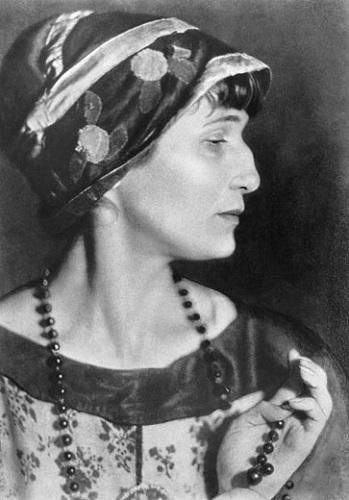
Anna Akhmatova
Also known as: Anna Andreevna Akhmatova, Akhmatova Anna.
Anna Andreyevna Gorenko was born at Bolshoy Fontan, near the Black Sea port of Odessa, and moved with her family to Tsarskoye Selo, near St. Petersburg when she was eleven months old. Her parents were both descended from Russian nobility. From age 7 to 13 she and her family spent their summers in a dacha near Sevastopol. She started writing poetry at the age of 11, and was first published at age 17. Her father did not want poetry published under his name, so she adopted her grandmother's surname "Akhmatova" and published under the name Anna Akhmatova. In 1905 her parents separated, and in 1906 she moved to Kiev. In 1910, she married another poet, Nikolay Gumilev and began attending Kiev University to study law. After one year, she then moved to St Petersburg to study literature. She became known in literary circles in St Petersburg's and gave regular public readings of her work. In 1910, she co-founded the influential Guild of Poets, which went on to develop the Acmeist anti-symbolist school of poetry. In 1912, she published her first book, Evening, with the Guild of Poets. She also gave birth to a son, Lev. In 1918, at the height of her fame, she ended her difficult marriage to Nikolay Gumilev and went on to marry another poet, Vladimir Shilejko. She shortly began having affairs again. In 1921 her first husband was executed for his alleged role in a monarchist anti-Bolshevik conspiracy. His execution, along with those of 61 others of Russia's intelligentsia, led to the break-up of the Acmeist poetry group. Akhmatova and her son Lev were criticized by the Marxist state as representing a "bourgeois aesthetic", and in 1925 her work was unofficially banned. She continued to write (but not to publish) poetry while working as a translator and critic. Because of his parentage, her son Lev was denied admission to academic institutions and was imprisoned several times on accusations of counter-revolutionary activity. She queued for hours to deliver him food packages and plead on his behalf. Akhmatova married Nikolai Punin, and stayed with him until 1935. He was also repeatedly imprisoned and in 1953 he died in the Gulag. Stalin approved the publication of one volume of her poetry, but it was withdrawn and pulped after only a few months. During this time, the government kept her under surveillance, going so far as to place recording devices in her flat, and produced 900 pages of reports on her. Despite this suppression, her work continued was secretly circulated in the gulags. During World War II, Akhmatova read to soldiers in military hospitals and on the front line. She witnessed the 900 day Siege of Leningrad, and in 1940, she began to write "Poem without a Hero", which she considered to be her major work. In 1946 she received a visit from the liberal, western, Jewish philosopher Isaiah Berlin in 1946, and was accusing by the government of poisoning the minds of Soviet youth. Surveillance of her was increased and she was expelled from the Union of Soviet Writers. In 1949 Akhmatova's son Lev was sentenced to 10 years in a Siberian prison camp. She spent several years trying to get him released, and she began to publish overtly propagandist poetry praising Stalin and his regime, although she did not consider this work, which may have saved both her life and her son's, as part of her official corpus. In 1951 she was readmitted to Union of Writers. In 1956 her son Lev was released from the prison camp, and her poetry began to be published again. Several books of her collected poetry were published in the following years. In 1962 she was visited by Robert Frost and in her dacha in Komarovo she met with young Russian poets. In the 1960s she had become more popular in the than she had been before the revolution. Even the government came to recognize her as one of the major poets of the Silver Age, and she was permitted to travel. She visited Sicily and England, meeting with some pre-revolutionary friends and receiving the Taromina Prize. She died shortly after returning to Russia. Thousands attended the two memorial ceremonies which were held in Moscow and in Leningrad. After being displayed in an open coffin, she was interred at Komarovo Cemetery in St Petersburg. Akhmatova's poem Requiem, which documented her experiences during the 1930s when she lived in poverty and her son and husband were repeatedly arrested, was finally published within USSR in 1987.
Courage my soul, now learn to wield The weight of thine immortal shield.
— from Selected poems, 1990
Most acclaimed

Twenty poems
"Twenty Poems from Rudyard Kipling" is a collection of Kipling's most evocative poems, including "The Holy War," "The Sons of Martha," and "For All We Have and Are," offering a glimpse into Kipling's writing style and themes. Here's a more detailed overview: Content: The collection features twenty of Kipling's most celebrated poems, including some that appeared for the first time in this volume. Author: Joseph Rudyard Kipling (1865-1936) was a renowned English journalist, short-story writer, poet, and novelist, known for his works inspired by his time in India. Notable Poems: The collection includes poems such as "The Holy War", "The Sons of Martha", and "For All We Have and Are". Themes: Kipling's poems often explore themes of imperialism, adventure, and the human spirit, reflecting his experiences and observations. Significance: This collection provides a valuable introduction to Kipling's poetic style and allows readers to appreciate his enduring legacy.
Poems
This is an edition of all the known poems of Mark Akenside, the eighteenth-century English poet and physician, whose poetry has not been newly edited for more than a century. This edition will thus provide scholars and students with a much-needed opportunity to reassess the extent of Akenside's contribution to literary culture, and it will also clarify his role in the development of the aesthetic theories of his own generation and the one that followed. The career of Mark Akenside (1721-70) spans a period of extraordinarily fast change in English literature: his first major poem, The Pleasures of Imagination, appeared in the year of Pope's death; and Akenside died in the year Wordsworth was born. His works not only reflected the very considerable changes that took place during these years; they also contributed in many ways to the shifts in focus, interest, and emphasis that characterize the literature of the later eighteenth century. Akenside's fascination with the imagination, its characteristics and functions, resulted in an intriguing and influential blend of the poetic and the philosophical in his longer poems, The Pleasures of Imagination (1744) and The Pleasures of the Imagination (1772). The earlier work explores the then new subject of aesthetics in greater detail than it had ever been explored before, presenting various original insights and arguments. Yet it would be wrong to see the poem as merely a versified philosophical treatise; its complex structure offers satisfactions beyond those of sequential logic, and the examples cited to illustrate the central ideas are imbued with considerable vigor and clarity. As products of, and contributors to, the eighteenth-century enthusiasm for aesthetics, Akenside's longer poems are captivating examples of the eighteenth- and nineteenth-century experiment in developing the philosophical poem into a major literary form. It is for this reason above all others that they are valued by Coleridge and the writers of the next generation. Because of the comparative obscurity into which Akenside's works fell after the demise of the long philosophical poem in the latter part of the nineteenth century, they have not by and large attracted the attention of modern bibliographers. In this edition numerous bibliographical and textual puzzles presented by his poems are solved for the first time. The apparatus, meanwhile, demonstrates the full extent of the poet's urge to revise - an urge that extended from the wholesale rewriting of some poems to subtle alterations of textual minutiae, showing a mind and an ear alive to nuances of meaning and intonation.
Selected poems
1990
Charles Olson, the poet who coined the word post-modern and helped shape the generation that would emerge under its mantle, is known for the immense range of his intellectual and poetic reach. Here, in this selection by Robert Creeley, Olson's personal friend and literary ally, is the more "intimate order" of the poet who sought to embrace all of history and human thought. Olson came from working-class immigrant roots in a Massachusetts mill town. A scholar of profound originality and vision, he worked for Roosevelt's administration during the war years, then at Black Mountain, the prototypical experimental college and enclave of avantgarde writers and artists. In 1957 he settled in Gloucester, a town on the shore north of Boston where he had spent summers as a child. It was Gloucester, with its richness of history and human use, that provided the ground of The Maximus Poems, begun as letters some years before and which over the next two decades grew into a masterwork of epic dimensions. From the more than three hundred poems making up The Maximus Poems and the comparable number in Olson's Collected Poems, Creeley's selection makes available for the first time an essential sampling of Olson's poetry. Included are paradigmatic early works like "The Kingfishers," which Guy Davenport called "the most modern of American poems, the most energetically influential text in the last thirty-five years," as well as familiar pieces from Maximus like "Maximus, to Gloucester" and "Celestial Evening." Also represented are less known poems, such as "The chain of memory is resurrection" and "The Lamp," works that reveal a more personal side of this major American poet. Together these poems demonstrate Olson's genius and grace, a poet as at home in Gloucester as in the cosmos, a reckoner with dreams and myths, and "Western man at the limit of himself."