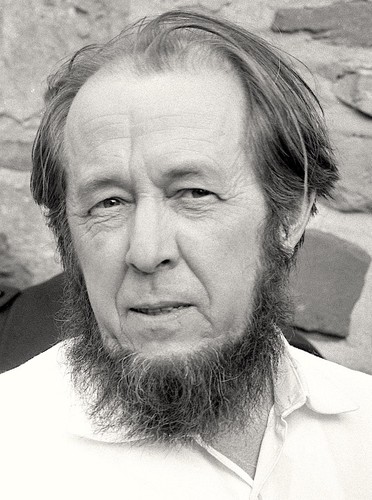
Александр Исаевич Солженицын
Personal Information
Description
Aleksandr Solzhenitsyn was a Russian novelist, dramatist, and historian. Through his writings he helped to make the world aware of the Gulag, the Soviet Union's forced labor camp system – particularly The Gulag Archipelago and One Day in the Life of Ivan Denisovich, two of his two best-known works. Solzhenitsyn was awarded the Nobel Prize in Literature in 1970. He was exiled from the Soviet Union in 1974 and returned to Russia in 1994. Solzhenitsyn was the father of Ignat Solzhenitsyn, a conductor and pianist.
Books
Sobranie sochineniĭ v 30 tt., T. 8: Krasnoe koleso: povestvovanie v otmerennykh srokakh. Uzel 1: Avgust Chetyrnadt︠s︡atogo. Kn. 2
Архипелаг ГУЛАГ
The Gulag Archipelago is Solzhenitsyn's masterwork, a vast canvas of camps, prisons, transit centres and secret police, of informers and spies and interrogators and also of heroism, a Stalinist anti-world at the heart of the Soviet Union where the key to survival lay not in hope but in despair. The work is based on the testimony of some two hundred survivors, and on the recollection of Solzhenitsyn's own eleven years in labour camps and exile. It is both a thoroughly researched document and a feat of literary and imaginative power. This edition has been abridged into one volume at the author's wish and with his full co-operation.
Invisible allies
After his expulsion from Russia, Aleksandr Solzhenitsyn secretly worked on a memoir that would acknowledge the courageous efforts of the people who hid his writings and smuggled them to the West. Before the fall of Communism, the very publication of Invisible Allies would have put these friends in jeopardy. Now we are finally granted an intimate account of the extensive, ever-shifting network of individuals who risked life and liberty to ensure that Solzhenitsyn's works were kept safe, circulated in samizdat, and "exported" via illicit channels. These imperiled conspirators, often unknown to one another, shared a devotion to the dissident writer's work and a hatred of the regime that brought terror to every part of their lives. The circle included scholars and fellow writers and artists, but also such unlikely operatives as an elderly babushka who picked up and delivered manuscripts in her shopping bag. With tenderness, respect, and humor, Solzhenitsyn tells us of the fates of these partners in intrigue: the women who typed distribution copies of his works late into the night under the noses of prying neighbors; the correspondents and diplomats who covertly carried the microfilmed texts across borders; the farflung friends who hid various drafts of Solzhenitsyn's works anywhere they could - under an apple tree, beneath the bathtub, in a mathematics professor's loft with her canoe. In this group of deftly drawn portraits, Solzhenitsyn pays tribute to the anonymous heroes who evaded the KGB to bring The Gulag Archipelago and his many other works to the world.
Russkiĭ vopros
On the occasion of his return to the country from which he was expelled twenty years ago, Russia's greatest living writer gives us a succinct and impassioned impression of his beliefs and hopes for his homeland. Beginning with an overview of the last five hundred years of Russian history, Aleksandr Solzhenitsyn highlights his country's accomplishments and mistakes, analyzing the disaster of the Soviet years and painting a brutally vivid picture of the current state of affairs. Although he sees Russia in moral, economic, and social disarray, he also sees the possibility of a way out for a new generation who, with a renewed understanding of their history, can surmount the obstacles of the day and create a just and independent society - a Russian future. Provocative, spirited, and timely, The Russian Question speaks not only to Russians, whose destiny Solzhenitsyn has returned to share, but also to the Western world that received him in exile, awarded him a Nobel Prize in Literature, and made him one of the most widely read writers of our time.
Candle in the wind
Every word of his might well be a lie Adrift in the Caribbean, wrecked against a reef, stranded alone on an island with someone who called himself Mike Scott--Samantha tried desperately to recall the events that had brought her to such an impasse. Samantha couldn't remember anything--not her name, nor even this tall, suntanned stranger who had saved her from death and who claimed to be her husband. But Samanha had no proof, no papers, no ring, no recollection of those deep blue eyes that kept staring intently into her own. She wanted to believe him--but how could she?
Один день Ивана Денисовича
First published in the Soviet journal Novy Mir in 1962, One Day in the Life of Ivan Denisovich stands as a classic of contemporary literature. The story of labor-camp inmate Ivan Denisovich Shukhov, it graphically describes his struggle to maintain his dignity in the face of communist oppression. An unforgettable portrait of the entire world of Stalin's forced work camps, One Day in the Life of Ivan Denisovich is one of the most extraordinary literary documents to have emerged from the Soviet Union and confirms Solzhenitsyn's stature as "a literary genius whose talent matches that of Dosotevsky, Turgenev, Tolstoy"--Harrison Salisbury This unexpurgated 1991 translation by H. T. Willetts is the only authorized edition available and fully captures the power and beauty of the original Russian.
Rebuilding Russia
The Nobel Prize winning author offers proposals for the economic and political revitalization of the Soviet Union.
The First Circle
Written from his own experiences this short novel focuses on the lives of a group of political prisoners held in a sharashka, a research & development laboratory near Moscow manned by engineers & technicians plucked from the gulags to perform work for the state.
Detente
"The subject of Detente, Democracy and Dictatorship has been with us since the breakdown of the Cold War and the termination of the Soviet system, indeed, if not since the origins of Bolshevism. No more vigorous critic of the uneasy co-existence of democracy and dictatorship exists than the greatest writer that the Soviet era of Russian history produced, Aleksandr Solzhenitsyn. This third edition is based on major addresses, especially aimed at Americans, delivered in 1975 in Washington, D.C. and New York, and again, in 1978, at Harvard University in Cambridge, all on the subject of detente, democracy and dictatorship. It also includes Solzhenitsyn's final 2007 interview with the German publication "Der Spiegel". These major statements are brilliant and forthright comment on the risks of confusing ideology with diplomacy. But more than that, they summarize the Soviet debacle, the theoretical underpinnings, and distill Solzhenitsyn's multi-volumed masterpiece, the Gulag Archipelago". -- Book cover.