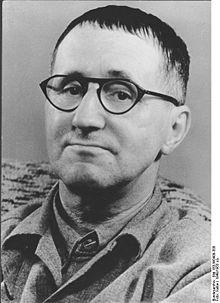
Bertolt Brecht
Personal Information
Description
A German poet, playwright, and theatre director.
Books
Poetry and prose
Seeks to supply a sounder and more uncluttered text for reading than has been heretofore available, together with variant and delected passages for study/
The tutor
Master of psychological suspense Peter Abrahams returns with an ingenious tale of an ordinary family that unknowingly invites the agent of their destruction into their own home.When Scott and Linda Gardner hire Julian Sawyer to tutor their troubled teenage son Brandon, he seems like the answer to a prayer. Capable and brilliant, Julian connects with Brandon in a way neither of his parents can. He also effortlessly helps Linda to salvage a troubled business deal and gives Scott expert advice on his tennis game. Only eleven-year old Ruby--funny, curious, devoted to Sherlock Holmes--has doubts about the stranger in their midst who has so quickly become like a member of the family. But even the observant Ruby is far from understanding Julian's true designs on the Gardners.For Julian, the Gardners are like specimens in jars, creatures to be studied-- and manipulated. Scott is a gambler with no notion of odds, festering in the shadow of his more successful brother. Linda is ambitious, hungry for the cultured stimulation Julian easily provides. Brandon is risking his future late at night in the town woods. And Ruby--well, she's just a silly little girl. And in that miscalculation lies the Gardner family's only possible salvation.In The Tutor, Peter Abrahams creates a living, breathing portrait of an American family, their town, their secrets, their dreams--and a portrait just as compelling of the menace they welcome into their home. It is his most chilling, suspenseful novel to date.From the Hardcover edition.
Die Dreigroschenoper:= The Threepenny Opera
First staged in Berlin in 1928, 'The Threepenny Opera' remains one of Brecht's most performed plays. Based on John Gay's 18th century satire, 'The Beggar's Opera', the play is a satire on the bourgeois capitalist society of the Weimar Republic.
Bertolt Brecht
Werke
Bertolt Brecht's Me-Ti
"First published in German in 1965 and now translated and edited by Antony Tatlow, Brecht's Me-ti: Book of Interventions in the Flow of Things provides readers with a much-anticipated accessible edition of this important work. It features a substantial introduction to the concerns of the work, its genesis and context - both within Brecht's own writing and within the wider social and political history, and provides an original selection and organisation of texts. Extensive notes illuminate the work and provide commentary on related works from Brecht's oeuvre."
Gute Mensch von Sezuan
"The Good Woman of Setzuan, written during Brecht's exile and set in pre-Communist China, is a parable of a young woman torn between obligation and reality, between love and practicality, and between her own needs and those of her friends and neighbors." "Eric Bentley provides here a reliable English version of one of Brecht's most popular plays. This performance-friendly translation is often used in the theater.". "Bertolt Brecht (1898-1956) is one of Germany's best-known playwrights. His social critiques, including The Caucasian Chalk Circle, Mother Courage and Her Children, and The Threepenny Opera, resonate with modern audiences and continue to be frequently performed."--BOOK JACKET.
Aufstieg und Fall der Stadt Mahagonny
Welcome to Mahagonny, where sin is 'in' and love is always on sale. This Old West boomtown rises from the desert to become a razzle-dazzle mecca for lust and the pursuit of pleasure, where cash is king and poverty is punishable by death.
The good person of Szechwan
Brecht's famous parable pivots around a moral paradox - that in an unjust society good can only survive by means of evil. Through the sharply split personality of the central character Shen Teh / Shui Ta Brecht points to the impossibility of living anything like a 'good' life in a corrupted and persistently exploitative world. 'The Good Person of Szechwan' was first performed in Zurich in 1943.
Brecht on art and politics
"This collection of newly translated writing, a companion volume to Brecht on Theatre and Brecht on Film and Radio, transforms our image of one of the literary giants of the twentieth century." "The essays, criticism, speeches, diaries and journalism included here represent the work of a uniquely entertaining, illuminating and thought-provoking commentator on culture, aesthetics and politics. Across four decades of economic turmoil, war and social upheaval, these pieces offer an extraordinary insight into the concerns of a writer for whom art and politics were inseparable." "From 1914 when Brecht was a teenager, through his long years of exile from Nazi Germany to his controversial postwar residence in East Berlin, the book covers the whole span of Brecht's life and thought."--Jacket.