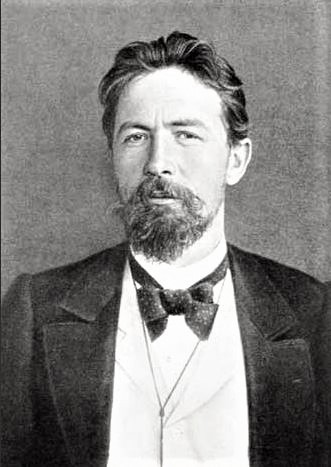
Антон Павлович Чехов
Personal Information
Description
Anton Pavlovich Chekhov (Russian: Антон Павлович Чехов) was a Russian playwright and short-story writer who is considered to be one of the greatest writers of all time. His career as a playwright produced four classics, and his best short stories are held in high esteem by writers and critics. Along with Henrik Ibsen and August Strindberg, Chekhov is often referred to as one of the three seminal figures in the birth of early modernism in the theatre. Chekhov was a physician by profession. "Medicine is my lawful wife", he once said, "and literature is my mistress."
Books
Backpack Literature--Second Edition
Carry literature in your backpack as well as in your heart. With new contemporary and classic selections and an emphasis on writing, Backpack Literature will motivate you to read, think, and write about literature! You'll like the size because it easily fits into your backpack and makes taking the book to class a breeze. Backpack Literature includes a powerful range of stories, poems, and plays that will give you a chance to meet some of the world's most memorable characters. Written by two published poets, Kennedy and Gioia, this textbook is lively, accessible, and engaging. When you read literature, you learn how to see the world from another person's point of view- an ability that will benefit you in your professional and personal life.
The Duel and Other Stories [8 stories]
Contains: Аптекарша В родном углу Дорогие уроки [Дуэль]( Княгиня Соседи [Тина]( [Хорошие люди](
The House With The Mezzanine and Other Stories [7 stories]
Contains: [Моя жизнь](
Love and other stories [23 stories]
From the book:THREE o'clock in the morning. The soft April night is looking in at my windows and caressingly winking at me with its stars. I can't sleep, I am so happy! My whole being from head to heels is bursting with a strange, incomprehensible feeling. I can't analyse it just now - I haven't the time, I'm too lazy, and there - hang analysis! Why, is a man likely to interpret his sensations when he is flying head foremost from a belfry, or has just learned that he has won two hundred thousand? Is he in a state to do it?"
Essentials of British and World Literature
The Story and Its Writer -- Compact Seventh Edition
The horse-stealers and other stories
From the book:A HOSPITAL assistant, called Yergunov, an empty-headed fellow, known throughout the district as a great braggart and drunkard, was returning one evening in Christmas week from the hamlet of Ryepino, where he had been to make some purchases for the hospital. That he might get home in good time and not be late, the doctor had lent him his very best horse. At first it had been a still day, but at eight o'clock a violent snow-storm came on, and when he was only about four miles from home Yergunov completely lost his way.
The Bishop and Other Stories [7 stories]
Short story collection containing: [Степь](
The Cook's Wedding and Other Stories
From the book:GRISHA, a fat, solemn little person of seven, was standing by the kitchen door listening and peeping through the keyhole. In the kitchen something extraordinary, and in his opinion never seen before, was taking place. A big, thick-set, red-haired peasant, with a beard, and a drop of perspiration on his nose, wearing a cabman's full coat, was sitting at the kitchen table on which they chopped the meat and sliced the onions. He was balancing a saucer on the five fingers of his right hand and drinking tea out of it, and crunching sugar so loudly that it sent a shiver down Grisha's back. Aksinya Stepanovna, the old nurse, was sitting on the dirty stool facing him, and she, too, was drinking tea. Her face was grave, though at the same time it beamed with a kind of triumph. Pelageya, the cook, was busy at the stove, and was apparently trying to hide her face.
The schoolmaster and other stories
From the book:FYODOR LUKITCH SYSOEV, the master of the factory school maintained at the expense of the firm of Kulikin, was getting ready for the annual dinner. Every year after the school examination the board of managers gave a dinner at which the inspector of elementary schools, all who had conducted the examinations, and all the managers and foremen of the factory were present. In spite of their official character, these dinners were always good and lively, and the guests sat a long time over them; forgetting distinc-tions of rank and recalling only their meritorious labours, they ate till they were full, drank amicably, chattered till they were all hoarse and parted late in the evening, deafening the whole factory settlement with their singing and the sound of their kisses. Of such dinners Sysoev had taken part in thirteen, as he had been that number of years master of the factory school.
4 Plays (Вишнёвый сад / Дядя Ваня / Три сестры / Чайка)
Because Chekhov's plays convey the universally recognizable, sometimes comic, sometimes dramatic, frustrations of decent people trying to make sense of their lives, they remain as fresh and vigorous as when they were written a century ago. Gathered here in superb new renderings by one of the most highly regarded translators of our time--versions that have been staged throughout the United States, Canada, and Great Britain--are Chekhov's four essential masterpieces for the theater.From the Trade Paperback edition.
Letters of Anton Chekhov to his family and friends
From the book:In 1841 a serf belonging to a Russian nobleman purchased his freedom and the freedom of his family for 3,500 roubles, being at the rate of 700 roubles a soul, with one daughter, Alexandra, thrown in for nothing. The grandson of this serf was Anton Chekhov, the author; the son of the nobleman was Tchertkov, the Tolstoyan and friend of Tolstoy. There is in this nothing striking to a Russian, but to the English student it is sufficiently significant for several reasons. It illustrates how recent a growth was the educated middle-class in pre-revolutionary Russia, and it shows, what is perhaps more significant, the homogeneity of the Russian people, and their capacity for completely changing their whole way of life.
Ведьма
From the book:IT was approaching nightfall. The sexton, Savely Gykin, was lying in his huge bed in the hut adjoining the church. He was not asleep, though it was his habit to go to sleep at the same time as the hens. His coarse red hair peeped from under one end of the greasy patchwork quilt, made up of coloured rags, while his big unwashed feet stuck out from the other. He was listening. His hut adjoined the wall that encircled the church and the solitary window in it looked out upon the open country. And out there a regular battle was going on. It was hard to say who was being wiped off the face of the earth, and for the sake of whose destruction nature was being churned up into such a ferment; but, judging from the unceasing malignant roar, someone was getting it very hot. A victorious force was in full chase over the fields, storming in the forest and on the church roof, battering spitefully with its fists upon the windows, raging and tearing, while something vanquished was howling and wailing. . . . A plaintive lament sobbed at the window, on the roof, or in the stove. It sounded not like a call for help, but like a cry of misery, a consciousness that it was too late, that there was no salvation. The snowdrifts were covered with a thin coating of ice; tears quivered on them and on the trees; a dark slush of mud and melting snow flowed along the roads and paths. In short, it was thawing, but through the dark night the heavens failed to see it, and flung flakes of fresh snow upon the melting earth at a terrific rate. And the wind staggered like a drunkard. It would not let the snow settle on the ground, and whirled it round in the darkness at random.
Жена
«Жена́» — рассказ Антона Павловича Чехова. Написан в 1892 году, впервые опубликован в 1892 году в журнале «Северный вестник» № 1 с подписью «Антон Чехов».
The Complete Short Novels (Дуэль / Моя жизнь / Рассказ неизвестного человека / Степь / Три года)
[Дуэль]( [Моя жизнь]( Рассказ неизвестного человека [Степь]( [Три года](
Иванов
"In Ivanov, Anton Chekhov's first full-length play, Chekhov created a portrait of a man plagued with self-doubt and despair. Considered one of Chekhov's most elusive characters, he seeks more in life than the self-absorption and ennui he sees in his contemporaries. Tormented by falling out of love with his dying Jewish wife, Ivanov, on her death, proposes to the young daughter of a neighbor, but, as the wedding party assembles, a final burst of his habitual indecisiveness has fatal results."--Jacket.