Discover

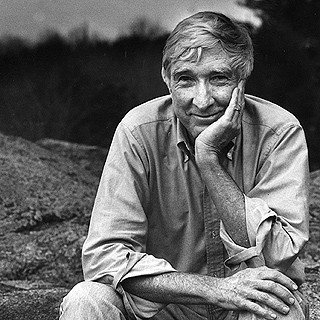
John Updike

Personal Information

Born March 18, 1932
Died January 27, 2009 (76 years old)
Reading, United States
Also known as: UPDIKE,J, J Updike
155 books
3.8 (41)
724 readers

Description

John Hoyer Updike (March 18, 1932 – January 27, 2009) was an American novelist, poet, short-story writer, art critic, and literary critic. One of only four writers to win the Pulitzer Prize for Fiction more than once (the others being Booth Tarkington, William Faulkner, and Colson Whitehead), Updike published more than twenty novels, more than a dozen short-story collections, as well as poetry, art and literary criticism and children's books during his career. Hundreds of his stories, reviews, and poems appeared in The New Yorker starting in 1954. He also wrote regularly for The New York Review of Books. His most famous work is his "Rabbit" series (the novels Rabbit, Run; Rabbit Redux; Rabbit Is Rich; Rabbit at Rest; and the novella Rabbit Remembered), which chronicles the life of the middle-class everyman Harry "Rabbit" Angstrom over the course of several decades, from young adulthood to death.

Books

Newest First

Selected poems

D. J. Enright, Jones Very, Herman Melville, Michael S. Harper, Wyatt, Thomas Sir, David Lawrence, Lewis Carroll, Paul Celan, Octavio Paz, Boynton, Henry Walcott, Pāratitācan̲, George Mackay Brown, Hans Magnus Enzensberger, Dylan Thomas, Saint-John Perse, Giuseppe Ungaretti, Stéphane Mallarmé, Sir Philip Sidney, Ennis Rees, Elizabeth Barrett Browning, John Glassco, Karl Jay Shapiro, William Barnes, Jorge Luis Borges, Niyi Osundare, Robert Louis Stevenson, Leah Goldberg, Cyprian Norwid, Yvor Winters, Anne Brontë, Carol Ann Duffy, Seán Ó Ríordáin, Czesław Miłosz, Sister Mary Madeleva, Oxenham, John, Mongane Wally Serote, Michael Rosen, Paul Éluard, Harvey Shapiro, Johannes Bobrowski, Barnabe Googe, Sophocles, Rudyard Kipling, Walter De la Mare, Aldous Huxley, Charles Olson, William Butler Yeats, Walt Whitman, Frank O'Hara, Kōnstantinos Petrou Kabaphēs, Diana Der Hovanessian, D. H. Lawrence, John Keats, Lorna Goodison, Edwin Arlington Robinson, Wallace Stevens, Percy Bysshe Shelley, César Vallejo, Paul Verlaine, Graham, W. S., Ovid, James Arlington Wright, John Ashbery, Анато́лий Александрович Биск, Tomas Tranströmer, John Updike, Gaspara Stampa, Emma Lazarus, W. H. Auden, Lord Byron, Robinson Jeffers, Fergusson, Robert, Léopold Sédar Senghor, Rita Dove, William Shakespeare, Laurie Lee, Carl Sandburg, John Frederick Nims, Langston Hughes, Yves Bonnefoy, Edgar Allan Poe, Conrad Aiken, John Greenleaf Whittier, Eugène Guillevic, Michael Longley, Günter Grass, F. R. Scott, Oliver St. John Gogarty, Muriel Rukeyser, Les A. Murray, Allen Ginsberg, Robert Pinsky, Odysseas Elytis, Pierre Reverdy, Hugo, Richard, Emily Brontë, Seamus Deane, Dannie Abse, Adrienne Rich, Laura Riding, Friedrich Hölderlin, Georg Trakl, John Davidson, Rabindranath Tagore, Pádraic H. Pearse, Clarke, Austin, Steve Griffiths, George Crabbe, Fred Wah, Robert Bly, Roy Fuller, Pierre de Ronsard, Gaius Valerius Catullus, John Wilmot, Earl of Rochester, Derek Walcott, Algernon Charles Swinburne, Cecil Day-Lewis, Anne Stevenson, David Malouf, Thomas Gray, Emily Dickinson, Siegfried Sassoon, Robert Herrick, Oscar Williams, Isaac Watts, Charlotte Brontë, Vernon Phillips Watkins, Rafael Alberti, Jean Garrigue, Zbigniew Herbert, Young, Andrew, A. M. Klein, James Tate, William Wordsworth, Charlotte Mary Mew, Theocritus, Charles Churchill, Oscar Wilde, Rainer Maria Rilke, Anna Akhmatova, George Fetherling, Robert Bringhurst, Gascoyne, David, Robert Henryson, Lewis, Saunders, Pratt, E. J., Rosalía de Castro, Thomas Merton, Edward Robeson Taylor, John Shaw Neilson, Christopher Smart, Ai Weiwei, John Skelton, Kevin Crossley-Holland, U. A. Fanthorpe, Margaret Avison, John Peale Bishop, Al Purdy, Boileau, Vladimir Nabokov, Thompson, Denys, Giacomo Leopardi, Kenneth Rexroth, Adam Czerniawski, Kenneth Koch, Gerard Manley Hopkins, Robin Hyde, John Ciardi, Alfred Lord Tennyson, Andrew Marvell, David John Murray Wright, Thomas Chatterton, William Blake, T. S. Eliot, Henry Wadsworth Longfellow, Giovanni Pascoli, Guillaume Apollinaire, Stevie Smith, Andrew Barton 'Banjo' Paterson, John Gay, Emile Nelligan, Henrik Nordbrandt, Ausiàs March, Aaron J. Clarke, Jules Laforgue, Ezra Pound, John Hollander, Christina Georgina Rosetti, George William Russell, Theodore Roethke, Jaime Torres Bodet, Jibanananda Das, Gyula Illyés, Robert Frost, John Milton, Attilio Bertolucci, Federico García Lorca, Sir Walter Scott, Lars Gustafsson, Anne Sexton, John Berryman, W. D. Snodgrass, Heinz Piontek, Kenneth Patchen, Bill Bissett, William Peskett, Sylvia Townsend Warner, Sophie Hannah, António Machado
0.0 (0)
0

Fifty Best American Short Stories

0.0 (0)
56

Contents: Survivors / Elsie Singmaster -- Lost Phoebe / Theodore Dreiser -- Golden honeymoon / Ring W. Lardner -- I'm a fool / Sherwood Anderson -- My old man / Ernest Hemingway -- Telephone call / Dorothy Parker -- Double birthday / Willa Cather -- Faithful wife / Morley Callaghan -- Little wife / William March -- Babylon revisited / F. Scott Fitzgerald-- How beautiful with shoes / Wilbur Daniel Steele -- Resurrection of a life / William Saroyan -- Only the dead know Brooklyn / Thomas Wolfe -- Life in the day of a writer / Tess Slesinger -- Iron City / Lovell Thompson -- Christ in concrete / Pietro Di Donato -- Chrysanthemums / John Steinbeck -- Bright and morning star / Richard Wright -- Hand upon the waters / William Faulkner -- Net / Robert M. Coates -- Nothing ever breaks except the heart / Kay Boyle -- Search through the streets of the city / Irwin Shaw -- Who lived and died believing / Nancy Hale -- Peach stone / Paul Horgan -- Dawn of remembered spring / Jesse Stuart -- Catbird seat / James Thurber -- Of this time, of that place / Lionel Trilling -- Wind and the snow of winter / Walter Van Tilburg Clark -- Enormous radio / John Cheever -- Children are bored on Sunday / Jean Stafford -- NRACP / George P. Elliott -- In Greenwich there are many gravelled walks / Hortense Calisher -- Other foot / Ray Bradbury -- Three players of a summer game / Tennessee Williams -- Mother's tale / James Agee -- Magic barrel / Bernard Malamud -- Circle in the fire / Flannery O'Connor -- First flower / Augusta Wallace Lyons -- Contest for Aaron Gold / Philip Roth -- One ordinary day, with peanuts / Shirley Jackson -- To the wilderness I wander / Frank Butler -- Ledge / Lawrence Sargent Hall -- This morning, this evening, so soon / James Baldwin -- Tell me a riddle / Tillie Olsen -- Old army game / George Garrett -- Pigeon feathers / John Updike -- Sound of a drunken drummer / H.W. Blattner -- Keyhole eye / John Stewart Carter -- Long day's dying / William Eastlake -- Upon the sweeping flood / Joyce Carol Oates.

The Centaur

4.0 (1)
14

In a small Pennsylvania town in the late 1940s, schoolteacher George Caldwell yearns to find some meaning in his life. Alone with his teenage son for three days in a blizzard, Caldwell sees his son grow and change as he himself begins to lost touch with his life. Interwoven with the myth of Chiron, the noblest centaur, and his own relationship to Prometheus, The Centaur is one of John Updike's most brilliant and unusual novels.

Rabbit, Run

0.0 (0)
0

Tired of the responsibility of married life, Harry Angstrom leaves his wife and home.

Picked-Up Pieces

0.0 (0)
0

A collection of the author's non-fiction prose pieces and reviews.

Terrorist

3.0 (1)
11

John Updike has written a brilliant novel that ranks among the most provocative of his distinguished career. Terrorist is the story of Ahmad Ashmawy Mulloy, an alienated American-born teenager who spurns the materialistic, hedonistic life he witnesses in the slumping New Jersey factory town he calls home. Turning to the words of the Holy Qur'an as expounded to him by the pedantic imam of a local mosque, Ahmad devotes himself fervently to God. Neither the world-weary guidance counselor at his high school nor Ahmad's mischievously seductive classmate Joryleen succeeds in deflecting him from his course, as the threads of an insidious plot gather around him."One compelling and surprising ride."--USA Today"The startlingly contemporary story of a high school student . . . whose zealous Islamic faith and disaffection with modern life make him a pawn in the larger conflict between Muslim and Christian, East and West. They also make him a powerful voice for Updike's ongoing critique of American civilization."--Time"A chilling tale that is perhaps the most essential novel to emerge from Sept. 11."--People (Critic's Choice)From the Trade Paperback edition.

The Maples stories

0.0 (0)
2

(Book Jacket Status: Jacketed)Collected together for the first time in hardcover, these eighteen classic stories from across John Updike's career form a luminous chronicle of the life and times of one marriage in all its rich emotional complexity.In 1956, Updike published a story, "Snowing in Greenwich Village," about a young couple, Joan and Richard Maple, at the beginning of their marriage. Over the next two decades, he returned to these characters again and again, tracing their years together raising children, finding moments of intermittent happiness, and facing the heartbreak of infidelity and estrangement. Seventeen Maples stories were collected in 1979 in a paperback edition titled Too Far to Go, prompted by a television adaptation. Now those stories appear in hardcover for the first time, with the addition of a later story, "Grandparenting," which returns us to the Maples's lives long after their wrenching divorce.From the Hardcover edition.

Les vídues d'Eastwick

0.0 (0)
0

Han passat més de tres dècades des que l’Alexandra, la Jane i la Sukie van deixar Rhode Island. Totes tres s’han tornat a casar i s’han quedat vídues quan decideixen recuperar la seva amistat. Suporten el dolor i la soledat viatjant per tot el món, a països com el Canadà, Egipte o la Xina. «Per què no tornem a Eastwick a l’estiu?», es pregunten. L’antiga ciutat costanera, on gaudiren de malèvoles malifetes sota la influència del diabòlic Darryl van Horne, encara és màgica per a elles. Ara en Darryl ja no hi és, i els amants que col·leccionaven en aquella època han envellit o han mort, però la màgia roman en els carrers tan familiars de la vila, on elles van gaudir la joventut com a dones lliures i poderoses.  Però el passat ni és mort ni està oblidat, i caldrà fer front al balanç final d’encanteris i crims. Les joves sensuals que el genial John Updike va retratar en la seva obra més popular, Les bruixes d’Eastwick, es converteixen en aquesta novel·la –l’última que va publicar l’autor en vida– en dones que voregen els setanta, i el seu poder de fascinació ha deixat pas a les marques pròpies de l’envelliment. Una seqüela tan deliciosa com sinistra.--Edicions Bromera website.

The seducer's diary

5.0 (1)
31

This work, a chapter from Kierkegaard's first major volume, Either/Or, springs from his relationship with his fiancee, Regine Olsen. Kierkegaard fell in love with the young woman, ten years his junior, proposed to her, but then broke off their engagement a year later. This event affected Kierkegaard profoundly. Olsen became a muse for him, and a flood of volumes resulted. His attempt to set right, in writing, what he feels was a mistake in his relationship with Olsen taught him the secret of "indirect communication." The Seducer's Diary, then, becomes Kierkegaard's attempt to portray himself as a scoundrel and thus make their break easier for her. Matters of marriage, the ethical versus the aesthetic, dread, and, increasingly, the severities of Christianity are pondered by Kierkegaard in this intense work.

Always Looking

0.0 (0)
0

In this posthumous collection of John Updike's art writings, a companion volume to the acclaimed "Just Looking "(1989) and "Still Looking" (2005), readers are again treated to "remarkably elegant essays" ("Newsday") in which "the psychological concerns of the novelist drive the eye from work to work until a deep understanding of the art emerges" ("The New York Times Book Review"). " Always Looking "opens with "The Clarity of Things," the Jefferson Lecture in the Humanities for 2008. Here, in looking closely at individual works by Copley, Homer, Eakins, Norman Rockwell, and others, the author teases out what is characteristically "American" in American art. This talk is followed by fourteen essays, most of them written for "The New York Review of Books," on certain highlights in Western art of the last two hundred years: the iconic portraits of Gilbert Stuart and the sublime landscapes of Frederic Edwin Church, the series paintings of Monet and the monotypes of Degas, the richly patterned canvases of Vuillard and the golden extravagances of Klimt, the cryptic triptychs of Beckmann, the personal graffiti of Miro, the verbal-visual puzzles of Magritte, and the monumental Pop of Oldenburg and Lichtenstein. The book ends with a consideration of recent works by a living American master, the steely sculptural environments of Richard Serra. John Updike was a gallery-goer of genius. "Always Looking" is, like everything else he wrote, an invitation to look, to "see, " to apprehend the visual world through the eyes of a connoisseur.--publisher.

Bech at bay

0.0 (0)
0

Henry Bech, the moderately well known Jewish-American writer who served as the hero of John Updike's previous Bech: A Book (1970) and Bech Is Back (1982), has become older but scarcely wiser. In these five new chapters from his life, he is still at bay, pursued by the hounds of desire and anxiety, of unbridled criticism and publicity in a literary world ever more cheerfully crass. He fights intimations of annihilation in still-Communist Czechoslovakia, while promiscuously consorting with dissidents, apparatchiks, and Midwestern Republicans. Next, he succumbs to the temptations of power by accepting the presidency of a quaint and cosseted honorary body patterned on the Academie Francaise. Then, the reader finds him on trial in California and on a criminal rampage in a gothic Gotham, abetted by a nubile sidekick called Robin. Lastly, our septuagenarian veteran of the literary wars is rewarded with a coveted medal, stunning him into a well-deserved silence.
