Discover

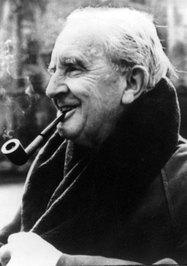
J.R.R. Tolkien

Personal Information

Born January 3, 1892
Died September 2, 1973 (81 years old)
Bloemfontein, United Kingdom
Also known as: Dzhon R. R. Tolkin, J. R. R. Tolkien
100 books
4.3 (1,025)
7,946 readers

Description

John Ronald Reuel Tolkien (1892-1973) was a major scholar of the English language, specialising in Old and Middle English. Twice Professor of Anglo-Saxon (Old English) at the University of Oxford, he also wrote a number of stories, including most famously The Hobbit (1937) and The Lord of the Rings (1954-1955), which are set in a pre-historic era in an invented version of the world which he called by the Middle English name of Middle-earth. This was peopled by Men (and women), Elves, Dwarves, Trolls, Orcs (or Goblins) and of course Hobbits. He has regularly been condemned by the Eng. Lit. establishment, with honourable exceptions, but loved by literally millions of readers worldwide. In the 1960s he was taken up by many members of the nascent "counter-culture" largely because of his concern with environmental issues. In 1997 he came top of three British polls, organised respectively by Channel 4 / Waterstone's, the Folio Society, and SFX, the UK's leading science fiction media magazine, amongst discerning readers asked to vote for the greatest book of the 20th century.

Books

Newest First

The Children of Húrin

4.0 (33)
164

The ‘Great Tale’ of The Children of Húrin, set during the legendary time before The Lord of the Rings. Morgoth, the first Dark Lord, dwells in the vast fortress of Angband in the North; and within the shadow of the fear of Angband, and the war waged by Morgoth against the Elves, the fates of Turin and his sister Nienor will be tragically entwined. Their brief and passionate lives are dominated by the elemental hatred that Morgoth bears them as the children of Hurin, the man who dared to defy him to his face. Against them Morgoth sends his most formidable servant, Glaurung, a powerful spirit in the form of a huge wingless dragon of fire. Sardonic and mocking, Glaurung manipulates the fates of Turin and Nienor by lies of diabolic cunning and guile, in an attempt to fulfil the curse of Morgoth.

The Tolkien Treasury

0.0 (0)
0

Farmer Giles of Ham -- Smith of Wootton Major -- Leaf by Niggle -- Roverandom -- Letters from Father Christmas.

The Two Towers

4.4 (223)
1,334

The Lord of the Rings, J.R.R. Tolkien's three-volume epic, is set in the imaginary world of Middle-earth -- home to many strange beings, and most notably hobbits, a peace-loving "little people," cheerful and shy. Since its original British publication in 1954-55, the saga has entranced readers of all ages. It is at once a classic myth and a modern fairy tale. Critic Michael Straight has hailed it as one of the "very few works of genius in recent literature." Middle-earth is a world receptive to poets, scholars, children, and all other people of good will. Donald Barr has described it as "a scrubbed morning world, and a ringing nightmare world...especially sunlit, and shadowed by perils very fundamental, of a peculiarly uncompounded darkness." The story of this world is one of high and heroic adventure. Barr compared it to Beowulf, C.S. Lewis to Orlando Furioso, W.H. Auden to The Thirty-nine Steps. In fact the saga is sui generis -- a triumph of imagination which springs to life within its own framework and on its own terms. - Jacket flap. Frodo and the Companions of the Ring have been beset by danger during their quest to prevent the Ruling Ring from falling into the hands of the Dark Lord by destroying it in the Cracks of Doom. They have lost the wizard, Gandalf, in the battle with an evil spirit in the Mines of Moria; and at the Falls of Rauros, Boromir, seduced by the power of the Ring, tried to seize it by force. While Frodo and Sam made their escape the rest of the company were attacked by Orcs. Now they continue their journey alone down the great River Anduin – alone, that is, save for the mysterious creeping figure that follows wherever they go. J.R.R. Tolkien’s great work of imaginative fiction has been labelled both a heroic romance and a classic fantasy fiction. By turns comic and homely, epic and diabolic, the narrative moves through countless changes of scene and character in an imaginary world which is totally convincing in its detail.

Roverandom

4.2 (5)
51

Roverandom is a novella written by J.R.R. Tolkien, originally told in 1925. It deals with the adventures of a young dog, Rover. In the story, an irritable wizard turns Rover into a toy, and Rover goes to the moon and under the sea in order to find the wizard again to turn him back into a normal-sized dog. The author wrote Roverandom for his son Michael Tolkien to amuse him upon the loss of his favorite toy — a little leaden dog. The work is in tone a children's story, but contains many allusions and references in the manner of "Farmer Giles of Ham".

Tales from the Perilous Realm

4.0 (1)
54

Never before published in a single volume, Tolkien's four novellas (Farmer Giles of Ham, Leaf by Niggle, Smith of Wootton Major, and Roverandom) and one book of poems (The Adventures of Tom Bombadil) are gathered together for the first time, in a fully illustrated volume. This new, definitive collection of works -- which had appeared separately, in various formats, between 1949 and 1998 -- comes with a brand-new foreword and endmatter, and with a series of detailed pencil illustrations by Alan Lee.

The Father Christmas letters

4.5 (4)
45

A collection of illustrated letters from Father Christmas recapping the activities of the preceding year at the North Pole. The letters were written by the author to his children.

Morgoth's Ring

3.5 (2)
49

In Morgoth's Ring, the tenth volume of The History of Middle-earth and the first of two companion volumes, Christopher Tolkien describes and documents the legends of the Elder Days, as they were evolved and transformed by his father in the years before he completed The Lord of the Rings. The text of the Annals of Aman, the "Blessed Land" in the far West, is given in full. And in writings never before published, we can see the nature of the problems that J.R.R. Tolkien explored in his later years as new and radical ideas, portending upheaval in the heart of the mythology. At this time Tokien sought to redefine the old legends, and wrote of the nature and destiny of Elves, the idea of Elvish rebirth, the origins of the Orcs, and the Fall of Men. His meditation of mortality and immortality as represented in the lives of Men and Elves led to another major writing at this time, the "Debate of Finrod and Andreth," which is reproduced here in full. "Above all," Christopher Tolkien writes in his foreward, "the power and significance of Melkor-Morgoth...was enlarged to become the ground and source of the corruption of Arda." This book indeed is all about Morgoth. Incomparably greater than the power of Sauron, concentrated in the One Ring, Morgoth's power (Tolkien wrote) was dispersed into the very matter of Arda: "The whole of Middle-earth was Morgoth's Ring."

Sauron Defeated

5.0 (1)
24

In the first part of Sauron Defeated, Christopher Tolkien completes his account of the writing of The Lord of the Rings, beginning with Sam's rescue of Frodo from the Tower of Kirith Ungol, and giving a very different account of the Scouring of the Shire. This part ends with versions of the previously unpublished Epilogue, an alternate ending to the masterpiece in which Sam attempts to answer his children's questions years after the departure of Bilbo and Frodo from the Grey Havens. The second part introduces The Notion Club Papers, now published for the first time. Written by J.R.R. Tolkien in the interval between The Two Towers and The Return of the King (1945-1946), these mysterious Papers, discovered in the early years of the twenty-first century, report the discussions of a literary club in Oxford in the years 1986-1987. Those familiar with the Inklings will see a parallel with the group whose members included J.R.R. Tolkien and C.S. Lewis. After a discussion of the possiblities of travel through space and time through the medium of 'true dream," the story turns to the legend of Atlantis, the strange communications received by members of the club out of remote past, and the violent irruption of the legend into northwestern Europe. Closely associated with the Papers is a new version of the Numenorean legend, The Drowning of Anadune, which constitutes the third part of the book. At this time the language of the Men of the West, Adunaic, was first devised - Tolkien's fifteenth invented language. The book concludes with an elaborate account of the structure of this language by Arundel Lowdham, a member of the Notion Club, who learned it in his dreams. Sauron Defeated is illustrated with the changing conceptions of the fortress of Kirith Ungol and Mount Doom, previously unpublished drawings of Orthanc and Dunharrow, and fragments of manuscript written in Numenorean script.

The War of the Ring

0.0 (0)
36

The War of the Ring is the third volume of The History of The Lord of the Rings and the eighth volume in The History of Middle-earth. The War of the Ring takes up the story of The Lord of the Rings with the Battle of the Hornburg and the drowning of Isengard by the Ents, continues with the journey of Frodo, Sam and Gollum to the Pass of Cirith Ungol, describes the war in Gondor, and ends with the parley between Gandalf and the ambassador of the Dark Lord before the Black Gate of Mordor. In describing his intentions for The Return of the King, J.R.R. Tolkien said that 'It will probably work out very differently from this plan when it really gets written, as the thing seems to write itself once it gets going'; and in The War of the Ring totally unforeseen developments that would become central to the narrative are seen at the moment of their emergence: the palantir bursting into fragments on the stairs of Orthanc, its nature as unknown to the author as to those who saw it fall, or the entry of Faramir into the story ('I am sure I did not invent him, though I like him, but there he came walking into the woods of Ithilien'). The book is illustrated with plans and drawings of the changing conceptions of Orthanc, Dunharrow, Minas Tirith and the tunnels of Shelob's Lair.

The Treason of Isengard

4.0 (1)
26

The Treason of Isengard is the second volume of The History of The Lord of the Rings and the seventh volume of The History of Middle-earth. The Treason of Isengard continues the account of the creation of The Lord of the Rings started in the earlier volume, The Return of the Shadow. In this book, following the long halt in the darkness of the Mines of Moria with which The Return of the Shadow ended, is traced the great expansion of the tale into new lands and new peoples south and east of the Misty Mountains; the emergence of Lothlorien, of Ents, of the Riders of Rohan, and of Saruman the White in the fortress of Isengard. In brief outlines and penciled drafts dashed down on scraps of paper are seen the first entry of Galadriel, the earliest ideas of the history of Gondor, the original meeting of Aragorn and Eowyn, its significance destined to be wholly transformed. Conceptions of what lay ahead are seen dissolving as the story took its own paths, as in the account of the capture of Frodo and his rescue by Sam Gamgee from Minas Morgul, written long before J.R.R. Tolkien actually came to that point in the writing of The Lord of the Rings. A chief feature of the book is a full account of the original Map, with re-drawings of successive phases, which was long the basis and accompaniment of the emerging geography of Middle-earth. An appendix to the book describes the Runic alphabets as they were at that time, with illustrations of the forms and an analysis of the Runes used in the Book of Mazarbul found beside Balin's Tomb in Moria.

Works (Farmer Giles of Ham / Leaf by Niggle / Smith of Wootton Major)

3.0 (2)
9

"Títulos de los originales en inglés: Farmer Giles of Ham, Leaf by Niggle, Smith of Wootton Major."

The Return of the Shadow

4.0 (1)
63

The Return of the Shadow is the first volume of the The History of The Lord of the Rings and the sixth volume of The History of Middle-earth. It is a history of the creation of The Lord of the Rings, a fascinating study of Tolkien's great masterpiece, from its inception to the end of the first volume, The Fellowship of the Ring. In The Return of the Shadow (the abandoned title of the first volume of The Lord of the Rings) Christopher Tolkien describes, with full citation of the earliest notes, outline plans, and narrative drafts, the intricate evolution of The Fellowship of the Ring and the gradual emergence of the conceptions that transformed what J.R.R. Tolkien for long believed would be a far shorter book, 'a sequel to The Hobbit'. The enlargement of Bilbo's 'magic ring' into the supremely potent and dangerous Ruling Ring of the Dark Lord is traced and the precise moment is seen when, in an astonishing and unforeseen leap in the earliest narrative, a Black Rider first rode into the Shire, his significance still unknown. The character of the hobbit called Trotter (afterwards Strider or Aragorn) is developed while his indentity remains an absolute puzzle, and the suspicion only very slowly becomes certainty that he must after all be a Man. The hobbits, Frodo's companions, undergo intricate permutations of name and personality, and other major figures appear in strange modes: a sinister Treebeard, in league with the Enemy, a ferocious and malevolent Farmer Maggot. The story in this book ends at the point where J.R.R. Tolkien halted in the story for a long time, as the Company of the Ring, still lacking Legolas and Gimli, stood before the tomb of Balin in the Mines of Moria. The Return of the Shadow is illustrated with reproductions of the first maps and notable pages from the earliest manuscripts.

The lost road and other writings

4.0 (1)
40

At the end of the 1937 J.R.R. Tolkien reluctantly set aside his now greatly elaborated work on the myths and heroic legends of Valinor and Middle-earth and began The Lord of the Rings. This fifth volume of The History of Middle-earth, edited by Christopher Tolkien, completes the presentation of the whole compass of his writing on those themes up to that time. Later forms of the Annuals of Valinor and the Annals of Berleriand had been composed, The Silmarillion was nearing completion in a greatly amplified version, and a new map had been made; the myth of the Music of the Ainur had become a separate work; and the legend of the Downfall of Numenor had already entered in a primitive form, introducing the cardinal ideas of the World Made Round and the Straight Path into the vanished West. Closely associated with this was the abandoned time-travel story, The Lost Road, which was to link the world of Numenor and Middle-earth with the legends of many other times and peoples. A long essay, The Lhammas, had been written on the ever more complex relations of the languages and dialects of Middle-earth; and an etymological dictionary had been undertaken, in which a great number of words and names in the Elvish languages were registered and their formation explained - thus providing by far the most extensive account of their vocabularies that has appeared.

The Shaping of Middle-Earth

0.0 (0)
37

In this truly indispensable reference, trace the development of the early lore of Middle-earth. Poems and prose, maps and chronologies, detours and diversions along the road to Middle-earth -- Christopher Tolkien has gathered archival materials that his late father, J.R.R. Tolkien, used to create the world and the history behind his classic stories. The Shaping of Middle-earth presents early versions of those first tales, from the creation myth to the fall of Morgoth. Writings include a chronology of the events in Beleriand, the first Silmarillion map, and the only known description of the physical nature of Middle-earth's universe. Detailed annotations highlight changes ranging from the spelling of Elvish names to pivotal emendations whose effects reach even to the War of the Ring. This extraordinary book will be fascinating reading for those just entering this world -- and a delight for fans of this endlessly beloved land. - Back cover.

The Book of Lost Tales [2/2]

2.0 (1)
62

The stories continues from "Part I", and begins with Eriol, having spent spent many days at the 'Cottage of Lost Play', a house he arrived at while traveling. It is owned by Lindo and Vairë. There he has listened to stories by the family that had taken him in. The first story in this book that he hears is "The Tale of Tinúviel". "The Tale of Tinúviel" tells the story of Beren a human male who falls in love with Lúthien Tinúviel a female elf. He wishes to marry her but is given a seemingly impossible task to get a Silmaril jewel from the crown of a evil being. He succeeds in getting the jewel but loses his hand in the attempt, and after their marriage he dies, and she also dies from heartbreak, and they are returned to life for second chance. Eriol himself tells the next story, that of "Turambar and the Foalókë". "Turambar and the Foalókë" is the story of a warrior that is imprissioned by the evil being and set on a mountain top to watch his family suffer while he watches with the curse of special sight. The story then changes to his son, Túrin, who also fights but is betrayed by his men and cursed, after losing a battle with a dragon he changes his name. His sister and mother look for him but are captured and their memories erased by the dragon. He later meets his sister, now strangers to each other, they become married. He finally defeats the dragon, but with that her memory returns. Realizing he's her brother she jumps off a cliff, he kills himself, and the mother goes screaming into the woods. The father then is released by the evil being and he goes and kills the men that betrayed his son. Then goes looking for his wife in the woods. The story ends with the family reunited and dwelling with the spirits.

The Book of Lost Tales [1/2]

4.1 (11)
125

The story begins with a man named Eriol, as he lands on the 'Lonely Island' mythical prehistory England. While traveling he stops at the "Cottage of Lost Play" a house owned by Lindo and Vairë elves. They tell him how they came to be there, and of a place called the 'Cottage of Children', a place where Children that had gotten lost in the woods could stay. Its caretaker left and the cottage was rediscovered by Lindo's father, and he took the children to this island, with him, and now Lindo looks after them. The next day Eriol walks in the garden and meets the door man, and is told the story of "The Music of the Ainur". A creation myth where the creator sings into being immortal spirits, that with their help sing into being the world. One of these spirits becomes evil, and begins to dislike the two races that are placed within the world, Elves and Men. Some of the spirits decided to be caretakers for the world and broke up into two groups the Valor, care takers and the Maia, servants to them. That night he asks to hear more stories, and is told "The Coming of Valor and the Building of Valinor". the care takers have their own parts of the world, but eventually get together and create a can all live in the world. They placed it on the war West of the world and they call it Valinor, all but the evil one decided to live there, he made his home in the mountains of the north. Eriol soon wishes to stay on the island, but must get the queen's permission, but she tells him he must learn more about them first. She then tells him of "The Chaining of Melko". It tells how the evil one tried to destroy that which the other Valor created and how subdued him and put him on trial for his crimes. Eriol then asks about the elves and is told "The Coming of the Elves and the Making of Kôr." Near the end of the evil ones imprisonment the Elves came into being, and seeing them, the Valor requested to talk with them, but only three came to Valinor, of these three the original three tribes of Elves grew, of these many returned and built the city Kôr near Valinor. Here the magic Silmarillion jewels. The queen ends her story, and Eriol returns to Lindo's house, where at story time Lindo tells "The Theft of Melko and the Darkening of Valinor" This tells how the evil one causes distrust between the elves and the Valor, then while the elves are at Valinor the three Silmarils. He hides in a cave and meets a spider woman that offers to help him, and together they go to Valinor, and destroy the two Trees of Light, they are almost caught but manage to escape, with the help of the spider woman's power to cause darkness. The story continues without a break, but with a new title "The Flight of the Noldoli". One of the groups of elves gets restless after helping hunt for the evil one, they feel ill used and steal boats from another group, they become exiles and escape to the East and to the continent. Some time later a guest arrives and Lindo tells "The Tale of the Sun and Moon". It tells that after Valinor was darkened, they cried over the trees which made bloom one last fruit, it shined brightly and they placed it in the sky. One of the valor sing to the other tree and then touch it as it brings a blossom of a fruit but it is dropped and the fruit doesn't shine as brightly, they place it in the sky also, where they will now be the moon and sun. Lindo asks his wife to tell the next story which is, "The Hiding of Valinor" This tells how the valor feared evil would return so they destroy all roads leading to Valinor, and the only way for the elves to reach there is by a bridge rainbow, that is really the hair of a Valor. Then three strangers come to Valinor and they asked to take hold of the sun, and moon, and with a cord they bind them together, and create the days, months and years. They then introduce themselves as the sons of time. Time passes and the new guest to the cottage is asked to tell a story, he then tells, "Gilfanon's Tale: The Travail of the Noldoli and the Coming of Mankind". The story starts with elves that did not go to Valinor but stayed where they awakened, they were taught forbidden things by a wizard. They found men sleeping in caves and woke them up. At first they were friends by the evil one sent messengers to make men and elves hate, a war broke out, and men where beaten and driven away. They get together with the Noldoli who left Valinor, and try to fight the evil one but lose and some are turned into slaves while the two groups of elves learn to distrust each other. The new guest's story ends and he leaves, while Eriol remains at Lindo's for a while longer. The story continues in "The Book of Lost Tales: Part II".