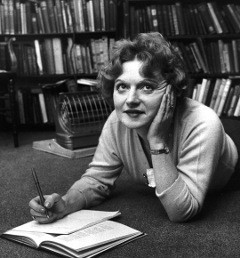
Muriel Spark
Personal Information
Description
Dame Muriel Spark, DBE was a prolific Scottish novelist, short story writer, and poet whose darkly comedic voice made her one of the most distinctive writers of the twentieth century. Spark received the James Tait Black Memorial Prize in 1965 for The Mandelbaum Gate, the Ingersoll Foundation TS Eliot Award in 1992 and the David Cohen Prize in 1997. She became Dame Commander of the Order of the British Empire in 1993, in recognition of her services to literature. In 1998, she was awarded the Golden PEN Award by English PEN for "a Lifetime's Distinguished Service to Literature". Spark received eight honorary doctorates in her lifetime. These included a Doctor of the University degree from her alma mater, Heriot-Watt University in 1995; a Doctor of Humane Letters from the American University of Paris in 2005; and Honorary Doctor of Letters degrees from the Universities of Aberdeen, Edinburgh, London, Oxford, St Andrews and Strathclyde. Spark grew up in Edinburgh and worked as a department store secretary, writer for trade magazines, and literary editor before publishing her first novel, The Comforters, in 1957. The Prime of Miss Jean Brodie, published in 1961, and considered her masterpiece, was made into a stage play, a TV series, and a film.
Books
Frau Dr. Wolfs Methode
In Aiding and Abetting, the doyenne of literary satire has written a wickedly amusing and subversive novel around the true-crime case of one of England's most notorious uppercrust scoundrels and the "aiders and abetters" who kept him on the loose.When Lord Lucan walks into psychiatrist Hildegard Wolf's Paris office, there is one problem: she already has a patient who says he's Lucan, the fugitive murderer who bludgeoned his children's nanny in a botched attempt to kill his wife. As Dr. Wolf sets about deciding which of her patients, if either, is the real Lucan, she finds herself in a fierce battle of wills and an exciting chase across Europe. For someone is deceiving someone, and it may be the good doctor, who, despite her unorthodox therapeutic method (she talks mainly about her own life), has a sinister past, too.Exhibiting Muriel Spark's boundless imagination and biting wit, Aiding and Abetting is a brisk, clever, and deliciously entertaining tale by one of Britain's greatest living novelists.From the Trade Paperback edition.
The Penguin Book of Horror Stories
The Monk of horror, or The Conclave of corpses, by Anonymous The Astrologer's prediction, or The Maniac's fate, by Anonymous The expedition to Hell, by James Hogg Mateo Falcone, by Prosper Merimee [Facts in the Case of M. Valdemar]( by Edgar Allan Poe Le Grande Breteche, by Honore de Balzac The romance of certain old clothes, by Henry James Who knows?, by Guy de Maupassant The body snatcher, by Robert Louis Stevenson The death of Olivier Becaille, by Emile Zola The boarded window, by Ambrose Bierce Lost hearts, by M.R. James The sea-raiders, by H.G. Wells The derelict, by William Hope Hodgson Thurnley Abbey, by Perceval Landon The fourth man, by John Russell In the penal colony, by Franz Kafka The waxwork, by A.M. Burrage Mrs. Amworth, by E.F. Benson The reptile, by Augustus Muir Mr. Meldrum's Mania, by John Metcalfe The beast with five fingers, by William Fryer Harvey Dry September, by William Faulkner Couching at the door, by D.K. Broster The two bottles of relish, by Lord Dunsany The man who liked Dickens, by Evelyn Waugh Taboo, by Geoffrey Household The thought, by L.P. Hartley Comrade death, by Gerald Kersh Leningen versus the ants, by Carl Stephenson The brink of darkness, by Yvor Winters Activity time, by Monica Dickens Earth to Earth, by Robert Graves The dwarf, by Ray Bradbury The Portabello Road, by Muriel Spark No flies on Frank, by John Lennon Sister Coxall's revenge, by Dawn Muscillo Thou shalt not suffer a witch ..., by Dorothy K. Haynes The terrapin, by Patricia Highsmith [Man from the south]( by Roald Dahl Uneasy home-coming, by Will F. Jenkins The Aquarist, by J.N. Allan An interview with M. Chakko, by Vilas Sarang
Public Image, the
Annabel Christopher, a talented actress jealous of her image, is on indifferent terms with her disturbed husband, Frederick. When Frederick apparently commits suicide, his death releases leters accusing Annabel of complicity in an orgy and other immoralities, of which she knows nothing.
Reality and dreams
Tom Richards has fallen off a crane while directing his latest movie, The Hamburger Girl, fracturing some ribs and a hip. A comic procession of doctors, nurses, and relatives files through his hospital room. Another director replaces him at the studio, and everything in his cinematic dream is being changed - the screenplay, the title, the plot. Tom is baffled and furious. His children's marriages are coming apart, and who can be certain of his own? People everywhere are losing their jobs. His real life and his creative life become ever more displaced while he gradually recovers his health, his balance, and his natural imbalance. Tom's shrewd wife, Claire; their daughter Marigold, for whom Tom has ambivalent feelings; his beautiful daughter Cora, by his first marriage; and his lovers, family, friends, and colleagues all find themselves revolving in a sexual and economic maelstrom that gradually results in violence. "What we are doing," Tom tells his film crew at last, "is real and not real. We are living in a world where dreams are reality and reality is dreams. In our world everything starts from a dream."
Mary Shelly (Biography & Memoirs)
Traces the life of Mary Shelley, describes her relationship with her poet husband, and discusses her own literary achievements.
A far cry from Kensington
Set in 1954, this is a tale narrated by one Mrs Agnes Hawkins, a plump, forthright and no-nonsense young war widow. Nancy (as she is called) is the calm at the center of the perennial storm in the offices of a struggling London publishing house in the difficult years after WWII. At work and at her seedy boarding house she is involved with a cast of characters ranging from the charmingly useless to the downright unhinged; included an author she rejects and who tries to revenge himself through a quack science known as "radionics" (use of radio waves to influence health).
Territorial rights
Robert wants nothing more than to become a serious art historian. But his hopes for a staid academic life are put on hold when he's driven from London to Venice to escape one lover and seek out another: the enigmatic Bulgarian refugee Lina Pancev. In Venice, Robert encounters a grand carnival of lust, lies, blackmail, cocktail parties, and regicide. As he chases Lina, his heart's desire, the city itself provides a priceless education in love, art, and beauty. Witty yet elegant, Territorial Rights is a celebration of human imperfection and complexity, with as many shifting identities, wardrobe changes, and sumptuous settings as a comic opera.
The Abbess of Crewe
The Abbess has been newly elected crushing her one rival, the bleeding heart Felicity. The abbey Crewe finds itself deeply troubled with police and their dogs and the scandal-scenting media, and it all began with a stolen thimble.
Not to disturb
The stylish servants in a house in Geneva plot a murder, a marriage, and their own high standing in the career of domestic servants.
The driver's seat
Lise is thin, neither good-looking nor bad-looking. One day she walks out of her office, acquires a gaudy new outfit, adopts a girlier tone of voice, and heads to the airport to fly south. On the plane she takes a seat between two men. One is delighted with her company, the other is deeply perturbed. So begins an unnerving journey into the darker recesses of human nature.
The very fine clock
Because Ticky, the clock, is extremely wise, the professor and his friends vote to bestow upon him the title of Professor. But Ticky declines the honor.
The Mandelbaum Gate
When a young English woman, a half-Jewish Catholic convert, insists upon crossing over from Israel into Jordan, she sets off a series of bizarre situations.