
UNITED STATES AUTHOR · POETRY · TRANSLATIONS INTO ENGLISH
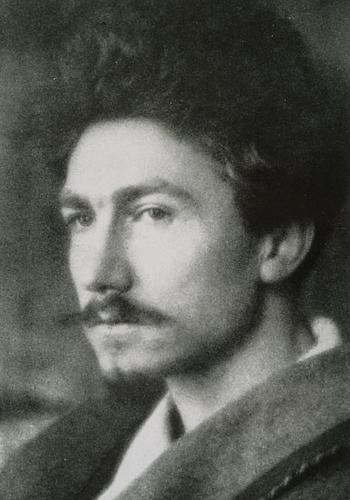
Ezra Pound
Also known as: Ezra Loomis Pound
Ezra Weston Loomis Pound was an American expatriate poet, critic and intellectual who was a major figure of the Modernist movement in the first half of the 20th century. He is generally considered the poet most responsible for defining and promoting a modernist aesthetic in poetry.The critic Hugh Kenner said of Pound upon meeting him: "I suddenly knew that I was in the presence of the center of modernism."Source and more information
WHO stands on that cliff, like a figure of stone,
— from Poems
Most acclaimed

Ezra Pound Poems (Poet to Poet: An Essential Choice of Classic Verse)
"In this series, a contemporary poet advocates a poet of the past or present whom they have particularly admired. By their selection of verses and by the personal and critical reactions they express, the selectors offer intriguing insight into their own work." --Publisher description.
Poems
This is an edition of all the known poems of Mark Akenside, the eighteenth-century English poet and physician, whose poetry has not been newly edited for more than a century. This edition will thus provide scholars and students with a much-needed opportunity to reassess the extent of Akenside's contribution to literary culture, and it will also clarify his role in the development of the aesthetic theories of his own generation and the one that followed. The career of Mark Akenside (1721-70) spans a period of extraordinarily fast change in English literature: his first major poem, The Pleasures of Imagination, appeared in the year of Pope's death; and Akenside died in the year Wordsworth was born. His works not only reflected the very considerable changes that took place during these years; they also contributed in many ways to the shifts in focus, interest, and emphasis that characterize the literature of the later eighteenth century. Akenside's fascination with the imagination, its characteristics and functions, resulted in an intriguing and influential blend of the poetic and the philosophical in his longer poems, The Pleasures of Imagination (1744) and The Pleasures of the Imagination (1772). The earlier work explores the then new subject of aesthetics in greater detail than it had ever been explored before, presenting various original insights and arguments. Yet it would be wrong to see the poem as merely a versified philosophical treatise; its complex structure offers satisfactions beyond those of sequential logic, and the examples cited to illustrate the central ideas are imbued with considerable vigor and clarity. As products of, and contributors to, the eighteenth-century enthusiasm for aesthetics, Akenside's longer poems are captivating examples of the eighteenth- and nineteenth-century experiment in developing the philosophical poem into a major literary form. It is for this reason above all others that they are valued by Coleridge and the writers of the next generation. Because of the comparative obscurity into which Akenside's works fell after the demise of the long philosophical poem in the latter part of the nineteenth century, they have not by and large attracted the attention of modern bibliographers. In this edition numerous bibliographical and textual puzzles presented by his poems are solved for the first time. The apparatus, meanwhile, demonstrates the full extent of the poet's urge to revise - an urge that extended from the wholesale rewriting of some poems to subtle alterations of textual minutiae, showing a mind and an ear alive to nuances of meaning and intonation.
Selected poems
1990
Charles Olson, the poet who coined the word post-modern and helped shape the generation that would emerge under its mantle, is known for the immense range of his intellectual and poetic reach. Here, in this selection by Robert Creeley, Olson's personal friend and literary ally, is the more "intimate order" of the poet who sought to embrace all of history and human thought. Olson came from working-class immigrant roots in a Massachusetts mill town. A scholar of profound originality and vision, he worked for Roosevelt's administration during the war years, then at Black Mountain, the prototypical experimental college and enclave of avantgarde writers and artists. In 1957 he settled in Gloucester, a town on the shore north of Boston where he had spent summers as a child. It was Gloucester, with its richness of history and human use, that provided the ground of The Maximus Poems, begun as letters some years before and which over the next two decades grew into a masterwork of epic dimensions. From the more than three hundred poems making up The Maximus Poems and the comparable number in Olson's Collected Poems, Creeley's selection makes available for the first time an essential sampling of Olson's poetry. Included are paradigmatic early works like "The Kingfishers," which Guy Davenport called "the most modern of American poems, the most energetically influential text in the last thirty-five years," as well as familiar pieces from Maximus like "Maximus, to Gloucester" and "Celestial Evening." Also represented are less known poems, such as "The chain of memory is resurrection" and "The Lamp," works that reveal a more personal side of this major American poet. Together these poems demonstrate Olson's genius and grace, a poet as at home in Gloucester as in the cosmos, a reckoner with dreams and myths, and "Western man at the limit of himself."