
RUSSIAN EMPIRE AUTHOR · TRANSLATIONS INTO ENGLISH · POETRY
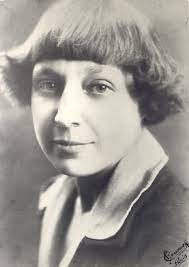
Marina T͡Svetaeva
Also known as: Marina Tsvetaeva, Marina I. Tsvetaeva
Marina Ivanovna Tsvetaeva (Russian: Марина Ивановна Цветаева) was a Russian poet. Her work is considered among some of the greatest in twentieth century Russian literature. She lived through and wrote of the Russian Revolution of 1917 and the Moscow famine that followed it. In an attempt to save her daughter Irina from starvation, she placed her in a state orphanage in 1919, where she died of hunger. Tsvetaeva left Russia in 1922 and lived with her family in increasing poverty in Paris, Berlin and Prague before returning to Moscow in 1939. Her husband Sergei Efron and their daughter Ariadna (Alya) were arrested on espionage charges in 1941; her husband was executed. Tsvetaeva committed suicide in 1941. As a lyrical poet, her passion and daring linguistic experimentation mark her as a striking chronicler of her times and the depths of the human condition.
WHO stands on that cliff, like a figure of stone,
— from Poems
Most acclaimed

Dark Elderberry Branch
2014 Eric Hoffer Award for Poetry – First Runner-Up 2014 Montaigne Medal Finalist 2014 da Vinci Eye Finalist A reading by Ilya Kaminsky and Jean Valentine “This ‘homage’ to Tsvetaeva captures moments, lines, and fragments the way a talented artist captures an individual with a few well-placed strokes of charcoal. As artists understand, a faithful rendering is not always the best way to capture an individual, a scene, or an idea. It is not completeness or precision that are most important, but instead, intuition, empathy, and artfulness. And in this sense Dark Elderberry Branch succeeds brilliantly.” ⎯Gwarlingo “. . .a master class in poetics. . . [bringing] layer after layer of meaning, context, and skill to life. . . . Tsvetaeva would approve of this re-vision of her work.” —The California Journal of Poetics “…with tenderness and emotional integrity [Valentine and Kaminsky] created a Tsvetaeva-centric world in gorgeous poems and fragments of prose.” —The Rumpus “Non-Russian speakers will still never know exactly what it’s like to read Tsvetaeva, but Valentine and Kaminsky have tapped into something that may contain the inklings of Tsvetaeva’s soul.” —Construction Magazine “The magnitude of love, exile, loss, desperation and faith is met with a fortitude most of us will never have to muster; a vulnerability most would never expose. We can thank the stoeln paper, quills, red ink; the bells of Moscow, piles of bills an bread from a stranger for a glimpse into the lines and life of Marina Tsvetaeva in a tender ‘reading’ by poets Ilya Kaminsky and Jean Valentine, a collaboration exquisitely suited to deliver these earthly traces.” —C.D. Wright “For a non-Russian reader, Tsvetaeva’s poetry has always been a house with neither doors nor windows. This is the first time when the translators do not claim to inhabit this house, but choose to stand outside—most importantly outside of themselves, as when in ecstasy, in love with Tsvetaeva’s genius. With these brilliantly introduced and delivered poems, Kaminsky and Valentine offer no less than the first real welcome of Marina Tsvetaeva into English. To turn to Tsvetaeva’s own words (I can eat—with dirty hands, sleep—with dirty hands, write with dirty hands I cannot), these two American poets wrote this Russian book with sparkling clean hands.” —Valzhyna Mort “Of the legendary four great Russian poets of her generation (others were Akhmatova, Mandelstam, Pasternak) at the beginning of the twentieth century, Marina Tsvetaeva has always seemed to me the most mysterious. Of course they were all mysterious–what great poet, indeed what individual person is not? — but I have turned from reading translations (I read no Russian) of her poems and writings, and from writings about her and her tormented story — and from reading them gratefully with a feeling that, vivid and searing though they may have been, she had been in them like a ghost in a cloud, and was gone again. This new selection from her poems and prose, a ‘homage’ to her by Ilya Kaminsky and Jean Valentine, brought me a closer and more intrimate sense of her and her voice and presence than I had before…this Dark Elderberry Branch is magic.” —W.S. Merwin “The poems Ilya Kaminsky and Jean Valentine have chosen to translate, by Marina Tsvetaeva, are blessings of experience, blessings even of suffering, though also of simpler causes of joy, someone’s body, a ray of light, a book. Kaminsky says he and Jean Valentine have very different temperaments from hers, but they show here what they show, differently, in their own poetry, that they are themselves, each of them, so very good at blessing experience, finding its indomitable life. This is radiant work. They chose the right poet to fall in love with, and her poems responded.” —David Ferry “As Brodsky once wrote of Tsvetaeva, ‘[her] voice had the sound of something unfamiliar and frightening to the Russian ear: the unacceptability of the world.’ Ilya Kaminsky’s and Jean Valentine’s homage is a work of true translatus, carrying-across that voice, that sound, ‘by hand—across the river,’ into an English of commensurate intensity, ferocity, and beauty. Dark Elderberry Branch is magnificent: absolutely essential reading for anyone who loves Tsvetaeva.” —Suji Kwock Kim “. . .[this] short, moving volume contains not translations but ‘readings,’ very free renderings. . . the careful words and the emotional extremes that characterize Tsvetaeva in English as in her original tongue.” —Publishers Weekly Praise for Marina Tsvetaeva: “A poet of genius.” —Vladimir Nabokov “Tsvetaeva was… absolutely natural, and fantastically self-willed… Her willfulness was not just a matter of temperament but a way of life… She always needed to experience every emotion to the maximum, seeking ecstasy not only in love, but in abandonment, loneliness, and disaster as well.” —Nadezhda Mandelstam
Poems
This is an edition of all the known poems of Mark Akenside, the eighteenth-century English poet and physician, whose poetry has not been newly edited for more than a century. This edition will thus provide scholars and students with a much-needed opportunity to reassess the extent of Akenside's contribution to literary culture, and it will also clarify his role in the development of the aesthetic theories of his own generation and the one that followed. The career of Mark Akenside (1721-70) spans a period of extraordinarily fast change in English literature: his first major poem, The Pleasures of Imagination, appeared in the year of Pope's death; and Akenside died in the year Wordsworth was born. His works not only reflected the very considerable changes that took place during these years; they also contributed in many ways to the shifts in focus, interest, and emphasis that characterize the literature of the later eighteenth century. Akenside's fascination with the imagination, its characteristics and functions, resulted in an intriguing and influential blend of the poetic and the philosophical in his longer poems, The Pleasures of Imagination (1744) and The Pleasures of the Imagination (1772). The earlier work explores the then new subject of aesthetics in greater detail than it had ever been explored before, presenting various original insights and arguments. Yet it would be wrong to see the poem as merely a versified philosophical treatise; its complex structure offers satisfactions beyond those of sequential logic, and the examples cited to illustrate the central ideas are imbued with considerable vigor and clarity. As products of, and contributors to, the eighteenth-century enthusiasm for aesthetics, Akenside's longer poems are captivating examples of the eighteenth- and nineteenth-century experiment in developing the philosophical poem into a major literary form. It is for this reason above all others that they are valued by Coleridge and the writers of the next generation. Because of the comparative obscurity into which Akenside's works fell after the demise of the long philosophical poem in the latter part of the nineteenth century, they have not by and large attracted the attention of modern bibliographers. In this edition numerous bibliographical and textual puzzles presented by his poems are solved for the first time. The apparatus, meanwhile, demonstrates the full extent of the poet's urge to revise - an urge that extended from the wholesale rewriting of some poems to subtle alterations of textual minutiae, showing a mind and an ear alive to nuances of meaning and intonation.