
UNITED KINGDOM OF GREAT BRITAIN AND IRELAND AUTHOR · HISTORY · AUTHORS
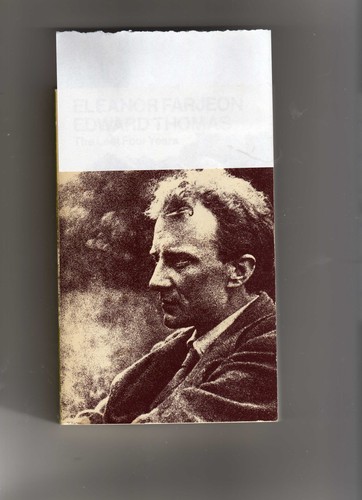
Edward Thomas
Also known as: Thomas, Edward
WHO stands on that cliff, like a figure of stone,
— from Poems
Most acclaimed

Selected letters
"A new and newly annotated selection of letters--the only selected edition available in hardcover--from the English eighteenth-century historian, novelist, and politician whose correspondence is one of the most admired in English literature. Author of the first gothic novel and son of the first prime minister of Great Britain, Horace Walpole had wide-ranging interests that included literature, politics, world affairs, collecting, antiquities, and architecture, and to his numerous correspondents he wrote on these and other topics in prose that is celebrated for its charm, eloquence, and wit. This new Everyman's edition offers an extensive selection of Walpole's letters, helpfully arranged by subject so the reader can choose from themes including social life, the Court, politics, literature, and the evolution of his Gothic castle and art and book collections at Strawberry Hill. This edition offers new annotations throughout, with introductions to its various sections and a general introduction on Walpole as a letter writer. In addition, the text of the letters has been corrected and previously excised passages have been restored"-- "A selection of the famous letters of Horace Walpole, the eighteenth-century English writer, art historian, antiquarian, and politician, newly edited by Stephen Clarke and arranged thematically for the general reader"--
The heart of England
Deep in the heart of England lie lush pasturelands and gentle rolling hills that stretch from Shrewsbury to Gloucester, and from the Welsh borders to Stratford-upon-Avon. This region has seen more passion and spilt more blood than any other area of the kingdom; poets have celebrated its legends, farmers blessed its fertility, and industrialists exploited its mineral resources. Discover it for yourself, with its cottages, ancient villages, elegant spa towns, great cathedrals, impressive fortresses, stately homes, and historic manors.
Poems
This is an edition of all the known poems of Mark Akenside, the eighteenth-century English poet and physician, whose poetry has not been newly edited for more than a century. This edition will thus provide scholars and students with a much-needed opportunity to reassess the extent of Akenside's contribution to literary culture, and it will also clarify his role in the development of the aesthetic theories of his own generation and the one that followed. The career of Mark Akenside (1721-70) spans a period of extraordinarily fast change in English literature: his first major poem, The Pleasures of Imagination, appeared in the year of Pope's death; and Akenside died in the year Wordsworth was born. His works not only reflected the very considerable changes that took place during these years; they also contributed in many ways to the shifts in focus, interest, and emphasis that characterize the literature of the later eighteenth century. Akenside's fascination with the imagination, its characteristics and functions, resulted in an intriguing and influential blend of the poetic and the philosophical in his longer poems, The Pleasures of Imagination (1744) and The Pleasures of the Imagination (1772). The earlier work explores the then new subject of aesthetics in greater detail than it had ever been explored before, presenting various original insights and arguments. Yet it would be wrong to see the poem as merely a versified philosophical treatise; its complex structure offers satisfactions beyond those of sequential logic, and the examples cited to illustrate the central ideas are imbued with considerable vigor and clarity. As products of, and contributors to, the eighteenth-century enthusiasm for aesthetics, Akenside's longer poems are captivating examples of the eighteenth- and nineteenth-century experiment in developing the philosophical poem into a major literary form. It is for this reason above all others that they are valued by Coleridge and the writers of the next generation. Because of the comparative obscurity into which Akenside's works fell after the demise of the long philosophical poem in the latter part of the nineteenth century, they have not by and large attracted the attention of modern bibliographers. In this edition numerous bibliographical and textual puzzles presented by his poems are solved for the first time. The apparatus, meanwhile, demonstrates the full extent of the poet's urge to revise - an urge that extended from the wholesale rewriting of some poems to subtle alterations of textual minutiae, showing a mind and an ear alive to nuances of meaning and intonation.