
CHILE AUTHOR · TRANSLATIONS INTO ENGLISH · POETRY
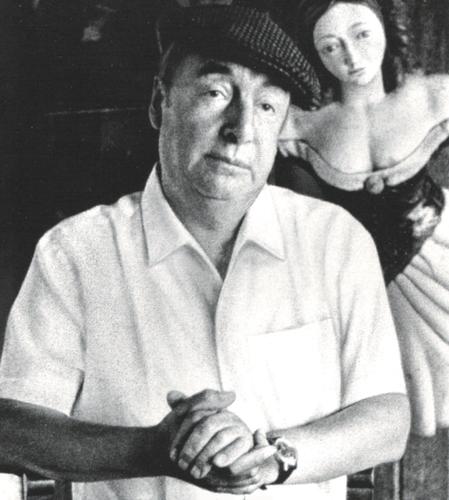
Pablo Neruda
Also known as: P Neruda, P. Neruda
Ricardo Eliécer Neftalí Reyes Basoalto (12 July 1904 – 23 September 1973), better known by his pen name and, later, legal name Pablo Neruda (/nəˈruːdə/; Spanish: [ˈpaβlo neˈɾuða]), was a Chilean poet-diplomat and politician who won the 1971 Nobel Prize in Literature. Neruda became known as a poet when he was 13 years old, and wrote in a variety of styles, including surrealist poems, historical epics, overtly political manifestos, a prose autobiography, and passionate love poems such as the ones in his collection Twenty Love Poems and a Song of Despair (1924). [source](
I did not know Milton Rogovin.
— from Windows that open inward, 1985
Most acclaimed

Love Poems
In a career that has spanned more than a quarter century, Nikki Giovanni has earned the reputation as one of America's most celebrated and contoversial writers.Now, she presents a stunning collection of love poems that includes more than twenty new works.From the revolutionary "Seduction" to the tender new poem, "Just a Simple Declaration of Love," from the whimsical "I Wrote a Good Omelet" to the elegiac "All Eyez on U," written for Tupac Shakur, these poems embody the fearless passion and spirited wit for which Nikki Giovanni is beloved and revered.Romantic, bold, and erotic, Love Poems expresses notions of love in ways that are delightfully unexpected. Articulating in sensuous verse what we know only instinctively, Nikki Giovanni once again confirms her place as one of our nations's most distinguished poets and powerful truth-tellers.
Cien sonetos de amor
Poems explore the depths of the distinguished Chilean writer's love for his wife.
Love
"A timeless treatise on the unique power of human emotion, Stendhal's "Love" is translated by Gilbert and Suzanne Sale with an introduction by Jean Stewart and B.C.J.G. "Knight" in "Penguin Classics". In 1818, when he was in his mid-thirties, Stendhal met and fell passionately in love with the beautiful Mathilde Dembowski. She, however, was quick to make it clear that she did not return his affections, and in his despair he turned to the written word to exorcise his love and explain his feelings. The result is an intensely personal dissection of the process of falling - and being - in love: a unique blend of poetry, anecdote, philosophy, psychology and social observation. Bringing together the conflicting sides of his nature, the deeply emotional and the coolly analytical, Stendhal created a work that is both acutely personal and universally applicable. This translation retains all the colour and passion of the original and is accompanied buy the author's original prefaces and appendices. In their introduction, Jean Stewart and B.C.J.G. "Knight" discuss the relationship between Stendhal and his beloved and explore his views on feminism, education and society. Stendhal (1783-1842) was the pseudonym of Henri Marie Beyle, born and raised in Grenoble. Offered a post in the Ministry of War, from 1800 onwards he followed Napoleon's campaigns throughout Europe before retiring to Italy. Here, as 'Stendhal', he began writing on art, music and travel. Though not well-received during his lifetime, his work, including "The Red and the Black" (1830) and "The Charterhouse of Parma" (1839), now places him among the pioneers of nineteenth-century literary realism. If you enjoyed "Love", you might like Gustave Flaubert's "Sentimental Education", also available in "Penguin Classics". "The single most insightful book on the role of imagination on love". (John Armstrong, author of "Conditions of Love: The Philosophy of Intimacy")." --from book description, Amazon.com.