Discover

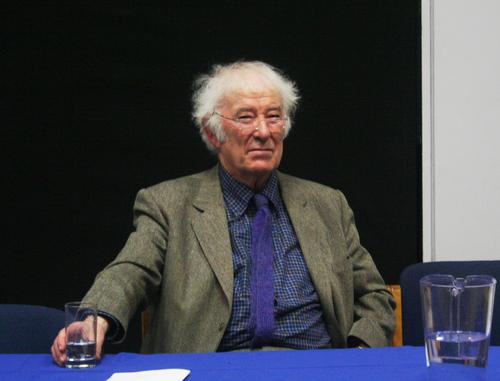
Seamus Heaney

Personal Information

Born April 13, 1939
Died August 30, 2013 (74 years old)
Castledawson, Ireland
Also known as: HEANEY, SEAMUS, 1939-, SEAMUS HEANEY
54 books
3.6 (9)
101 readers

Description

Seamus Justin Heaney MRIA (/ˈʃeɪməs ˈhiːni/; 13 April 1939 – 30 August 2013) was an Irish poet, playwright and translator. He received the 1995 Nobel Prize in Literature. Among his best-known works is Death of a Naturalist (1966), his first major published volume. Heaney was and is still recognised as one of the principal contributors to poetry in Ireland during his lifetime. American poet Robert Lowell described him as "the most important Irish poet since Yeats", and many others, including the academic John Sutherland, have said that he was "the greatest poet of our age". Robert Pinsky has stated that "with his wonderful gift of eye and ear Heaney has the gift of the story-teller." Upon his death in 2013, The Independent described him as "probably the best-known poet in the world". [source](

Books

Newest First

District and circle

0.0 (0)
2

Seamus Heaneys new collection starts in an age of bare hands and cast iron and ends as the automatic lock / clunks shut in the eerie new conditions of a menaced twentieth-first century. In their haunted, almost visionary clarity, the poems assay the weight and worth of what has been held in the hand and in the memory. Images out of a childhood spent safe from the horrors of World War II railway sleepers, a sledgehammer, the heavyweight silence of cattle out in rain are coloured by a strongly contemporary sense that anything can happen and other images from the dangerous present a journey on the underground, a melting glacier are fraught with this same anxiety.But District and Circle, which includes a number of prose poems and translations, offers resistance as the poet gathers his staying powers and stands his ground in the hiding places of love and excited language. In a sequence like The Tollund Man in Springtime and in several poems which do the rounds of the district its known roads and rivers and trees, its familiar and unfamiliar ghosts the gravity of memorial is transformed into the grace of recollection. With more relish and conviction than ever, Seamus Heaney maintains his trust in the obduracy of workaday realities and the mystery of everyday renewals.

Opened Ground

4.0 (2)
21

Seamus Heaney (winner of the Nobel prize for literature in 1995) gathered over 200 of his best poems in this collection, selected from twelve of his previous books of published poetry. The selection covers the period 1966 - 1996. It also contains his Nobel Lecture, "Crediting Poetry", since, as the author explains, "the ground covered in the lecture is ground originally opened by the poems which here precede it."

Finders Keepers

0.0 (0)
2

At the height of summer a dark shadow falls across Exmoor. Children are being stolen. Each disappearance is marked only by a terse note - a brutal accusation. There are no explanations, no ransom demands ... and no hope. Policeman Jonas Holly faces a precarious journey into the warped mind of the kidnapper if he's to stand any chance of catching him. But - still reeling from a personal tragedy - is Jonas really up to the task? Because there's at least one person on Exmoor who thinks that, when it comes to being the first line of defence, Jonas Holly may be the last man to trust ..."--Back cover.

The redress of poetry

0.0 (0)
8

These lectures were delivered by Seamus Heaney while he was Professor of Poetry at Oxford University. In the first of them, Heaney discusses and celebrates poetry's special ability to redress spiritual balance and to function as a counterweight to hostile and oppressive forces in the world. He proceeds to explore how this 'redress' manifests itself in a diverse range of poems and poets, including Christopher Marlowe's 'Hero and Leander', 'The Midnight Court' by the eighteenth-century Irish poet Brian Merriman, John Clare's vernacular writing and Oscar Wilde's 'The Ballad of Reading Gaol'. Several twentieth-century poets are also discussed - W. B. Yeats, Dylan Thomas, Elizabeth Bishop and others - and the whole book constitutes a vivid proof of the claim that 'poetry is strong enough to help'. Seamus Heaney defines the title of this work of criticism as follows: "To redress poetry is to know and celebrate it for its forcibleness as itself . . . not only as a matter of profferd argument and edifying content but as a matter of angelic potential, a motion of the soul." Throughout this collection, Heaney's insight and eloquence are themselves of a poetic order.

Selected Poems 1966-1987

0.0 (0)
1

"Between my fingers and my thumb The squat pen rests. I'll dig with it." Selected Poems 1966-1987 assembles the groundbreaking work of the first half of Seamus Heaney's extraordinary career. This edition, arranged by the author himself, includes the seminal early poetry that struck readers with the force of revelation and heralded the arrival of an heir to Gerard Manley Hopkins, W. B. Yeats, and Robert Frost. Helen Vendler called Heaney "a poet of the in-between," and the work collected here dwells in the borderlands dividing the ancient and the contemporary, the mythic and the quotidian. Gathering poetry from his first seven collections, Selected Poems 1966-1987 presents the young man from County Derry, Northern Ireland, who "emerged from a hidden, a buried life" in Death of a Naturalist (1966), with his cherished poems "Digging" and "Mid-term Break"; the poet of conscience "as bleak as he is bright" in "Whatever You Say Say Nothing" and "Singing School"; and the astonishingly gifted, mature craftsman behind Field Work (1979) and Station Island (1984)--an artist uncannily attuned to the "music of what happens," restlessly searching "for images and symbols adequate to our predicament." This volume, together with its companion Selected Poems 1988-2013 , allows us to revisit the essential work of one of the great writers of our age through his own compilation.

New selected poems, 1966-1987

0.0 (0)
1

A collection of poems previously published by Irish poet Seamus Heaney.
