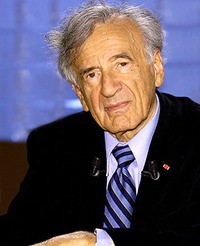
Elie Wiesel
Description
Eliezer Wiesel is a Romania-born American novelist, political activist, and Holocaust survivor of Hungarian Jewish descent. He is the author of over 40 books, the best known of which is Night, a memoir that describes his experiences during the Holocaust and his imprisonment in several concentration camps. Wiesel was awarded the Nobel Peace Prize in 1986. On November 30, 2006 Wiesel received an honorary knighthood in London, England in recognition of his work toward raising Holocaust education in the United Kingdom. Source: Goodreads.com
Books
Désir fou de danser
From Elie Wiesel, a recipient of the Nobel Peace Prize and one of our fiercest moral voices, a provocative and deeply thoughtful new novel about a life shaped by the worst horrors of the twentieth century and one man's attempt to reclaim happiness.Doriel, a European expatriate living in New York, suffers from a profound sense of desperation and loss. His mother, a member of the Resistance, survived World War II only to die in an accident, together with his father, soon after. Doriel was a child during the war, and his knowledge of the Holocaust is largely limited to what he finds in movies, newsreels, and books--but it is enough. Doriel's parents and their secrets haunt him, leaving him filled with longing but unable to experience the most basic joys in life. He plunges into an intense study of Judaism, but instead of finding solace, he comes to believe that he is possessed by a dybbuk.Surrounded by ghosts, spurred on by demons, Doriel finally turns to Dr. Therese Goldschmidt, a psychoanalyst who finds herself particularly intrigued by her patient. The two enter into an uneasy relationship based on exchange: of dreams, histories, and secrets. Despite Doriel's initial resistance, Dr. Goldschmidt helps to bring him to a crossroads--and to a shocking denouement.In Doriel's journey into the darkest regions of the soul, Elie Wiesel has written one of his most profoundly moving works of fiction, grounded always by his unparalleled moral compass.From the Hardcover edition.
Rashi
Some months ago the Jewish world celebrated the eight hundredth anniversary of the death of Rashi, who died at Troyes in 1105. On that occasion those whose knowledge authorizes them to speak gave eloquent accounts of his life and work. Science and devotion availed themselves of every possible medium-lectures and books, journals and reviews-to set forth all we owe to the illustrious Rabbi. The writer ventures to express the hope that in the present volume he has made at least a slight contribution toward discharging the common debt of the Jewish nation-that it is not utterly unworthy of him whose name it bears.
Day
Winner of the 2007 Costa Book AwardAlfred Day wanted his war. In its turmoil he found his proper purpose as the tail-gunner in a Lancaster bomber; he found the wild, dark fellowship of his crew, and - most extraordinary of all - he found Joyce, a woman to love. But that's all gone now - the war took it away. Maybe it took him, too. Now in 1949, employed as an extra in a war film that echoes his real experience, Day begins to recall what he would rather forget...
The judges
"Our courts, the third branch of the government, are central in the administration of our democracy. But their operations are shrouded in a mythology--which this book pierces. Many of our 30,000 judges are hard-working and distinguished jurists; most are simply lawyers who knew a politician. It does not help that the job pays poorly. We have no judicial profession: we do not train judges before or after they mount the bench. There is no national court system. Fifty states, a federal government, counties and municipalities all have their own courts, their own rules and their own laws and are deluged with cases filed by a million lawyers. Less than 3% of criminal charges and 4% of civil disputes are resolved in court. This noted author argues that a specialized world demands specialized courts and judges expert in the subjects they must consider.--From publisher description."--Source other than the Library of Congress.
The time of the uprooted
Tormented by feelings of loss and dispossession after spending his life fleeing first the Nazis and then the 1956 Russian invasion of Hungary, Gamaliel Friedman settles in New York, where he meets a fellow group of exiles.
Wise Men and Their Tales
In Wise Men and Their Tales, a master teacher gives us his fascinating insights into the lives of a wide range of biblical figures, Talmudic scholars, and Hasidic rabbis.The matriarch Sarah, fiercely guarding her son, Isaac, against the negative influence of his half-brother Ishmael; Samson, the solitary hero and protector of his people, whose singular weakness brought about his tragic end; Isaiah, caught in the middle of the struggle between God and man, his messages of anger and sorrow counterbalanced by his timeless, eloquent vision of a world at peace; the saintly Rabbi Yehoshua ben Levi, who by virtue of a lifetime of good deeds was permitted to enter heaven while still alive and who tried to ensure a similar fate for all humanity by stealing the sword of the Angel of Death.Elie Wiesel tells the stories of these and other men and women who have been sent by God to help us find the godliness within our own lives. And what interests him most about these people is their humanity, in all its glorious complexity. They get angry--at God for demanding so much, and at people, for doing so little. They make mistakes. They get frustrated. But through it all one constant remains--their love for the people they have been charged to teach and their devotion to the Supreme Being who has sent them. In these tales of battles won and lost, of exile and redemption, of despair and renewal, we learn not only by listening to what they have come to tell us, but by watching as they live lives that are both grounded in earthly reality and that soar upward to the heavens.From the Hardcover edition.
After the darkness
"Though Elie Wiesel's first book, Night, describes his concentration camp experience, Wiesel has rarely written directly about the Holocaust in his books. Now, as the last generation of survivors is passing and a new generation must be introduced to mankind's darkest hour, Wiesel has written a summing-up, illustrated, that serves both as a distillation of the most important aspects of Hitler's years in power and a fitting memorial to those who suffered and perished. He begins with the creation of the Third Reich, continues through Western acquiescence, war, the gas chambers, liberation, and, finally, memory. He criticizes both Churchill and Roosevelt for what they knew and ignored; he praises little-known Jewish heroes. Included are testimonies from survivors that mark watershed events, such as Hitler's rise to power, Kristallnacht, life in the ghettos and concentration camps, liberation, and the displaced persons camps."--BOOK JACKET.
Mémoires
Conversations with Elie Wiesel
Conversations with Elie Wiesel is a far-ranging dialogue with the Nobel Peace Prize-winner on the major issues of our time and on life's timeless questions.In open and lively responses to the probing questions and provocative comments of Richard D. Heffner--American historian, noted public television moderator/producer, and Rutgers University professor--Elie Wiesel covers fascinating and often perilous political and spiritual ground, expounding on issues global and local, individual and universal, often drawing anecdotally on his own life experience.We hear from Wiesel on subjects that include the moral responsibility of both individuals and governments; the role of the state in our lives; the anatomy of hate; the threat of technology; religion, politics, and tolerance; nationalism; capital punishment, compassion, and mercy; and the essential role of historical memory. These conversations present a valuable and thought-provoking distillation of the thinking of one of the world's most important and respected figures--a man who has become a moral beacon for our time.From the Hardcover edition.
The Golem
A clay giant miraculously brought to life by a saintly rabbi saves a Jewish banker who has been falsely accused in the Prague of Emperor Rudolf II.
The Holocaust in Romania
"In 1930, 757,000 Jews lived in Romania. They constituted the third-largest Jewish community in Europe. Today not more than 14,000 Jews live in Romania, most of them elderly. The record of the Holocaust in Romania includes many curious chapters of betrayal and support, but they have been largely unavailable until now. Radu Ioanid's account, based upon unparalleled access to previously secret East European government archives, is an unprecedented analysis of heretofore purposely hidden materials. Archival records, published and unpublished reports, memoirs of survivors, letters - Dr. Ioanid uses all these elements to build an accurate perspective on Romanian policies of racism, anti-Semitism, and the extermination of Jews during the regime of Ion Antonescu."--BOOK JACKET.
King Solomon and his magic ring
Recounts some of the stories of the wisdom and folly in the life of the legendary King Solomon.