Discover

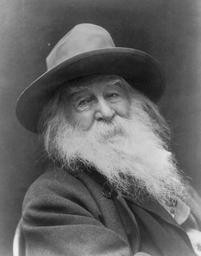
Walt Whitman

Personal Information

Born May 31, 1819
Died March 26, 1892 (72 years old)
West Hills, United States
Also known as: Walter Whitman, Wall Whitman
143 books
3.9 (32)
810 readers

Description

Walt Whitman was an American poet, essayist, journalist, and humanist. He was a part of the transition between Transcendentalism and realism, incorporating both views in his works. Whitman is among the most influential poets in the American canon, often called the father of free verse.His work was very controversial in its time, particularly his poetry collection Leaves of Grass, which was described as obscene for its overt sexuality.

Books

Newest First

Poetry and prose

0.0 (0)
2

Seeks to supply a sounder and more uncluttered text for reading than has been heretofore available, together with variant and delected passages for study/

Nothing but miracles

0.0 (0)
0

The author finds miracles everywhere--in nature, on city streets, and at home.

Leaves of grass

3.8 (12)
430

Leaves of Grass is a poetry collection by American poet Walt Whitman. First published in 1855, Whitman spent most of his professional life writing and rewriting Leaves of Grass, revising it multiple times until his death. There have been held to be either six or nine individual editions of Leaves of Grass, the count varying depending on how they are distinguished.This resulted in vastly different editions over four decades—the first edition being a small book of twelve poems, and the last, a compilation of over 400. (Source: [Wikipedia](

Wrenching times

0.0 (0)
0

Contains 16 poems about men at war, influenced by Whitman's experience at a volunteer hospital during the American Civil War.

Selected poems

D. J. Enright, Jones Very, Herman Melville, Michael S. Harper, Wyatt, Thomas Sir, David Lawrence, Lewis Carroll, Paul Celan, Octavio Paz, Boynton, Henry Walcott, Pāratitācan̲, George Mackay Brown, Hans Magnus Enzensberger, Dylan Thomas, Saint-John Perse, Giuseppe Ungaretti, Stéphane Mallarmé, Sir Philip Sidney, Ennis Rees, Elizabeth Barrett Browning, John Glassco, Karl Jay Shapiro, William Barnes, Jorge Luis Borges, Niyi Osundare, Robert Louis Stevenson, Leah Goldberg, Cyprian Norwid, Yvor Winters, Anne Brontë, Carol Ann Duffy, Seán Ó Ríordáin, Czesław Miłosz, Sister Mary Madeleva, Oxenham, John, Mongane Wally Serote, Michael Rosen, Paul Éluard, Harvey Shapiro, Johannes Bobrowski, Barnabe Googe, Sophocles, Rudyard Kipling, Walter De la Mare, Aldous Huxley, Charles Olson, William Butler Yeats, Walt Whitman, Frank O'Hara, Kōnstantinos Petrou Kabaphēs, Diana Der Hovanessian, D. H. Lawrence, John Keats, Lorna Goodison, Edwin Arlington Robinson, Wallace Stevens, Percy Bysshe Shelley, César Vallejo, Paul Verlaine, Graham, W. S., Ovid, James Arlington Wright, John Ashbery, Анато́лий Александрович Биск, Tomas Tranströmer, John Updike, Gaspara Stampa, Emma Lazarus, W. H. Auden, Lord Byron, Robinson Jeffers, Fergusson, Robert, Léopold Sédar Senghor, Rita Dove, William Shakespeare, Laurie Lee, Carl Sandburg, John Frederick Nims, Langston Hughes, Yves Bonnefoy, Edgar Allan Poe, Conrad Aiken, John Greenleaf Whittier, Eugène Guillevic, Michael Longley, Günter Grass, F. R. Scott, Oliver St. John Gogarty, Muriel Rukeyser, Les A. Murray, Allen Ginsberg, Robert Pinsky, Odysseas Elytis, Pierre Reverdy, Hugo, Richard, Emily Brontë, Seamus Deane, Dannie Abse, Adrienne Rich, Laura Riding, Friedrich Hölderlin, Georg Trakl, John Davidson, Rabindranath Tagore, Pádraic H. Pearse, Clarke, Austin, Steve Griffiths, George Crabbe, Fred Wah, Robert Bly, Roy Fuller, Pierre de Ronsard, Gaius Valerius Catullus, John Wilmot, Earl of Rochester, Derek Walcott, Algernon Charles Swinburne, Cecil Day-Lewis, Anne Stevenson, David Malouf, Thomas Gray, Emily Dickinson, Siegfried Sassoon, Robert Herrick, Oscar Williams, Isaac Watts, Charlotte Brontë, Vernon Phillips Watkins, Rafael Alberti, Jean Garrigue, Zbigniew Herbert, Young, Andrew, A. M. Klein, James Tate, William Wordsworth, Charlotte Mary Mew, Theocritus, Charles Churchill, Oscar Wilde, Rainer Maria Rilke, Anna Akhmatova, George Fetherling, Robert Bringhurst, Gascoyne, David, Robert Henryson, Lewis, Saunders, Pratt, E. J., Rosalía de Castro, Thomas Merton, Edward Robeson Taylor, John Shaw Neilson, Christopher Smart, Ai Weiwei, John Skelton, Kevin Crossley-Holland, U. A. Fanthorpe, Margaret Avison, John Peale Bishop, Al Purdy, Boileau, Vladimir Nabokov, Thompson, Denys, Giacomo Leopardi, Kenneth Rexroth, Adam Czerniawski, Kenneth Koch, Gerard Manley Hopkins, Robin Hyde, John Ciardi, Alfred Lord Tennyson, Andrew Marvell, David John Murray Wright, Thomas Chatterton, William Blake, T. S. Eliot, Henry Wadsworth Longfellow, Giovanni Pascoli, Guillaume Apollinaire, Stevie Smith, Andrew Barton 'Banjo' Paterson, John Gay, Emile Nelligan, Henrik Nordbrandt, Ausiàs March, Aaron J. Clarke, Jules Laforgue, Ezra Pound, John Hollander, Christina Georgina Rosetti, George William Russell, Theodore Roethke, Jaime Torres Bodet, Jibanananda Das, Gyula Illyés, Robert Frost, John Milton, Attilio Bertolucci, Federico García Lorca, Sir Walter Scott, Lars Gustafsson, Anne Sexton, John Berryman, W. D. Snodgrass, Heinz Piontek, Kenneth Patchen, Bill Bissett, William Peskett, Sylvia Townsend Warner, Sophie Hannah, António Machado
0.0 (0)
0

Complete poetry and collected prose

0.0 (0)
1

This is the most comprehensive volume of Walt Whitman (1819-1892) ever published. It includes all of his poetry and what he considered his complete prose. This is also the only collection that includes, in exactly the form in which it appeared in 1855, the first edition of Leaves of Grass. This was the book, a commercial failure, that prompted Emerson's famous message to Whitman: "I greet you at the beginning of a great career". These twelve poems, including what were later to be entitled "Song of Myself" and "I Sing the Body Electric", and a preface announcing the author's poetic theories, were the first stage of a massive, lifelong work. Six editions and some thirty-seven years later Leaves of Grass had become one of the central volumes in the history of world poetry. Each edition involved revisions of earlier poems and the incorporation of new ones. In 1856, for example, he added such poems as "Crossing Brooklyn Ferry" and "Spontaneous Me"; in the third edition (1860) "Out of the Cradle Endlessly Rocking" and two new sections, "Calamus" and "Children of Adam". In the fourth (1867) he incorporated the Civil War poems published a few years earlier as Drum-Taps and Sequel to Drum-Taps, including the poems on the death of Lincoln, notably "When Lilacs Last in the Door Yard Bloom'd." And so it went, a triumphant progress, hailed by Emerson, Thoreau, Rossetti and others, but also, as with the sixth edition in 1881-82, beset by charges of obscenity for such poems as "A Woman Waits for Me." Printed here is the final, the great culminating edition of 1891-92, the last supervised by Whitman himself just before his death. Whitman's prose is no less extraordinary. Specimen Days and Collect (1882) includes reminiscences of nineteenth-century New York City that will fascinate readers in the twentieth, notes on the Civil War, especially his service in Washington hospitals, and trenchant comments on books and authors. Democratic Vistas (1871), in its attacks on the misuses of national wealth after the Civil War, is relevant to conditions in our own time, and November Boughs (1888) brings together retrospective prefaces, opinions, random autobiographical bits that are in effect an extended epilogue on Whitman's life, works, and times. Here it all is, the complete Whitman-elegiac, comic, furtive, outrageous-the most innovative and original of American authors.
Overhead the sun

0.0 (0)
1

Excerpts from the longer works of Walt Whitman, a nineteenth-century poet whose words celebrated man and nature.

Walt Whitman's I Hear America Singing

0.0 (0)
0

Whitman's well-known poem is accompanied by full-page illustrations.
