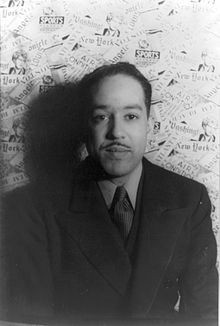

UNITED STATES AUTHOR · AFRICAN AMERICANS · FICTION
Langston Hughes
Also known as: Laugston Hughes, Langston HUGHES
Langston Hughes (1902-1967) Writer, editor, lecturer Langston Hughes achieved fame as a poet during the burgeoning of the arts known as the Harlem Renaissance, but those who label him "a Harlem Renaissance poet" have restricted his fame to only one genre and decade. In addition to his work as a poet, Hughes was a novelist, columnist, playwright, and essayist, and though he is most closely associated with Harlem, his world travels influenced his writing in a profound way. Langston Hughes followed the example of Paul Laurence Dunbar, one of his early poetic influences, to become the second African American to earn a living as a writer. His long and distinguished career produced volumes of diverse genres and inspired the work of countless other African American writers. --From Gale Cengage Learning Free resources
Melodramatic maybe, it seems to me now.
— from The big sea, 1940
Most acclaimed

The sweet flypaper of life
1955
The Sweet Flypaper of Life (1955) is the result of a collaborative effort between photographer Roy DeCarava and writer Langston Hughes. Their unique fusion of words and images provides an opportunity to examine how the two media can be brought together to form composite modes of expression. DeCarava and Hughes’s work reveals their deft command of both African American and Western cultural practices, which they employ to forward their vision of black Americans as full participants in American life and culture.
The big sea
1940
The Big Sea (1940) is a novel by American poet Langston Hughes. It chronicles Hughes’s life as a young adult in Harlem and Paris in the 1920s. In Paris, he was a cook and waiter in nightclubs. In Harlem, he was a rising young poet at the center of the Harlem Renaissance. The Big Sea (1940) is a novel by American poet Langston Hughes. It chronicles Hughes's life as a young adult in Harlem and Paris in the 1920s. In Paris, he was a cook and waiter in nightclubs. In Harlem, he was a rising young poet at the center of the Harlem Renaissance.
Short stories
For over three decades, Reynolds Price has been one of America's most distinguished writers, in a career that has been remarkable both for its virtuosity and for the variety of literary forms he has embraced. Now he shows himself as much a master of the story as he is of the novel, in a volume that presents fifty stories, including two early collections - The Names and Faces of Heroes and Permanent Errors - as well as more than two dozen new stories that have never been gathered together before. In his introduction, Mr. Price explains how, after the publication of his first two collections, he wrote no new stories for almost twenty years. "But once I needed - for unknown reasons in a new and radically altered life - to return to the story, it opened before me like a new chance...A collection like this then," he adds, "...will show a writer's pre-occupations in ways the novel severely rations (novels are partly made for that purpose - the release from self, long flights through the Other). John Keats's assertion that 'the excellence of every Art is its intensity' has served as a license and standard for me. From the start my stories were driven by heat - passion and mystery, often passion for the mystery I've found in particular rooms and spaces and the people they threaten or shelter - and my general aim is the transfer of a spell of keen witness, perceived by the reader as warranted in character and act.". There is, indeed, much for the reader to "witness" here of passion and mystery, of character and act. And the variety of stories - many of them set in Reynolds Price's native North Carolina, but a surprising number set in distant parts: Jerusalem in "An Early Christmas," the American Southwest in "Walking Lessons," and a number in Europe - will astonish even his most devoted readers. In short, The Collected Stories of Reynolds Price is as deeply rewarding a book as any he has yet published.