Discover

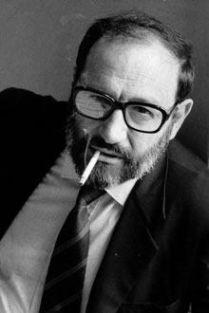
Umberto Eco

Personal Information

Born January 5, 1932
Died February 19, 2016 (84 years old)
Alessandria, Kingdom of Italy
Also known as: Умберто Эко, Umberto Eco (Italia)
109 books
4.0 (265)
2,021 readers

Description

Umberto Eco (5 January 1932 – 19 February 2016) was an Italian novelist, literary critic, philosopher, semiotician, and university professor. He is widely known for his 1980 novel Il nome della rosa (The Name of the Rose), a historical mystery combining semiotics in fiction with biblical analysis, medieval studies, and literary theory. He later wrote other novels, including Il pendolo di Foucault (Foucault's Pendulum) and L'isola del giorno prima (The Island of the Day Before). His novel Il cimitero di Praga (The Prague Cemetery), released in 2010, topped the bestseller charts in Italy. Eco also wrote academic texts, children's books, and essays, and edited and translated into Italian books from French, such as Raymond Queneau’s “Exercises in Style” (1983). He was the founder of the Department of Media Studies at the University of the Republic of San Marino,president of the Graduate School for the Study of the Humanities at the University of Bologna, member of the Accademia dei Lincei, and an honorary fellow of Kellogg College, Oxford.

Books

Newest First

TURNING BACK THE CLOCK; TRANS. BY ALASTAIR MCEWEN

3.0 (1)
3

"The time: 2000 to 2005, the years of neoconservatism, terrorism, the twenty-four-hour news cycle, the ascension of Bush, Blair, and Berlusconi, and the invasions of Afghanistan and Iraq. Umberto Eco's response is a series of essays - which originally appeared in the Italian newspapers La Repubblica and L'espresso - that leaves no slogan unexamined, no innovation unexposed. What led us into this age of hot wars and media populism, and how was it sold to us as progress? Eco discusses such topics as racism, mythology, the European Union, rhetoric, the Middle East, technology, September 11, medieval Latin, television ads, globalization, Harry Potter, anti-Semitism, logic, the Tower of Babel, intelligent design, Italian street demonstrations, fundamentalism, The Da Vinci Code, and magic and magical thinking."--Jacket.

Los Tres Astronautas/ The Three Astronauts

0.0 (0)
1

Three astronauts from different countries land on Mars, meet a strange Martian, and make an amazing discovery about the nature of humanity.

Baudolino

3.9 (14)
82

Born a simple peasant in northern Italy, Baudolino narrates the story of his life, from his adoption by Emperor Frederick Barbarossa and his education in Paris to his arrival in Constantinople during the turmoil of the Fourth Crusade.

La Misteriosa fiamma della Regina Loana

3.5 (4)
22

Giambattista Bodoni, bouquiniste de 60 ans, perd la mémoire suite à une attaque. Il ne reconnaît pas sa femme ni ses enfants mais il se souvient de ce qui a trait à la vie extérieure : les évènements oubliés, les lectures. Sur les conseils de sa femme, il retourne dans leur maison de campagne où sont conservés les objets de son enfance. Il revit ainsi sa jeunesse dans l'Italie des années 1930.

Apocalipticos E Integrados/ Apocalyptics and integrators (Filosofia)

5.0 (1)
12

An erudite and witty collection of Umberto Eco's essays on mass culture from the 1960s through the 1980s, including major pieces which have not been translated into English before. The discussion is framed by opposing characterizations of current intellectuals as apocalyptic and opposed to all mass culture, or as integrated intellectuals, so much a part of mass culture as to be unaware of serving it. Organized in four main parts, "Mass Culture: Apocalypse Postponed," "Mass Media and the Limits of Communication," "The Rise and Fall of Counter-Cultures," and "In Search of Italian Genius," Eco looks at a variety of topics and cultural productions, including the world of Charlie Brown, distinctions between highbrow and lowbrow, the future of literacy, Chinese comic strips, whether countercultures exist, Fellini's Ginger and Fred, and the Italian genius industry.

Il nome della rosa

4.2 (116)
747

It is the year 1327. Franciscans in an Italian abbey are suspected of heresy, but Brother William of Baskerville’s investigation is suddenly overshadowed by seven bizarre deaths. Ultima settimana del novembre 1327. Il novizio Adso da Melk accompagna in un'abbazia dell'alta Italia frate Guglielmo da Baskerville, incaricato di una sottile e imprecisa missione diplomatica. Ex inquisitore, amico di Guglielmo di Occam e di Marsilio da Padova, frate Guglielmo si trova a dover dipanare una serie di misteriosi delitti (sette in sette giorni, perpetrati nel chiuso della cinta abbaziale) che insanguinano una biblioteca labirintica e inaccessibile. Per risolvere il caso, Guglielmo dovrà decifrare indizi di ogni genere, dal comportamento dei santi a quello degli eretici, dalle scritture negromantiche al linguaggio delle erbe, da manoscritti in lingue ignote alle mosse diplomatiche degli uomini di potere. La soluzione arriverà, forse troppo tardi, in termini di giorni, forse troppo presto, in termini di secoli. La copertina dell'articolo può variare.

Il pendolo di Foucault

3.9 (50)
327

Il pendolo di Foucault è il secondo romanzo dello scrittore italiano Umberto Eco. Pubblicato nel 1988 dalla casa editrice Bompiani (con cui Eco aveva già un pluridecennale rapporto), è ambientato negli anni della vita dello scrittore, fino ai primi anni ottanta. Il pendolo di Foucault è suddiviso in dieci segmenti che rappresentano le dieci Sephirot. Il romanzo è ricco di citazioni esoteriche, dalla Cabala all'alchimia e alla teoria del complotto, così tante che il critico letterario e romanziere Anthony Burgess ha suggerito che sarebbe stato utile un indice.

Experiences in translation

0.0 (0)
3

"Translation is not about comparing two languages, Umberto Eco argues, but about the interpretation of a text in two different languages.". "In this book he draws on his substantial practical experience to identify and discuss some central problems of translation. As he demonstrates, a translation can express an evident deep sense of a text even when violating both lexical and referential faithfulness. Depicting translation as a semiotic task, he uses a wide range of source materials as illustration: the translations of his own and other novels, translations of the dialogue of American films into Italian, and various versions of the Bible. In the second part of his study he deals with translation theories proposed by Jakobson, Steiner, Peirce, and others." "Overall, Eco identifies the different types of interpretive acts that count as translation. A new typology emerges, based on his insistence on a common-sense approach and the necessity of taking a critical stance."--BOOK JACKET.

Comment voyager avec un saumon

3.9 (7)
44

How to Travel with a Salmon is a highly engaging collection of what Umberto Eco calls his diario minimo - minimal diaries - after the magazine column in which he began "pursuing the pathways of parody.". These essays, written in the late eighties and early nineties, are his playful but unfailingly accurate takes on militarism, computer jargon, Westerns, art criticism, librarians, bureaucrats, meals on airplanes, Amtrak trains, bad coffee, maniacal taxi drivers, express mail, 33-function watches, fax machines and cellular phones, pornography, soccer fans, academia, and - last but definitely not least - the author's own self. How to Travel with a Salmon gives us Umberto Eco's acute vision of the absurdities of modern life.

Cinq questions de morale

4.5 (2)
18

"In these essays, Eco recalls experiencing liberation from fascism in Italy as a boy, and examines the various historical forms of fascism, always with an eye to such ugly manifestations today. And finally, in an intensely personal open letter to an Italian cardinal, Eco questions what it means to be moral or ethical when one doesn't believe in God.". "As thoughtful and subtle as they are pragmatic and relevant, these essays present one of the world's most important thinkers at the height of his critical powers."--BOOK JACKET.

Art et beauté dans l'esthétique médiévale

4.0 (1)
28

Tutte le culture hanno avuto un'idea del bello e dell'arte, ma non tutte l'hanno elaborata in forma teorica esplicita, non sempre hanno considerato i due problemi come strettamente connessi e di solito non ne hanno parlato in termini di "estetica" - perché questo concetto è nato in Europa nel XVIII secolo. Pertanto molte storie dell'estetica avevano preso in scarsa considerazione le teorie del bello e dell'arte elaborate prima di questa data, e l'epoca medievale è stata per lungo tempo una vittima illustre di questo equivoco. Ma da più di cinquant'anni l'atteggiamento degli storici è mutato e il Medioevo è stato riscoperto come un'epoca ricca di speculazioni affascinanti sulla bellezza, il piacere estetico, il gusto, il bello naturale e artistico, i rapporti tra l'arte e le altre attività umane. Questo volume racconta, in modo accessibile anche al lettore non specialista, le tappe di un dibattito che dalla Patristica, attraverso l'alto Medioevo sino agli albori del Rinascimento, presenta aspetti drammatici e avvincenti e che ci permette di capire meglio la mentalità, il gusto, gli umori dell'uomo medievale.

Kant e l'ornitorinco

0.0 (0)
20

"The history of research into the philosophy of language is full of men (who are rational and mortal animals), bachelors (who are unmarried adult males), and tigers (though it is not clear whether we should define them as feline mammals or big cats with a yellow coat and black stripes)."
