
POETRY · TRANSLATIONS INTO ENGLISH
Ovid
Also known as: Publius Ovidius Naso, Ovidio
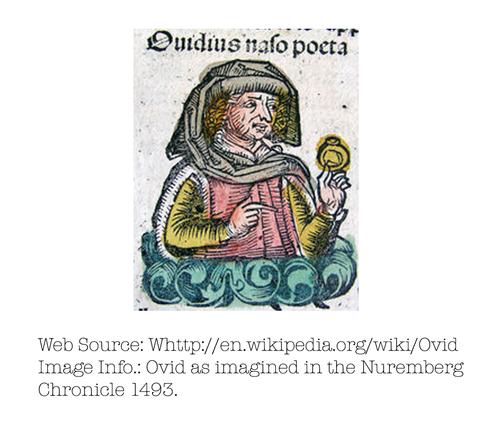
Ovid, was a Roman poet who is best known as the author of the Heroides, Amores, and Ars Amatoria, three major collections of erotic poetry, the Metamorphoses a mythological hexameter poem, the Fasti, about the Roman calendar, and the Tristia and Epistulae ex Ponto, two collections of poems written in exile on the Black Sea. Ovid was also the author of several smaller pieces, the Remedia Amoris, the Medicamina Faciei Femineae, and the Ibis, a long curse-poem. He also authored a lost tragedy, Medea. He is considered a master of the elegiac couplet, and is traditionally ranked alongside Virgil and Horace as one of the three canonic poets of Latin literature. The scholar Quintilian considered him the last of the canonical Latin love elegists.His poetry, much imitated during Late Antiquity and the Middle Ages, decisively influenced European art and literature and remains as one of the most important sources of classical mythology.
I'd meant in solemn metre to rehearse
— from Ars Amatoria
Most acclaimed
![[Opera]](/placeholder-book-lazy.jpg)
[Opera]
The book introduces opera and analyzes eight masterpieces: "Don Giovanni" by Mozart, "Dido and Aeneas" by Purcell, "The Barber of Seville" by Rossini, "Rigoletto" by Verdi, "The mastersingers of Nuremberg" by Wagner, "Boris Godunov" by Mussorgsky, "Carmen" by Bizet, and "Tosca" by Puccini. The cd contains key songs from each opera that are broken into "timelines" in the text.
Selected poems
1990
Charles Olson, the poet who coined the word post-modern and helped shape the generation that would emerge under its mantle, is known for the immense range of his intellectual and poetic reach. Here, in this selection by Robert Creeley, Olson's personal friend and literary ally, is the more "intimate order" of the poet who sought to embrace all of history and human thought. Olson came from working-class immigrant roots in a Massachusetts mill town. A scholar of profound originality and vision, he worked for Roosevelt's administration during the war years, then at Black Mountain, the prototypical experimental college and enclave of avantgarde writers and artists. In 1957 he settled in Gloucester, a town on the shore north of Boston where he had spent summers as a child. It was Gloucester, with its richness of history and human use, that provided the ground of The Maximus Poems, begun as letters some years before and which over the next two decades grew into a masterwork of epic dimensions. From the more than three hundred poems making up The Maximus Poems and the comparable number in Olson's Collected Poems, Creeley's selection makes available for the first time an essential sampling of Olson's poetry. Included are paradigmatic early works like "The Kingfishers," which Guy Davenport called "the most modern of American poems, the most energetically influential text in the last thirty-five years," as well as familiar pieces from Maximus like "Maximus, to Gloucester" and "Celestial Evening." Also represented are less known poems, such as "The chain of memory is resurrection" and "The Lamp," works that reveal a more personal side of this major American poet. Together these poems demonstrate Olson's genius and grace, a poet as at home in Gloucester as in the cosmos, a reckoner with dreams and myths, and "Western man at the limit of himself."