
SPAIN AUTHOR · TRANSLATIONS INTO ENGLISH · SPANISH
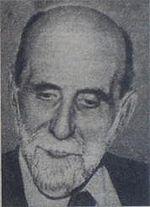
Juan Ramón Jiménez
Also known as: Juan Ramón Jiménez Mantecón
Juan Ramón Jiménez Mantecón (Moguer, España, 23 de diciembre de 1881-San Juan de Puerto Rico, 29 de mayo de 1958) fue un poeta español, autor esencial para la poesía en lengua española y para la poesía contemporánea occidental. Ganó el Premio Nobel de Literatura en 1956 por el conjunto de su obra ("un ejemplo de espíritu elevado y pureza artística"), entre la que destaca la obra lírica en prosa Platero y yo.
Maria Concepcion walked carefully, keeping to the middle of the white dusty road, where the maguey thorns and the treacherous curved spines of organ cactus had not gathered so profusely.
— from Short stories
Most acclaimed

Selected writings
1994
Sir Thomas Browne (1605-82), physician and philosopher, is celebrated principally for his Religio Medici and his study of burial customs, Urn Burial, masterpieces of English prose. But a portrait of Browne as a seventeenth-century intellectual must include much that is rarely seen except by specialists. The Pseudodoxia Epidemica, for example, tracts, letters to naturalists and antiquarians, notebooks and observations on natural history, are neglected. This modernised edition includes the complete text of Urn Burial, selections from Religio Medici, and much else to give account of Browne as doctor, scientist, philosopher, Christian, political and social being. Designed for those unfamiliar with Browne's sometimes opaque prose, it includes substantial annotation and a full introduction. . Browne's elaborate wit engages us by its reflective, at times outrageous tone. He can parody himself: 'if elegancy still proceedeth...we shall, within few years, be fain to learn Latin to understand English...' He was 'rich in various knowledge, exuberant in conceptions and conceits; contemplative, imaginative, often truly great and magnificent in his style,' Coleridge said. His work has marked generations of English writers.
Short stories
For over three decades, Reynolds Price has been one of America's most distinguished writers, in a career that has been remarkable both for its virtuosity and for the variety of literary forms he has embraced. Now he shows himself as much a master of the story as he is of the novel, in a volume that presents fifty stories, including two early collections - The Names and Faces of Heroes and Permanent Errors - as well as more than two dozen new stories that have never been gathered together before. In his introduction, Mr. Price explains how, after the publication of his first two collections, he wrote no new stories for almost twenty years. "But once I needed - for unknown reasons in a new and radically altered life - to return to the story, it opened before me like a new chance...A collection like this then," he adds, "...will show a writer's pre-occupations in ways the novel severely rations (novels are partly made for that purpose - the release from self, long flights through the Other). John Keats's assertion that 'the excellence of every Art is its intensity' has served as a license and standard for me. From the start my stories were driven by heat - passion and mystery, often passion for the mystery I've found in particular rooms and spaces and the people they threaten or shelter - and my general aim is the transfer of a spell of keen witness, perceived by the reader as warranted in character and act.". There is, indeed, much for the reader to "witness" here of passion and mystery, of character and act. And the variety of stories - many of them set in Reynolds Price's native North Carolina, but a surprising number set in distant parts: Jerusalem in "An Early Christmas," the American Southwest in "Walking Lessons," and a number in Europe - will astonish even his most devoted readers. In short, The Collected Stories of Reynolds Price is as deeply rewarding a book as any he has yet published.
Poems
This is an edition of all the known poems of Mark Akenside, the eighteenth-century English poet and physician, whose poetry has not been newly edited for more than a century. This edition will thus provide scholars and students with a much-needed opportunity to reassess the extent of Akenside's contribution to literary culture, and it will also clarify his role in the development of the aesthetic theories of his own generation and the one that followed. The career of Mark Akenside (1721-70) spans a period of extraordinarily fast change in English literature: his first major poem, The Pleasures of Imagination, appeared in the year of Pope's death; and Akenside died in the year Wordsworth was born. His works not only reflected the very considerable changes that took place during these years; they also contributed in many ways to the shifts in focus, interest, and emphasis that characterize the literature of the later eighteenth century. Akenside's fascination with the imagination, its characteristics and functions, resulted in an intriguing and influential blend of the poetic and the philosophical in his longer poems, The Pleasures of Imagination (1744) and The Pleasures of the Imagination (1772). The earlier work explores the then new subject of aesthetics in greater detail than it had ever been explored before, presenting various original insights and arguments. Yet it would be wrong to see the poem as merely a versified philosophical treatise; its complex structure offers satisfactions beyond those of sequential logic, and the examples cited to illustrate the central ideas are imbued with considerable vigor and clarity. As products of, and contributors to, the eighteenth-century enthusiasm for aesthetics, Akenside's longer poems are captivating examples of the eighteenth- and nineteenth-century experiment in developing the philosophical poem into a major literary form. It is for this reason above all others that they are valued by Coleridge and the writers of the next generation. Because of the comparative obscurity into which Akenside's works fell after the demise of the long philosophical poem in the latter part of the nineteenth century, they have not by and large attracted the attention of modern bibliographers. In this edition numerous bibliographical and textual puzzles presented by his poems are solved for the first time. The apparatus, meanwhile, demonstrates the full extent of the poet's urge to revise - an urge that extended from the wholesale rewriting of some poems to subtle alterations of textual minutiae, showing a mind and an ear alive to nuances of meaning and intonation.