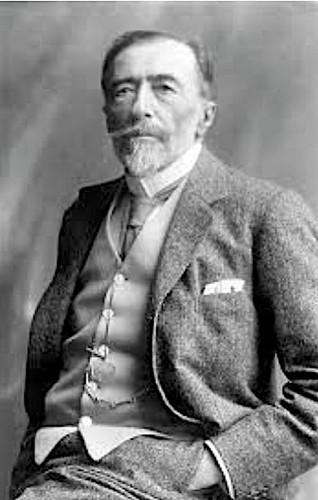
Joseph Conrad
Personal Information
Description
Joseph Conrad was a Polish-born British novelist, who became a British subject in 1886. He is regarded as one of the greatest novelists in English though he did not speak the language fluently until he was in his twenties (and then always with a marked Polish accent). He wrote stories and novels, predominantly with a nautical or seaboard setting, that depict trials of the human spirit by the demands of duty and honor.
Books
Œuvres
Forms of the Novella
Gogol, N. The overcoat. Melville, H. [Billy Budd, sailor]( James, H. The Aspern papers. Chopin, K. [The awakening]( Conrad, J. Heart of darkness. Joyce, J. [The dead]( Kafka, F. The metamorphosis. Lawrence, D.H. St. Mawr. Porter, K.A. Pale horse, pale rider. Pynchon, T. The crying of Lot 49.
Romance
Understanding fiction -- Second Edition
The Attack on the Fort Sir Tatton Sykes Captain Isaiah Sellers Lady Blessington RMS. Titanic The Man Who Would Be King The Secret Life of Walter Mitty The Lottery The Girls in Their Sunnner Dresses The Furnished Room De Mortuis The Necklace [Occurrence at Owl Creek Bridge]( A Piece of Neus I See You Never Haircut Crossing into Poland War The Bride Comes to Yellow Sky Tennessee's Partner [Araby]( The Drunkard The Lament Tickets, Please Eventide Old Red Cruel and Barbarous Treatment A Domestic Dilennna Christ in Flanders Love: Three Pages from a Sportsman's Book Love The Killers The Fly I Want to Knou Why The Adulterous Woman [A Rose for Emily]( A Good Man Is Hard to Find In the Penal Colony Through the Quinquina Glass The Bitch A Father-to-Be The Fight The Far and the Near The Sensible Thing A Christmas Memory Realpolitik The Sailor Boy's Tale Amy Foster The Killing of the Dragon Dermuche Disorder and Early Sorro•-w No Place for You, My Love 1 Write Goodbye, My Brother What Happened Noon Wine Blackberry Winter
Essays of the masters
The Return
Desta and the other members of her Falasha family, Jews suffering from discrimination in Ethiopia, finally flee the country and attempt the dangerous journey to Israel.
Heart Of Darkness
Marlowe, sails down the Congo in search of Kurtz, a company agent and an idealist apparently crazed and depraved by his power over the natives.
Youth
"Youth" sprang from Joseph Conrad's own experience sailing in the Far East with the merchant navy. In it he captures a young man's exhilaration in the face of danger and the unknown.
Joseph Conrad's letters to R. B. Cunninghame Graham
Joseph Conrad's friendship with R. B. Cunninghame Graham was stimulating and in many ways paradoxical. Cunninghame Graham was a remarkable figure - a Scottish aristocrat who lived variously as a South American cowboy, a fencing master, a socialist Member of Parliament and a highly respected writer of travel, histories and short stories. His political beliefs, to which he was deeply and passionately committed, contrasted sharply with Conrad's pessimistic conservatism. They became friends in 1897, when Cunninghame Graham first wrote a letter of admiration to Conrad, and they remained friends until Conrad's death in 1924. The letters to Cunninghame Graham are the most illuminating sequence of letters from Conrad to any of his correspondents. He struggles to define his philosophical and political beliefs in relation to Graham's radical and provocative opinions. The letters also provide comments on Conrad's work, notably The Nigger of the 'Narcissus', Heart of Darkness, Nostromo and The Secret Agent, and show how Graham became a central figure in Conrad's life and helped to sustain him in some of his most strenuous literary struggles.
