Discover
Dec 31, 1908 — Sep 20, 2005· 96 yrs

SECOND POLISH REPUBLIC AUTHOR · JEWS · PERSECUTIONS

Simon Wiesenthal

Also known as: Wiesenthal, Simon

10
BOOKS
5.0
AVG RATING (2)
3
READERS

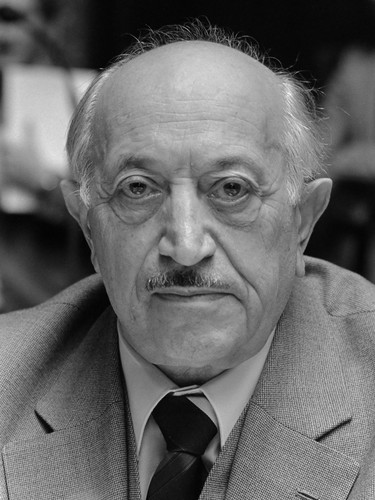
Simon Wiesenthal (31 December 1908 – 20 September 2005) was an Austrian Holocaust survivor, Nazi hunter, and writer. He studied architecture, and was living in Lwów at the outbreak of World War II. He survived the Janowska concentration camp (late 1941 to September 1944), the Kraków-Płaszów concentration camp (September to October 1944), the Gross-Rosen concentration camp, a death march to Chemnitz, Buchenwald, and the Mauthausen concentration camp (February to May 1945). After the war, Wiesenthal dedicated his life to tracking down and gathering information on fugitive Nazi war criminals, so that they could be brought to trial. In 1947, he co-founded the Jewish Historical Documentation Centre in Linz, Austria, where he and others gathered information for future war crime trials and aided Jewish refugees in their search for lost relatives. He opened the Documentation Centre of the Association of Jewish Victims of the Nazi Regime in Vienna in 1961, and continued to try to locate missing Nazi war criminals.

Buchach, Second Polish Republic
Wikipedia

On Sunday, March 19, 1944, Rafi (Raphael) Friedl, a young eighteen-year-old Slovak Jew, alias Janos Sampias, a Catholic Christian, had every reason to fear for his life.

— from Dangerous diplomacy

Most acclaimed

#1

Sonnenblume

1969

0.0 (0)

While imprisoned in a Nazi concentration camp, Simon Wiesenthal was taken one day from his work detail to the bedside of a dying member of the SS. Haunted by the crimes in which he had participated, the soldier wanted to confess to--and obtain absolution from--a Jew. Faced with the choice between compassion and justice, silence and truth, Wiesenthal said nothing. But even years after the way had ended, he wondered: Had he done the right thing? What would you have done in his place?In this important book, fifty-three distinguished men and women respond to Wiesenthal's questions. They are theologians, political leaders, writers, jurists, psychiatrists, human rights activists, Holocaust survivors, and victims of attempted genocides in Bosnia, Cambodia, China and Tibet. Their responses, as varied as their experiences of the world, remind us that Wiesenthal's questions are not limited to events of the past. Often surprising and always thought provoking, The Sunflower will challenge you to define your beliefs about justice, compassion, and human responsibility.From the Trade Paperback edition.
#2

The murderers among us

5.0 (1)
#3

Antisemitism

0.0 (0)

A history of antisemitism, written to accompany the Thames Television series "The Longest Hatred" (1991). Surveys the evolution in antiquity from pagan hostility toward Jews to Christian anti-Judaism, and the latter's overwhelming influence on modern antisemitism. Mentions the antisemitic leanings of 19th-century socialist ideologues and of Karl Marx. Traces the evolution of Austrian and German antisemitism and their culmination in Hitler's racist ideology and the legitimation of the Final Solution. Examines postwar forms of antisemitism in both countries, focusing on Fassbinder's play and the Waldheim affair. Reviews past and present-day antisemitism in Britain, America, France, and Eastern Europe. Remarks on the extent of anti-Zionist propaganda in the Soviet Union and ideological antisemitic tendencies among former Soviet dissidents (e.g. I. Shafarevich). Surveys the status of the Jews in Islamic lands, blood libels in those countries, widespread anti-Jewish stereotypes, the "world Jewish conspiracy" accusation, and Islamic fundamentalist antisemitism.

Books

Newest First
