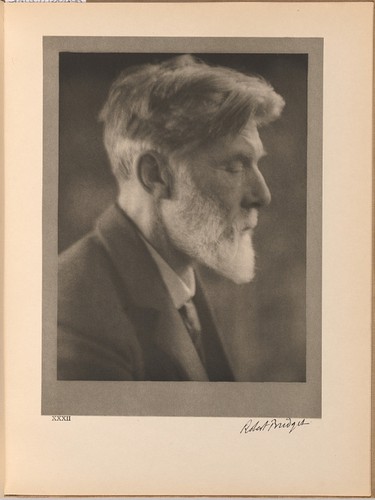

UNITED KINGDOM AUTHOR · POETRY · ENGLISH
Robert Seymour Bridges
Also known as: Robert Bridges, Robert Seymour 1844-1930 Bridges
WHO stands on that cliff, like a figure of stone,
— from Poems
Most acclaimed

The Chilswell book of English poetry
An annotated anthology of poetry written by well-known English poets.
John Keats.
The life of Keats provides a unique opportunity for the study of literary greatness and of what permits or encourages its development. Its interest is deeply human and moral, in the most capacious sense of the words. In this authoritative biography—the first full-length life of Keats in almost forty years—the man and the poet are portrayed with rare insight and sympathy. In spite of a scarcity of factual data for his early years, the materials for Keats’s life are nevertheless unusually full. Since most of his early poetry has survived, his artistic development can be observed more closely than is possible with most writers; and there are times during the period of his greatest creativity when his personal as well as his artistic life can be followed week by week. The development of Keats’s poetic craftsmanship proceeds simultaneously with the steady growth of qualities of mind and character. Walter Jackson Bate has been concerned to show the organic relationship between the poet’s art and his larger, more broadly humane development. Keats’s great personal appeal—his spontaneity, vigor, playfulness, and affection—are movingly recreated; at the same time, his valiant attempt to solve the problem faced by all modern poets when they attempt to achieve originality and amplitude in the presence of their great artistic heritage is perceptively presented. In discussing this matter, Mr. Bate says, “The pressure of this anxiety and the variety of reactions to it constitute one of the great unexplored factors in the history of the arts since 1750. And in no major poet, near the beginning of the modern era, is this problem met more directly than it is in Keats. The way in which Keats was somehow able, after the age of twenty-two, to confront this dilemma, and to transcend it, has fascinated every major poet who has used the English language since Keats’s death and also every major critic since the Victorian era.” Mr. Bate has availed himself of all new biographical materials, published and unpublished, and has used them selectively and without ostentation, concentrating on the things that were meaningful to Keats. Similarly, his discussions of the poetry are not buried beneath the controversies of previous critics. He approaches the poems freshly and directly, showing their relation to Keats’s experience and emotions, to premises and values already explored in the biographical narrative. The result is a book of many dimensions, not a restricted critical or biographical study but a fully integrated whole.
Poems
This is an edition of all the known poems of Mark Akenside, the eighteenth-century English poet and physician, whose poetry has not been newly edited for more than a century. This edition will thus provide scholars and students with a much-needed opportunity to reassess the extent of Akenside's contribution to literary culture, and it will also clarify his role in the development of the aesthetic theories of his own generation and the one that followed. The career of Mark Akenside (1721-70) spans a period of extraordinarily fast change in English literature: his first major poem, The Pleasures of Imagination, appeared in the year of Pope's death; and Akenside died in the year Wordsworth was born. His works not only reflected the very considerable changes that took place during these years; they also contributed in many ways to the shifts in focus, interest, and emphasis that characterize the literature of the later eighteenth century. Akenside's fascination with the imagination, its characteristics and functions, resulted in an intriguing and influential blend of the poetic and the philosophical in his longer poems, The Pleasures of Imagination (1744) and The Pleasures of the Imagination (1772). The earlier work explores the then new subject of aesthetics in greater detail than it had ever been explored before, presenting various original insights and arguments. Yet it would be wrong to see the poem as merely a versified philosophical treatise; its complex structure offers satisfactions beyond those of sequential logic, and the examples cited to illustrate the central ideas are imbued with considerable vigor and clarity. As products of, and contributors to, the eighteenth-century enthusiasm for aesthetics, Akenside's longer poems are captivating examples of the eighteenth- and nineteenth-century experiment in developing the philosophical poem into a major literary form. It is for this reason above all others that they are valued by Coleridge and the writers of the next generation. Because of the comparative obscurity into which Akenside's works fell after the demise of the long philosophical poem in the latter part of the nineteenth century, they have not by and large attracted the attention of modern bibliographers. In this edition numerous bibliographical and textual puzzles presented by his poems are solved for the first time. The apparatus, meanwhile, demonstrates the full extent of the poet's urge to revise - an urge that extended from the wholesale rewriting of some poems to subtle alterations of textual minutiae, showing a mind and an ear alive to nuances of meaning and intonation.