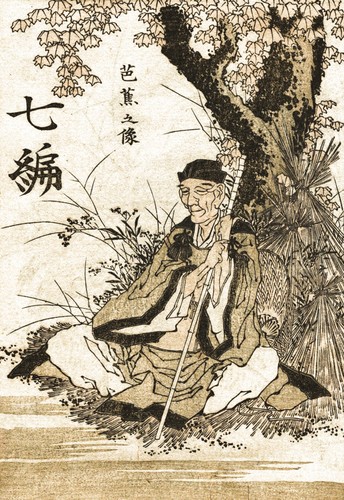
Bashō Matsuo
Personal Information
Description
There is no description yet, we will add it soon.
Books
The essential Bashō
The Essential Basho is the most complete single-volume collection of the writings of one of the great luminaries of Asian literature. Basho (1644-1694) - who elevated the haiku to an art form of utter simplicity and intense spiritual beauty - is best known in the West as the author of Narrow Road to the Interior, a travel diary of linked prose and haiku that recounts his journey through the far northern provinces of Japan. Included here is a masterful translation of this celebrated work, along with three other less well-known but important works by Basho: Travelogue of Weather-Beaten Bones, The Knapsack Notebook, and Sarashina Travelogue. There is also a selection of over 250 of Basho's finest haiku. In addition, the translator has provided an introduction detailing Basho's life and work and an essay on the art of haiku.
Bashō's Narrow road
Matsuo Basho (1644-94) is considered Japan's greatest haiku poet. Narrow Road to the Interior (Oku no Hosomichi) is his masterpiece. Ostensibly a chronological account of the poet's five-month journey in 1689 into the deep country north and west of the old capital, Edo, the work is in fact artful and carefully sculpted, rich in literary and Zen allusion and filled with great insights and vital rhythms. In Basho's Narrow Road: Spring and Autumn Passages, poet and translator Hiroaki Sato presents the complete work in English and examines the threads of history, geography, philosophy, and literature that are woven into Basho's exposition. He details in particular the extent to which Basho relied on the community of writers with whom he traveled and joined in linked verse (renga) poetry sessions, an example of which, A Farewell Gift to Sora, is included in this volume. In explaining how and why Basho made the literary choices he did, Sato shows how the poet was able to transform his passing observations into words that resonate across time and culture.
The Narrow Road to Oku
Oku no Hosomichi (奥の細道, originally おくのほそ道, meaning "Narrow road to/of the interior"), translated alternately as The Narrow Road to the Deep North and The Narrow Road to the Interior, is a major work of haibun by the Japanese poet Matsuo Bashō, considered "one of the major texts of classical Japanese literature." The text is written in the form of a prose and verse travel diary and was penned as Bashō made an epic and dangerous journey on foot through the Edo Japan of the late 17th century. While the poetic work became seminal of its own account, the poet's travels in the text have since inspired many people to follow in his footsteps and trace his journey for themselves. In one of its most memorable passages, Bashō suggests that "every day is a journey, and the journey itself home." The text was also influenced by the works of Du Fu, who was highly revered by Bashō. Of Oku no Hosomichi, Kenji Miyazawa once suggested, "It was as if the very soul of Japan had itself written it." —from [Wikipedia](
Basho's Haiku
"Basho's Haiku offers the most comprehensive translation yet of the poetry of Japanese writer Matsuo Basho (1644-1694), who is credited with perfecting and popularizing the haiku form of poetry. One of the most widely read Japanese writers, both within his own country and worldwide, Basho is especially beloved by those who appreciate nature and those who practice Zen Buddhism. Born into the samurai class, Basho rejected that world after the death of his master and became a wandering poet and teacher. During his travels across Japan, he became a lay Zen monk and studied history and classical poetry. His poems contained a mystical quality and expressed universal themes through simple images from the natural world." "David Landis Barnhill's book strives for literal translations of Basho's work, arranged chronologically in order to show Basho's development as a writer. Avoiding wordy and explanatory translations, Barnhill captures the brevity and vitality of the original Japanese, letting the images suggest the depth of meaning involved. Barnhill also presents an overview of haiku poetry and analyzes the significance of nature in this literary form, while suggesting the importance of Basho to contemporary American literature and environmental thought."--BOOK JACKET.
Moon woke me up nine times
Vivid new translations of Basho's popular haiku, in a selected format ideal for newcomers as well as fans long familiar with the Japanese master. Basho, the famously bohemian traveler through seventeenth-century Japan, is a poet attuned to the natural world as well as humble human doings; "Piles of quilts/ snow on distant mountains/ I watch both," he writes. His work captures both the profound loneliness of one observing mind and the broad-ranging joy he finds in our connections to the larger community. David Young, acclaimed translator and Knopf poet, writes in his introduction to this selection, "This poet's consciousness affiliates itself with crickets, islands, monkeys, snowfalls, moonscapes, flowers, trees, and ceremonies...Waking and sleeping, alone and in company, he moves through the world, delighting in its details." Young's translations are bright, alert, musically perfect, and rich in tenderness toward their maker.
Prentice Hall Literature -- Timeless Voices, Timeless Themes -- Bronze Level
Oku no hosomichi
Early one spring morning in 1689 Basho, arguably the greatest of all Japanese poets, accompanied by his friend and disciple Sora, set forth on foot from his hermitage in Edo (old Tokyo) on one final journey. This pilgrimage took him through the backlands and highlands north of the capital, then across the island of Honshu and down the west coast toward Lake Biwa, a journey of nearly 1,500 miles. Basho would not return to Edo until 1691, three years before his death. Back Roads to Far Towns, the last of Basho's travel diaries, is the evocative account of this arduous journey, the crowning achievement of a lifetime of writing. This edition is introduced by Robert Hass, Poet Laureate of the United States.
