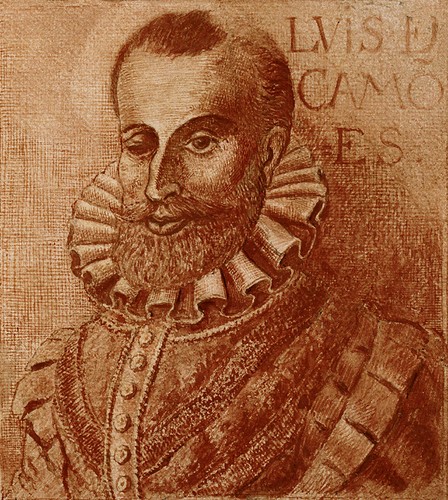

KINGDOM OF PORTUGAL AUTHOR
Luís de Camões
Also known as: Luís Vaz de Camões, Camoens
Luís Vaz de Camões is considered Portugal's and the Portuguese language's greatest poet. His mastery of verse has been compared to that of Shakespeare, Milton, Vondel, Homer, Virgil and Dante. He wrote a considerable amount of lyrical poetry and drama, but is best remembered for his epic work Os Lusíadas.
WHO stands on that cliff, like a figure of stone,
— from Poems
Most acclaimed

Os Lusiadas
1872
Os Lusíadas, usually translated as The Lusiads, is a Portuguese epic poem written by Luís de Camões and first published in 1572. It is widely regarded as the most important work of Portuguese-language literature and is frequently compared to Virgil's Aeneid. The work celebrates the discovery of a sea route to India by the Portuguese explorer Vasco da Gama (1469–1524). The ten cantos of the poem are in ottava rima and total 1,102 stanzas.
Poems
This is an edition of all the known poems of Mark Akenside, the eighteenth-century English poet and physician, whose poetry has not been newly edited for more than a century. This edition will thus provide scholars and students with a much-needed opportunity to reassess the extent of Akenside's contribution to literary culture, and it will also clarify his role in the development of the aesthetic theories of his own generation and the one that followed. The career of Mark Akenside (1721-70) spans a period of extraordinarily fast change in English literature: his first major poem, The Pleasures of Imagination, appeared in the year of Pope's death; and Akenside died in the year Wordsworth was born. His works not only reflected the very considerable changes that took place during these years; they also contributed in many ways to the shifts in focus, interest, and emphasis that characterize the literature of the later eighteenth century. Akenside's fascination with the imagination, its characteristics and functions, resulted in an intriguing and influential blend of the poetic and the philosophical in his longer poems, The Pleasures of Imagination (1744) and The Pleasures of the Imagination (1772). The earlier work explores the then new subject of aesthetics in greater detail than it had ever been explored before, presenting various original insights and arguments. Yet it would be wrong to see the poem as merely a versified philosophical treatise; its complex structure offers satisfactions beyond those of sequential logic, and the examples cited to illustrate the central ideas are imbued with considerable vigor and clarity. As products of, and contributors to, the eighteenth-century enthusiasm for aesthetics, Akenside's longer poems are captivating examples of the eighteenth- and nineteenth-century experiment in developing the philosophical poem into a major literary form. It is for this reason above all others that they are valued by Coleridge and the writers of the next generation. Because of the comparative obscurity into which Akenside's works fell after the demise of the long philosophical poem in the latter part of the nineteenth century, they have not by and large attracted the attention of modern bibliographers. In this edition numerous bibliographical and textual puzzles presented by his poems are solved for the first time. The apparatus, meanwhile, demonstrates the full extent of the poet's urge to revise - an urge that extended from the wholesale rewriting of some poems to subtle alterations of textual minutiae, showing a mind and an ear alive to nuances of meaning and intonation.
The Collected Lyric Poems of Luís de Camões
Gives English readers the first comprehensive collection of Camoes sonnets, songs, elegies, hymms, odes, eclogues, and other poems-more than 280 lyrics altogether, all rendered in engaging verse. Camoes was the first great European artist to cross into the Southern Hemisphere, and his poetry bears the marks of nearly two decades spent in north and east Africa, the Persian Gulf, India, and Macau. From an elegy set in Morocco, to a hymn written at Cape Guardafui on the northern tip of Somalia, to the first modern European love poems for a non-European woman, these lyrics reflect Camoes's encounters with radically unfamiliar peoples and places.