
KINGDOM OF ENGLAND AUTHOR · POETRY · CHRISTIAN PILGRIMS AND PILGRIMAGES
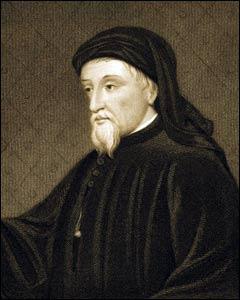
Geoffrey Chaucer
Also known as: Chaucer, Geoffrey CHAUCER
Geoffrey Chaucer was an English author, poet, philosopher, bureaucrat, courtier and diplomat. Although he wrote many works, he is best remembered for his unfinished frame narrative The Canterbury Tales. Sometimes called the father of English literature, Chaucer is credited by some scholars as the first author to demonstrate the artistic legitimacy of the vernacular English language, rather than French or Latin.
WHO stands on that cliff, like a figure of stone,
— from Poems
Most acclaimed

The Treasury of English Short Stories
1985
The Reeve's Tale / Geoffrey Chaucer -- The Apparition of Mrs. Veal / Daniel Defoe -- The Wedding of Jenny Distaff / Richard Steele -- A Story of an Heir / Joseph Addison -- The Mysterious Bride / James Hogg -- The Tapestried Chamber or The Lady in the Sacque / Sir Walter Scott -- The Half-Brothers / Elizabeth Gaskell -- Snobs and Marriage / William Makepeace Thackeray -- The Boots at the Holly-Tree Inn / Charles Dickens -- The White Cat of Drumgunniol / J.S. Le Fanu -- Returning Home / Anthony Trollope -- The Dead Hand / Wilkie Collins -- A Tradition of Eighteen Hundred and Four / Thomas Hardy -- The Story of a Piebald Horse / W.H. Hudson -- A Lodging for the Night / Robert Louis Stevenson -- The Birthday of the Infanta / Oscar Wilde -- Il Conde / Joseph Conrad -- The New Catacomb / Sir Arthur Conan Doyle -- Mary Postgate / Rudyard Kipling -- Mr. Brisher's Treasure / H.G. Wells -- The Broken Boot / John Galsworthy -- Tobermory / Saki (H.H. Munro) -- The Creatures / Walter de la Mare -- The Colonel's Lady / W. Somerset Maugham -- Arabesque- The Mouse / A.E. Coppard -- The Boarding House / James Moyce -- The Duchess and the Jeweller / Virginia Woolf. Bachelors / Hugh Walpole -- The Prussian Officer / D.H. Lawrence -- New Women / Joyce Cary -- Bliss / Katherine Mansfield -- Idenborough / Sylvia Townsend Warner -- Fard / Aldous Huxley -- Spring Sowing / Liam O'Flaherty -- Hand in Glove / Elizabeth Bowen -- Sinners / Sean O'Faolain -- The Spree / V.S. Pritchett -- A Wedding-Dress / Morley Callaghan -- Judas / Frank O'Connor -- A Drink in the Passage / Alan Paton -- Mortmain / Graham Greene -- The Spring Hat / H.E. Bates -- Under the Banyan Tree / R.K. Narayan -- The Old Man / Daphne du Maurier -- Eterna / Mary Lavin -- Willy-Wagtails by Moonlight / Patrick White -- The True Story / Dylan Thomas -- [Royal Jelly]( / Roald Dahl -- The Fathers' Daughters / Muriel Spark -- Two Potters / Doris Lessing -- The Confirmation Suit / Brendan Behan -- Native Country / Nadine Gordimer -- Prizes / Janet Frame -- Timoshenko / Iain Crichton Smith -- The Ballroom of Romance / William Trevor -- A Day in the Country / Dan Jacobson -- Weekend / Shirley Hazzard -- Prue / Alice Munro -- Legend for a Painting / Julia O'Faolain -- Threnody / Fay Weldon -- Cords / Edna O'Brien -- Rape Fantasies / Margaret Atwood -- The Courtship of Mr. Lyon / Angela Carter -- Secrets / Bernard MacLaverty -- Night in Tunisia / Neil Jordan.
Poems
This is an edition of all the known poems of Mark Akenside, the eighteenth-century English poet and physician, whose poetry has not been newly edited for more than a century. This edition will thus provide scholars and students with a much-needed opportunity to reassess the extent of Akenside's contribution to literary culture, and it will also clarify his role in the development of the aesthetic theories of his own generation and the one that followed. The career of Mark Akenside (1721-70) spans a period of extraordinarily fast change in English literature: his first major poem, The Pleasures of Imagination, appeared in the year of Pope's death; and Akenside died in the year Wordsworth was born. His works not only reflected the very considerable changes that took place during these years; they also contributed in many ways to the shifts in focus, interest, and emphasis that characterize the literature of the later eighteenth century. Akenside's fascination with the imagination, its characteristics and functions, resulted in an intriguing and influential blend of the poetic and the philosophical in his longer poems, The Pleasures of Imagination (1744) and The Pleasures of the Imagination (1772). The earlier work explores the then new subject of aesthetics in greater detail than it had ever been explored before, presenting various original insights and arguments. Yet it would be wrong to see the poem as merely a versified philosophical treatise; its complex structure offers satisfactions beyond those of sequential logic, and the examples cited to illustrate the central ideas are imbued with considerable vigor and clarity. As products of, and contributors to, the eighteenth-century enthusiasm for aesthetics, Akenside's longer poems are captivating examples of the eighteenth- and nineteenth-century experiment in developing the philosophical poem into a major literary form. It is for this reason above all others that they are valued by Coleridge and the writers of the next generation. Because of the comparative obscurity into which Akenside's works fell after the demise of the long philosophical poem in the latter part of the nineteenth century, they have not by and large attracted the attention of modern bibliographers. In this edition numerous bibliographical and textual puzzles presented by his poems are solved for the first time. The apparatus, meanwhile, demonstrates the full extent of the poet's urge to revise - an urge that extended from the wholesale rewriting of some poems to subtle alterations of textual minutiae, showing a mind and an ear alive to nuances of meaning and intonation.