
UNITED KINGDOM OF GREAT BRITAIN AND IRELAND AUTHOR · POETRY · POETS
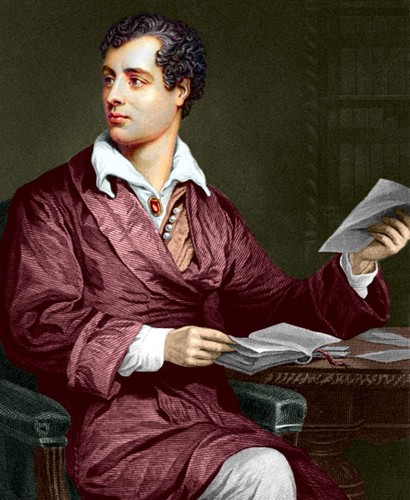
Lord Byron
Also known as: Lord George Gordon Byron, George Gordon Byron, 6th Baron Byron
Lord Byron was an English poet known as much for his life of scandals, exile and excess as for his elegant and well-crafted poetry. Known by his peers as dark, seductive and romantic, his legacy, the brooding Byronic hero still influences modern audiences two hundred years on.
Time is a blind guide.
— from Fugitive pieces
Most acclaimed

The Giaour
This is one of Byron's great Turkish tales told in very fine style. I have a lot of favorite Byron poems, or parts thereof. The Giaour is a wonderful poem and I think Byron at his best. I don't know why it's not as famous as Harold; I enjoy reading this poem over and over. Maybe it is as famous; however, neither Berlioz nor Tchaikovsky honored it with a masterpiece of music or opera. Painted by Eugène Delacroix (1826) in a masterpiece of color, now found in Chicago, I suspect in high tribute, by a great artist. I believe Giaour shows Byron's respect for Islam with regards to religion, but firmly takes a stand for women, however briefly. I think Byron intends Giaour to be pronounced as xio-er to rhyme with bower or power, and used as a disyllable.
Fugitive pieces
Anne Michaels's fiercely beautiful debut novel tells the interlocking stories of three men of different generations whose lives are transformed by the events and shifting effects of the same war. At its center is poet Jakob Beer: traumatically orphaned as a young boy during the Second World war, rescued from the mud of a buried Polish city and secreted to a Greek island by Athos Roussos, scientist, scholar, and, above all, humanist. After the war, in Toronto, where Athos has accepted a teaching post at the University, Jakob is faced with the tangible, insistent nature of the recent past: his own surfacing in all its darkness and profundity, the question of his beloved sister's fate its harrowing focus. Yet this is also the time when he meets the woman who will become his first wife, and begins his life-long work as a translator and poet. And in this layered process of reentering life, Jakob learns the power of language - to destroy, to omit, and to obliterate; but also to witness and tell, conjure and restore. And it is in Toronto as well that, late in his life, Jakob will cross paths with Ben: a young professor, expert in the dramas of weather and biography but naive in the drama of his own life. The quiet elation Ben senses in the older man, and Ben's own connection to the wounding legacies of the war, kindle a fascination with Jakob and his writing, upsetting and then opening that part of himself long since shut down against his knowledge of the past.
Poems
This is an edition of all the known poems of Mark Akenside, the eighteenth-century English poet and physician, whose poetry has not been newly edited for more than a century. This edition will thus provide scholars and students with a much-needed opportunity to reassess the extent of Akenside's contribution to literary culture, and it will also clarify his role in the development of the aesthetic theories of his own generation and the one that followed. The career of Mark Akenside (1721-70) spans a period of extraordinarily fast change in English literature: his first major poem, The Pleasures of Imagination, appeared in the year of Pope's death; and Akenside died in the year Wordsworth was born. His works not only reflected the very considerable changes that took place during these years; they also contributed in many ways to the shifts in focus, interest, and emphasis that characterize the literature of the later eighteenth century. Akenside's fascination with the imagination, its characteristics and functions, resulted in an intriguing and influential blend of the poetic and the philosophical in his longer poems, The Pleasures of Imagination (1744) and The Pleasures of the Imagination (1772). The earlier work explores the then new subject of aesthetics in greater detail than it had ever been explored before, presenting various original insights and arguments. Yet it would be wrong to see the poem as merely a versified philosophical treatise; its complex structure offers satisfactions beyond those of sequential logic, and the examples cited to illustrate the central ideas are imbued with considerable vigor and clarity. As products of, and contributors to, the eighteenth-century enthusiasm for aesthetics, Akenside's longer poems are captivating examples of the eighteenth- and nineteenth-century experiment in developing the philosophical poem into a major literary form. It is for this reason above all others that they are valued by Coleridge and the writers of the next generation. Because of the comparative obscurity into which Akenside's works fell after the demise of the long philosophical poem in the latter part of the nineteenth century, they have not by and large attracted the attention of modern bibliographers. In this edition numerous bibliographical and textual puzzles presented by his poems are solved for the first time. The apparatus, meanwhile, demonstrates the full extent of the poet's urge to revise - an urge that extended from the wholesale rewriting of some poems to subtle alterations of textual minutiae, showing a mind and an ear alive to nuances of meaning and intonation.