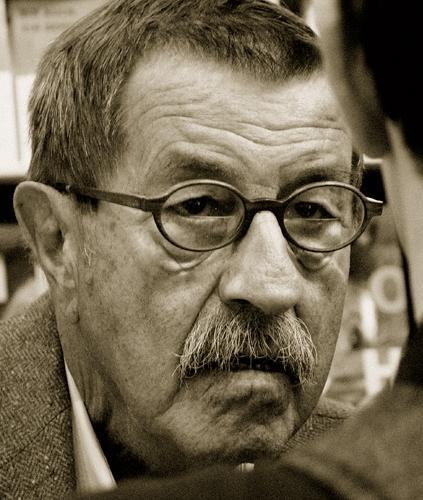
Günter Grass
Description
German novelist, poet, playwright, illustrator, graphic artist, and sculptor
Books
Selected poems
Werkausgabe
Von Buch zu Buch
Diese Dokumentation versucht, einen Überblick über die wichtigsten Rezensionen der Bücher von Günter Grass zu geben. Im Anhang Auzüge aus ausländische Rezensionen, Literaturhinweise und eine vollständige Bio- und Bibliographie.
Günter Grass
Rättin
A major new work from Germany's greatest modern writer, this wildly imaginative yet superbly told novel revives some of Grass's most famous characters from his novels The Tin Drum, Headbirths, and The Flounder, as it tells the story of a female rat who engages the narrator in a series of dialogues convincingly demonstrating that the rats will inherit a devastated earth.
Hundejahre
A novel in three parts, beginning in the 1920s and ending in the 1950s, that follows the lives of two friends from the prewar years in Germany through an apocalyptic period and its startling aftermath.
Aus dem Tagebuch einer Schnecke
Probably the most autobiographical of his novels, From the Diary of a Snail balances the agonising history of the persecuted Danzig Jews with an account of Grass's political campaigning with Willie Brandt.
Mein Jahrhundert
At the end of the 20th century Günter Grass published the 100 stories found in Moje stulecie, one for each consecutive year--from 1900 to 1999. In the book appear many narrators--witnesses of their time. These narrators speak of unusual and everyday things of their lives and times every now and again to other people -- both sexes, various epoques, educations and occupations, different opinions. Victims and executioners speak. Every now and again other Germans tell about political, artistic, scientific, moral, and athletic events -- important and dramatic, occasionally cheerful, more often horrific, in which appear images of the past century.
Pelures d'oignon
Pour G. Grass, l'épluchage de l'oignon est une métaphore du souvenir. Son récit couvre la période allant de 1939 (l'entrée en guerre et la perte de l'innocence) à 1959, où il devient une figure publique avec la publication du Tambour. C'est celle de sa jeunesse, celle qui contient la genèse de son oeuvre. Maints épisodes décrits ici ont inspiré un roman ou un personnage.
Das Treffen in Telgte
"In 1647, as the Thirty Years' War was drawing to its close, a group of poets from all parts of Germany gather at the pilgrimage town of Telgte, for the purpose of strengthening the last remaining bond within a divided nation: its language and literature. They meet and part in disarray, yet manage to discuss their manuscripts with all the liveliness of friendship and force of rivalry, against a background of brutality and anguish ... The fictitious meeting of 1647 is the replay of a real meeting of German poets and writers, known as Group 47, at the end of another devastating war three hundred years later"--Cover.
Der Butt
Based loosely on Grimm's The Fisherman and his Wife, this triumphant blend of folk tale and contemporary story takes place over the course of nine months, during which the wife of the narrator becomes pregnant and is regaled with tales of the various cooks the fisherman has met throughout his life. The emerging themes of the novel expose the periods when men made history and women's contributions went largely, in some cases gravely, unrecognized. Inventive, imaginitive and irreverent, this humorous, fundamentally brilliant novel highlights the value of modern-day myth and timeless legend.
