
POETRY · HISTORY
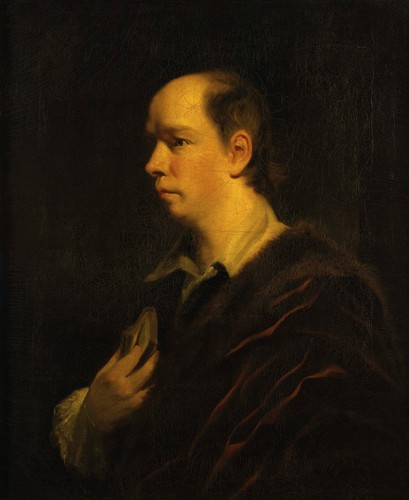
Oliver Goldsmith
Also known as: Olive Goldsmith, Oliver, Goldsmith
Oliver Goldsmith (10 November 1728 – 4 April 1774) was an Anglo-Irish poet, novelist, playwright, and hack writer. He produced literary works in a variety of genres and is regarded among the most versatile writers of the Georgian era. His works are known for their realistic depictions of British society, and his comedy plays for the English stage are considered second in importance only to those of playwright William Shakespeare. Credited with introducing sentimentalism in English literature in 18th-century Great Britain, several of Goldsmith's publications are popular classics of the period, including his only novel, The Vicar of Wakefield (1766), and the comedy play She Stoops to Conquer (1773). He wrote the play The Good-Natur'd Man (1768) and is additionally thought by commentators such as Washington Irving to have written the children's novel The History of Little Goody Two-Shoes (1765), one of the earliest classical works of children's literature.
Two very beautiful naked girls are crouched facing each other.
— from Essays, 1987
Most acclaimed

Selected works
1959
Since his first play, And Things That Go Bump in the Night, which premiered in 1965, McNally has proven himself to be a trailblazing figure and unique voice in American theater, known for his exploration of gay themes and his chronicling of America's changing social attitudes over the past fifty years. His thirty-three plays, nine musicals, three operas, and seven scripts for film and television, are a testament to his astonishing commitment to writing. In Selected Plays, for the very first time, McNally collects a set of eight plays that he considers the most important of his oeuvre, including the Tony-nominated Mothers and Sons and the critically acclaimed And Away We Go, neither of which have been previously published. Introducing each play with a personal essay that recounts an anecdote or discusses an aspect of the play that proceeds it, McNally himself frames his own life in the theater. Selected Plays is a landmark publication, a memoir in plays from one of America's most highly regarded and best-loved playwrights.
Selected writings
1994
Sir Thomas Browne (1605-82), physician and philosopher, is celebrated principally for his Religio Medici and his study of burial customs, Urn Burial, masterpieces of English prose. But a portrait of Browne as a seventeenth-century intellectual must include much that is rarely seen except by specialists. The Pseudodoxia Epidemica, for example, tracts, letters to naturalists and antiquarians, notebooks and observations on natural history, are neglected. This modernised edition includes the complete text of Urn Burial, selections from Religio Medici, and much else to give account of Browne as doctor, scientist, philosopher, Christian, political and social being. Designed for those unfamiliar with Browne's sometimes opaque prose, it includes substantial annotation and a full introduction. . Browne's elaborate wit engages us by its reflective, at times outrageous tone. He can parody himself: 'if elegancy still proceedeth...we shall, within few years, be fain to learn Latin to understand English...' He was 'rich in various knowledge, exuberant in conceptions and conceits; contemplative, imaginative, often truly great and magnificent in his style,' Coleridge said. His work has marked generations of English writers.
Essays
1987
The titles of Ralph Waldo Emerson’s essays consist of a range of general concepts such as character, experience, friendship, history, intellect, love, nature, politics, prudence and, most famously, self-reliance. However, in no case is the content of an essay limited to considerations relevant to its title concept. Emerson’s style is digressive and aphoristic, his lengthy paragraphs strewn with terse, dogmatic assertions. The pieces record the diffuse preconceptions and opinions of the author, typically without arguing for them. “Nature,” Emerson’s first published essay, was published independently five years before his first collection of essays. It became a foundational text for transcendentalism, the New England intellectual movement that upheld the divine character of the natural world and the importance of spiritual connection with it. In its emphasis on reason, individual conscience, and innate human goodness, transcendentalism was related to Unitarianism, where Emerson began his career as a minister. While Emerson resigned from this post after only a few years, he retained a lifelong concern with religion and theology that is frequently manifest in his essays. Even in the earlier essays Emerson expresses in passing a general opposition to slavery, but he has sometimes been criticized for remaining aloof from the social issues of his day, and especially from abolition. Emerson’s growing willingness to think and speak about slavery as he aged is visible in the collection; its final essay is a lecture given before the American Anti-Slavery Society. In “Politics,” he includes “emancipat[ing] the slave” alongside befriending the poor, building schools and cherishing the arts in a list of causes that he takes to represent “real good.” Emerson’s essays were especially influential among the members of the Transcendental Club that met in Cambridge, Massachusetts, which included Henry Thoreau among its members. Reading the essays was also instrumental in the literary development of Emerson’s later correspondent Walt Whitman, who in Leaves of Grass aimed to attain the ideal of the American poet described in “The Poet.” In German translation, the essays were read and appreciated by Nietzsche, who chose a quotation from “History” as the epigraph for the first edition of his 1882 book The Gay Science and in the same book named Emerson among the few men he judged to be “masters of prose.” The essays collected here were originally released in two volumes, or “series,” the first in 1841 and the second in 1844. In the original editions, each essay was prefaced by a poem of Emerson’s own authorship. While some of these poems were omitted in later editions, all have been included here.