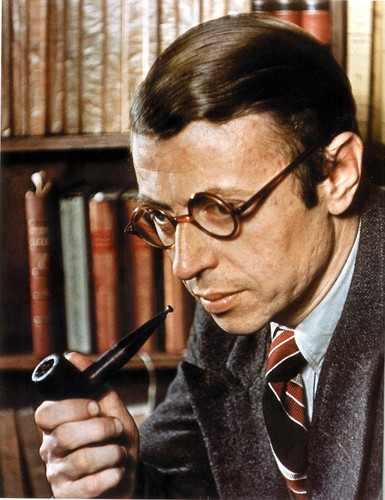
Jean-Paul Sartre
Personal Information
Description
A French existentialist philosopher, playwright, novelist, screenwriter, political activist, biographer, and literary critic. He was one of the leading figures in 20th century French philosophy, existentialism, and Marxism, and his work continues to influence fields such as Marxist philosophy, sociology, and literary studies.
Books
Remembering Sartre, 1905-1980
Contributed artilces presented at a Birth Centenary Seminar on Jean-Paul Sartre (1905-1980) held on 19th December, 2005 organized by Dept. of English, University of Calcutta.
La nausée
A fascinating existentialist novel, written in the form of a journal, about a historian who moves to a small port in northern France to research a biography he is intending to write. Whilst there his senses become dulled and he becomes increasingly disgusted by his own existence, finding no solace with friends or a woman he begins an affair with.
The wall
Riveting and compelling. The Wall tells the inspiring story of forty men and women who escape the dehumanizing horror of the Warsaw ghetto. John Hersey's novel documents the Warsaw ghetto both as an emblem of Nazi persecution and as a personal confrontation with torture, starvation, humiliation, and cruelty- a gripping and visceral story, impossible to put down. "Only a true novelist could breathe warmth, compassion, humor, into what a historian would necessarily have pictured as a stark, hopeless tragic series of events. Only a sensitive novelist could compel us to embark upon such a fearful adventure as this and remain until the end" -The New York Times "A searching, heroic story." -The Atlantic
Essays
Sursis
The French existentialist recreates the shock and confusion of Europe in September of 1938 in a novel which centers on man's search for freedom.
Sartre
Essays of the masters
Théâtre
L'être et le néant
Jean-Paul Sartre (1905-1980) betragtes af mange som grundlæggeren af den eksistentielle filosofi. Hovedværket Væren og Intet fra 1943 sætter for alvor eksistensfilosofien på dagsordenen i Efterkrigstidens Europa og bliver herved også et hovedværk inden for det 20. århundredes intellektuelle kultur. Sartres skarpsindige analyser af grundtrækkende ved den menneskelige eksistens, selvbedrag, kropslighed, fremmedgørelse og frihed diagnosticerer præcist den moderne verden som til stadighed er vores vilkår. Bogen foreligger for første gang i dansk oversættelse.