
FRANCE AUTHOR · FICTION · HISTORY
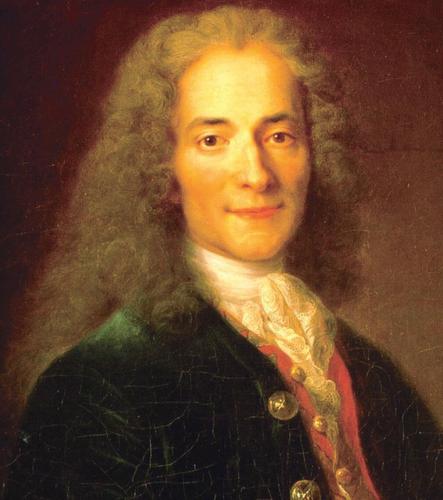
Voltaire
Also known as: F. M. de Voltaire, J. F. M. de Voltaire
François-Marie Arouet, better known by the pen name Voltaire, was a French Enlightenment writer and philosopher famous for his wit and for his advocacy of civil liberties, including freedom of religion and free trade. Voltaire was a prolific writer and produced works in almost every literary form including plays, poetry, novels, essays, historical and scientific works, more than 20,000 letters and more than 2,000 books and pamphlets. He was an outspoken supporter of social reform, despite strict censorship laws and harsh penalties for those who broke them. As a satirical polemicist, he frequently made use of his works to criticize intolerance, religious dogma and the French institutions of his day. Voltaire was one of several Enlightenment figures (along with Montesquieu, John Locke and Jean-Jacques Rousseau) whose works and ideas influenced important thinkers of both the American and French Revolutions.
Maria Concepcion walked carefully, keeping to the middle of the white dusty road, where the maguey thorns and the treacherous curved spines of organ cactus had not gathered so profusely.
— from Short stories
Most acclaimed

Selected works
1959
Since his first play, And Things That Go Bump in the Night, which premiered in 1965, McNally has proven himself to be a trailblazing figure and unique voice in American theater, known for his exploration of gay themes and his chronicling of America's changing social attitudes over the past fifty years. His thirty-three plays, nine musicals, three operas, and seven scripts for film and television, are a testament to his astonishing commitment to writing. In Selected Plays, for the very first time, McNally collects a set of eight plays that he considers the most important of his oeuvre, including the Tony-nominated Mothers and Sons and the critically acclaimed And Away We Go, neither of which have been previously published. Introducing each play with a personal essay that recounts an anecdote or discusses an aspect of the play that proceeds it, McNally himself frames his own life in the theater. Selected Plays is a landmark publication, a memoir in plays from one of America's most highly regarded and best-loved playwrights.
Short stories
For over three decades, Reynolds Price has been one of America's most distinguished writers, in a career that has been remarkable both for its virtuosity and for the variety of literary forms he has embraced. Now he shows himself as much a master of the story as he is of the novel, in a volume that presents fifty stories, including two early collections - The Names and Faces of Heroes and Permanent Errors - as well as more than two dozen new stories that have never been gathered together before. In his introduction, Mr. Price explains how, after the publication of his first two collections, he wrote no new stories for almost twenty years. "But once I needed - for unknown reasons in a new and radically altered life - to return to the story, it opened before me like a new chance...A collection like this then," he adds, "...will show a writer's pre-occupations in ways the novel severely rations (novels are partly made for that purpose - the release from self, long flights through the Other). John Keats's assertion that 'the excellence of every Art is its intensity' has served as a license and standard for me. From the start my stories were driven by heat - passion and mystery, often passion for the mystery I've found in particular rooms and spaces and the people they threaten or shelter - and my general aim is the transfer of a spell of keen witness, perceived by the reader as warranted in character and act.". There is, indeed, much for the reader to "witness" here of passion and mystery, of character and act. And the variety of stories - many of them set in Reynolds Price's native North Carolina, but a surprising number set in distant parts: Jerusalem in "An Early Christmas," the American Southwest in "Walking Lessons," and a number in Europe - will astonish even his most devoted readers. In short, The Collected Stories of Reynolds Price is as deeply rewarding a book as any he has yet published.
Mémoires
2001
"The name of Giacomo Casanova, Chevalier de Seingalt (1725-98), is now synonymous with amorous exploits, and there are plenty of these, vividly narrated, in his memoirs. But Casanova was not just an energetic lover. In his time he was a diplomat, businessman, trainee priest, traveler, prisoner, magician, confidence man, gambler, professional entertainer, and charlatan. He financed business projects, organized lotteries, wrote opera libretti, and dabbled in high politics. Above all he was an autobiographer of enduring brilliance and subtlety who left behind him what is probably the most remarkable confession ever written. Casanova explored to the full all the possibilities eighteenth-century Venice offered by way of love and profit before being imprisoned, escaping from jail, and fleeing from the city to begin travels that took him across Europe. In Moscow and London, Berlin and Constantinople, he met the famous men and women of his time--Catherine the Great, Voltaire, Louis XV, Rousseau--and recorded his encounters for the memoirs he wrote in retirement at the end of his life. History of My Life is by turns touching, thrilling, wonderfully comic, and quite irresistible. The present edition, which includes approximately one third of Casanova's enormous (and unfinished) book, contains all his major adventures and all his greatest affairs of the heart."--Publisher's description.