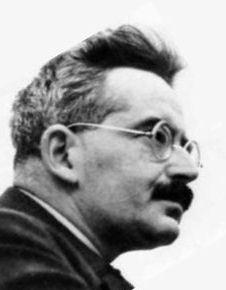
Walter Benjamin
Personal Information
Description
Walter Bendix Schönflies Benjamin was a German-Jewish Marxist philosopher-sociologist, literary critic, translator and essayist. He was at times associated with the Frankfurt School of critical theory. His Marxism was more influenced by Bertolt Brecht, who had developed his own critical aesthetics, which asked for the emotional distancing of the spectator (Verfremdungseffekt). An important earlier influence and friend was Gershom Scholem, who founded the modern, academic study of the Kabbalah and of Jewish mysticism. Over the last half-century the regard for his work and its influence have risen dramatically, making Benjamin one of the most important twentieth century thinkers about literature and about modern aesthetic experience. Source and more information
Books
The work of art in the age of its technological reproducibility, and other writings on media
Berlin childhood around 1900
Berlin Childhood around 1900 remained unpublished during Walter Benjamin's lifetime. Now translated into English for the first time in book form, on the basis of the recently discovered final version that contains the author's own arrangement of a suite of luminous vignettes, it can be more widely appreciated as one of the masterpieces of twentieth-century prose writing. This book is also one of Benjamin's great city texts, bringing to life the cocoon of his childhood--the parks, streets, schoolrooms, and interiors of an emerging metropolis. It reads the city as palimpsest and labyrinth, revealing unexpected lyricism in the heart of the familiar.
The Complete Correspondence, 1928-1940
"The correspondence between Walter Benjamin and Theodor W. Adorno, which appears here for the first time in its entirety in English translation, must rank among the most significant to have come down to us from that notable age of barbarism, the twentieth century. Benjamin and Adorno formed a uniquely powerful pair, Benjamin, riddle-like in his personality and given to tactical evasion, and Adorno full of his own importance, alternately support and compete with each other throughout the correspondence, until its imminent tragic end becomes apparent to both writers. Each had met his match, and happily, in the other. This book is the story of an elective affinity. Adorno was the only person who managed to sustain an intimate intellectual relationship with Benjamin for nearly twenty years. No one else, not even Gershom Scholem, coaxed so much out of Benjamin."--BOOK JACKET. "The more than one hundred letters in this book will allow readers to trace the developing character of Benjamin's and Adorno's attitudes toward each other and toward their many friends."--BOOK JACKET.
Briefe
The correspondence of Walter Benjamin, 1910-1940
Called "the most important critic of his time" by Hannah Arendt, Walter Benjamin has emerged as one of the most compelling thinkers of our time as well, his work assuming a crucial place in current debates over the interactions of art, culture, and meaning. A "natural and extraordinary talent for letter writing was one of the most captivating facets of his nature," writes Gershom Scholem in his Foreword; and indeed, Benjamin's correspondence reveals the evolution of some of his most powerful ideas. Published here in English for the first time, these letters offer an intimate picture of Benjamin himself and the times in which he lived. Written in a day when letters were an important vehicle for the presentation and development of intellectual matters, Benjamin's correspondence is rich in insight into the circumstances behind his often difficult work. . These letters provide a lively view of Benjamin's life and thought from his days as a student to his melancholy experiences as an exile in Paris. As he defends his changing ideas to admiring and skeptical friends - poets, philosophers, and radicals - we witness the restless self-analysis of a creative mind far in advance of his own time. Writing at length to Scholem and Theodor Adorno, and exchanging letters with Rainer Maria Rilke, Hannah Arendt, Hugo von Hofmannsthal, Max Horkheimer, Max Brod, Bertolt Brecht, and Kafka's friend Felix Weltsch, Benjamin elaborates his ideas about metaphor and language. He reflects on literary figures from Kafka to Karl Kraus, the "Jewish Question" and anti-Semitism, Marxism and Zionism. And he expounds his personal attitudes toward such subjects as the role of quotations in criticism, history, and tradition; the meaning of being a "collector"; and French culture and the national character. In sum, this magnificent collection is an exceptionally rich source of information and an essential key to understanding one of the preeminent figures of modern culture.
Selected writings
Correspondance
Passagen-Werk
"Conceived in Paris in 1927 and still in progress in 1940 when Benjamin fled the Nazis, only to find death on the Spanish border. The Arcades Project is his magnum opus: a new theory of history embodied in a new literary and philosophical historiography. With greater concreteness than had ever been achieved in historical narrative, Benjamin's text immerses the reader in the milieu of the Paris arcades - those precursors of today's shopping malls - during the period 1830-1870, when the modern industrial world was taking shape."--BOOK JACKET. "Like the arcades themselves, Benjamin's master-work is a vast montage in which he quotes and reflects on hundreds of topics - fashion, boredom, the collector, advertising, prostitution, photography, the theory of progress. By excavating from printed sources a wealth of details about daily existence in nineteenth-century Paris, Benjamin brings to life a world of things - from luxury goods, building facades, posters, and clothing fashions to barricades, omnibuses, cafes, and exhibition halls."--BOOK JACKET.