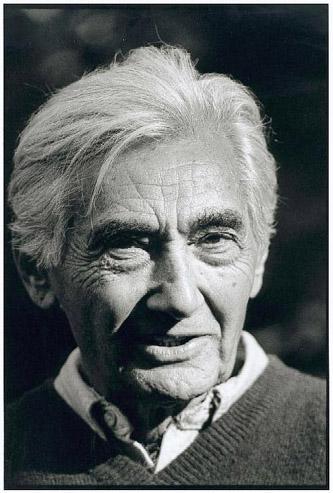
Howard Zinn
Personal Information
Description
Howard Zinn (August 24, 1922 – January 27, 2010) was an American historian, playwright, and socialist thinker. He was chair of the history and social sciences department at Spelman College, and a political science professor at Boston University. Zinn wrote over 20 books, including his best-selling and influential A People's History of the United States. In 2007, he published a version of it for younger readers, A Young People's History of the United States. Zinn described himself as "something of an anarchist, something of a socialist. Maybe a democratic socialist." He wrote extensively about the Civil Rights Movement, the anti-war movement and labor history of the United States. His memoir, You Can't Be Neutral on a Moving Train (Beacon Press, 2002), was also the title of a 2004 documentary about Zinn's life and work. Zinn died of a heart attack in 2010, at age 87. Source: [Howard Zinn]( on Wikipedia.
Books
Essays
Umberto Eco's latest work unlocks the riddles of history in an exploration of the "linguistics of the lunatic," stories told by scholars, scientists, poets, fanatics, and ordinary people in order to make sense of the world. Exploring the "Force of the False," Eco uncovers layers of mistakes that have shaped human history, such as Columbus's assumption that the world was much smaller than it is, leading him to seek out a quick route to the East via the West and thus fortuitously "discovering" America. In a careful unveiling of the fabulous and the false, Eco shows us how serendipities - unanticipated truths - often spring from mistaken ideas. From Leibniz's belief that the I Ching illustrated the principles of calculus to Marco Polo's mistaking a rhinoceros for a unicorn, Eco tours the labyrinth of intellectual history, illuminating the ways in which we project the familiar onto the strange.
Vietnam
Soldiers in revolt
Examines the evidence of increasing discontent within the U.S. armed services during the Vietnam War, discusses what has happened to the military establishment since the war's end, and proposes still further changes to bring the military in line with modern society.
Howard Zinn on War
Howard Zinn on War includes reflections on the Vietnam War, World War II, the recent wars against Iraq and in Kosovo, and on the meaning of war in a world where even the “most advanced” societies have proven themselves incapable of overcoming the primitive predilection for physically attacking their neighbors.In his conclusion to the essay “Just and Unjust War,” Howard Zinn writes, “It remains to be seen how many people in our time will make that journey from war to nonviolent action against war. It is the great challenge of our time: how to achieve justice, with struggle, but without war.” In this powerful collection of new and selected essays, Zinn explores our warring ways over the last hundred years, as well as his own transformation from bombardier to pacifist, from Brooklyn Navy Yard shipfitter to anti-war activist.Howard Zinn on War includes the essays “Violence and Human Nature,” “Non-Violent Direct Action,” “The Bombing of Royan,” “Of Fish and Fisherman,” “A Speech for LBJ,” “Dow Shalt Not Kill,” “Aggressive Liberalism,” “The Curious Chronology of the Mayaguez Incident,” “The CIA, Rockefeller, and the Boys in the Club,” “ What Did Richard Nixon Learn?,” “Machiavellian Realism and U.S. Foreign Policy: Means and Ends,” “Terrorism Over Tripoli;” and others.
Passionate declarations
From the bestselling author of A People's History of the United States comes this selection of passionate, honest, and piercing essays looking at American political ideology.Howard Zinn brings to Passionate Declarations the same astringent style and provocative point of view that led more than a million people to buy his book A People's History of the United States. He directs his critique here to what he calls "American orthodoxies" — that set of beliefs guardians of our culture consider sacrosanct: justifications for war, cynicism about human nature and violence, pride in our economic system, certainty of our freedom of speech, romanticization of representative government, confidence in our system of justice. Those orthodoxies, he believes, have a chilling effect on our capacity to think independently and to become active citizens in the long struggle for peace and justice.
SNCC
Howard Zinn tells the story of one of the most important political groups in American history. SNCC: The New Abolitionists influenced a generation of activists struggling for civil rights and seeking to learn from the successes and failures of those who built the fantastically influential Student Nonviolent Coordinating Committee. It is considered an indispensable study of the organization, of the 1960s, and of the process of social change. Includes a new introduction by the author.
Uncommon sense
The twentieth century
An illustrated history of Greenwich in the Twentieth Century with a detailed introduction and extended captions to the photographs of all the communities that make up the Borough of Greenwich: Deptford, Charlton, Woolwich, Plumstead, Eltham, Shooters Hill, Kidbrooke and Blackheath.
Terrorism and War
New interviews conducted since the tragic events of September 11 and the bombing campaign against Afghanistan, Terrorism and War provides Zinn?s most up-to-date thinking on war, terrorism, and the new global order. Truth, Zinn shows us, has indeed been the first casualty of war, starting from the beginnings of American empire in the Spanish-American War. But war has many other casualties, he argues, including civil liberties on the home front and human rights abroad. In Terrorism and War Zinn explores the growth of the American empire, as well as the long tradition of resistance in this country to U.S. militarism, from Eugene Debs and the Socialist Party during World War One to the opponents of U.S. military intervention in Afghanistan today. Howard Zinn may be America?s most articulate historian of the Left, whose life-long study of the purposes and outcomes of war has been among his most luminous contributions to our ongoing democratic conversation. Formerly a bombardier in World War Two, Zinn has spent decades contrasting the rhetoric governments use to justify wars and the reality of their impact, especially on the civilians who are increasingly the victims of military conflicts.Edited by Anthony Arnove Anthony Arnove is publisher and an editor at South End Press in Cambridge, Massachusetts, and an adjunct professor at Rhode Island College. He is the editor of Iraq Under Siege: The Deadly Impact of Sanctions and War. An activist based in Providence, Rhode Island, he is a member of the International Socialist Organization and the National Writers Union.
Vietnam: the logic of withdrawal
Critical view of the American presence in Vietnam, arguing for withdrawal of military forces.
A People's History of the United States
Known for its lively, clear prose as well as its scholarly research, A People's History of the United States is the only volume to tell America's story from the point of view of -- and in the words of -- America's women, factory workers, African Americans, Native Americans, working poor, and immigrant laborers.
You can't be neutral on a moving train
Acclaimed historian Howard Zinn has been at the center of the most important historical moments of the last thirty years, during which he has been admired both as a writer and as an important political and moral voice. Author of the epic A People's History of the United States, Zinn here applies his historian's skills to the remarkable life he himself has led. In this inspiring, personal book - which works both as memoir and as popular history of an era - Zinn brings to life more than thirty years of American social history by telling the stories behind a politically engaged life. Zinn grew up in the immigrant slums of Brooklyn and flew as a bombardier in World War II, and he writes about the ways both experiences helped shape a radical impulse, an opposition to war, and a passion for history. He writes about his first teaching job at Spelman College, where he worked with young civil rights activists including Alice Walker and Marian Wright Edelman. He paints vivid, portraits of key moments and people throughout the South in the early 1960s, where he was a chronicler and active ally of the civil rights movement. He talks about his days as a leading antiwar protester, going to Vietnam with Daniel Berrigan and testifying in his friend Daniel Ellsberg's Pentagon Papers trial. He recalls imprisonments for civil disobedience, fights for open debate in universities, his love of teaching. Running throughout this personal book is Zinn's charming, generous, engaged voice, as well as a message about history. You Can't Be Neutral on a Moving Train is Zinn's argument for hope - the stories of the people and events that inspire his faith in the possibility of historic change.