
FRANCE AUTHOR · PHILOSOPHY · PSYCHOANALYSIS
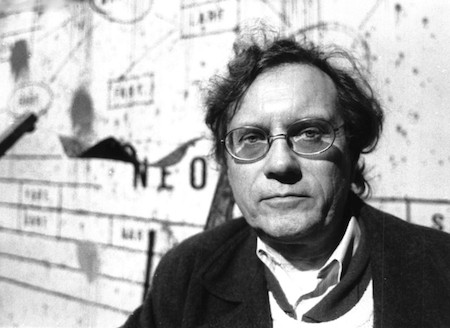
Félix Guattari
Also known as: Félix Guattari, Felix Guattari
Pierre-Félix Guattari (April 30, 1930 – August 29, 1992) was a French psychotherapist, philosopher, semiologist, and activist. He founded both schizoanalysis and ecosophy, and is best known for his intellectual collaborations with Gilles Deleuze, most notably Anti-Oedipus (1972) and A Thousand Plateaus (1980), the two volumes of Capitalism and Schizophrenia. Source: Felix Guattari on Wikipedia (CC BY-SA 3.0).
Two very beautiful naked girls are crouched facing each other.
— from Essays, 1987
Most acclaimed

The three ecologies
"Extending the definition of ecology to encompass social relations and human subjectivity as well as environmental concerns, The Three Ecologies argues that the ecological crises that threaten our planet are the direct result of the expansion of a new form of capitalism and that a new ecosophical approach must be found which respects the differences between all living systems. A powerful critique of capitalism and a manifesto for a new way of thinking, the book is also an ideal introduction to the work of one of Europe's most radical thinkers. This edition includes a chronology of Guattari's life and work, introductions to both his general philosophy and to the work itself, and extended notes to the original text"--
What is philosophy?
Called by many France's leading intellectual, Gilles Deleuze is one of the most important philosophers in the Western world. His acclaimed works and celebrated collaborations with Felix Guattari have established him as a seminal figure in the fields of philosophy, cultural studies, and literary theory. The publication of What Is Philosophy? marks the culmination of Deleuze's career. Deleuze and Guattari situate philosophy in the realm of problems and possibilities. The book presents a revolutionary theory of philosophy and in the process develops a new understanding of the interrelationships among philosophy, science, and the arts. The authors differentiate philosophy from science and the arts, seeing each domain as a means of confronting chaos, and challenging the common view that philosophy is an extension of logic. They discuss the similarities and distinctions between creative and philosophical writing. Fresh anecdotes from the history of philosophy illuminate the book, along with engaging discussions of composers, painters, writers, and architects. . A milestone in Deleuze's collaboration with Guattari, What Is Philosophy? brings new perspectives to Deleuze's studies of cinema, literature, painting, and music, while setting a brilliant capstone upon his intellectual corpus. Newcomers to the two thinkers' writings will relish the book's scope, energy, and inventiveness; veteran followers will appreciate Deleuze and Guattari's fierce determination to grasp the elusive meaning of philosophy in this, their last and most remarkable joint effort.
Essays
1987
The titles of Ralph Waldo Emerson’s essays consist of a range of general concepts such as character, experience, friendship, history, intellect, love, nature, politics, prudence and, most famously, self-reliance. However, in no case is the content of an essay limited to considerations relevant to its title concept. Emerson’s style is digressive and aphoristic, his lengthy paragraphs strewn with terse, dogmatic assertions. The pieces record the diffuse preconceptions and opinions of the author, typically without arguing for them. “Nature,” Emerson’s first published essay, was published independently five years before his first collection of essays. It became a foundational text for transcendentalism, the New England intellectual movement that upheld the divine character of the natural world and the importance of spiritual connection with it. In its emphasis on reason, individual conscience, and innate human goodness, transcendentalism was related to Unitarianism, where Emerson began his career as a minister. While Emerson resigned from this post after only a few years, he retained a lifelong concern with religion and theology that is frequently manifest in his essays. Even in the earlier essays Emerson expresses in passing a general opposition to slavery, but he has sometimes been criticized for remaining aloof from the social issues of his day, and especially from abolition. Emerson’s growing willingness to think and speak about slavery as he aged is visible in the collection; its final essay is a lecture given before the American Anti-Slavery Society. In “Politics,” he includes “emancipat[ing] the slave” alongside befriending the poor, building schools and cherishing the arts in a list of causes that he takes to represent “real good.” Emerson’s essays were especially influential among the members of the Transcendental Club that met in Cambridge, Massachusetts, which included Henry Thoreau among its members. Reading the essays was also instrumental in the literary development of Emerson’s later correspondent Walt Whitman, who in Leaves of Grass aimed to attain the ideal of the American poet described in “The Poet.” In German translation, the essays were read and appreciated by Nietzsche, who chose a quotation from “History” as the epigraph for the first edition of his 1882 book The Gay Science and in the same book named Emerson among the few men he judged to be “masters of prose.” The essays collected here were originally released in two volumes, or “series,” the first in 1841 and the second in 1844. In the original editions, each essay was prefaced by a poem of Emerson’s own authorship. While some of these poems were omitted in later editions, all have been included here.