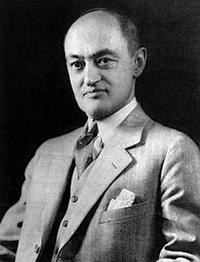
Joseph Alois Schumpeter
Personal Information
Description
Joseph Alois Schumpeter (German: [ˈʃʊmpeːtɐ]; February 8, 1883 – January 8, 1950) was an Austrian political economist. He served briefly as Finance Minister of Austria in 1919. In 1932, he emigrated to the United States to become a professor at Harvard University, where he remained until the end of his career, and in 1939 obtained American citizenship. Schumpeter was one of the most influential economists of the early 20th century, and popularized creative destruction, a term coined by Werner Sombart. His magnum opus is considered to be Capitalism, Socialism and Democracy.
Books
Power or pure economics?
This volume examines the central questions about the nature of economic theory, its historical development and its explanatory power. What determines economic distribution? Can pure economic theory itself explain the fundamentals of distribution or is a broader economics incorporating theories of power in society necessary? The book presents the debate through classic statements of each position from two leading economists of the century, Joseph A. Schumpeter and Yasuma Takata.
Essays
History of Economic Analysis
"At the time of his death in 1950, Joseph Schumpeter - one of the great economists of the first half of the 20th century - was working on his monumental History of Economic Analysis. A complete history of efforts to understand the subject of economics from ancient Greece to the present, this book is an important contribution to the history of ideas as well as to economics. Although never fully completed, it has gained recognition as a modern classic due to its broad scope and original examination of significant historical events." "Complete with a new introduction by Mark Perlman, who outlines the structure of the book and puts Schumpeter's work into current perspective. History of Economic Analysis remains a reflection of Schumpeter's diverse interest in history, philosophy, sociology, and psychology."--Publisher description.
Imperialism [and] Social classes; two essays
Joseph Schumpeter was not a member of the Austrian School, but he was an enormously creative classical liberal, and this 1919 book shows him at his best. He presents a theory of how states become empires and applies his insight to explaining many historical episodes. His account of the foreign policy of Imperial Rome reads like a critique of the US today. The second essay examines class mobility and political dynamics within a capitalistic society. Overall, a very important contribution to the literature of political economy.
Capitalism, Socialism and Democracy
Capitalism, Socialism, and Democracy is a book on economics, sociology, and history by Joseph Schumpeter, arguably one of—if not his most—famous, controversial, and important works. It’s also one of the most famous, controversial, and important books on social theory, social sciences, and economics—in which Schumpeter deals with capitalism, socialism, and creative destruction. It is the third most cited book in the social sciences published before 1950, behind Marx’s Capital and The Wealth of Nations by Adam Smith. (Source: [Wikipedia](
Business Cycles
"First printing, July, 1927.""A rewriting, based on new and fuller statistical material, of his book on 'Business cycles,' published in 1913."--Foreword.
Wirtschaft und Wirtschaftswissenschaft
Series title also at head of t.-p. Contains bibliographies. Volkswirtschaftliche Entwicklungsstufen, von Karl Bücher.--Epochen der dogmen- und Methodengeschichte, von Joseph Schumpeter.--Theorie der Gesellschaftlichen Wirtschaft, von Friedrich freiherrn von Wieser.
Ten great economists from Marx to Keynes
Originally published in 1952, this seminal work is reproduced here with a new introduction by Professor Mark Perlman, a well-known Schumpeterian scholar. Largely unavailable elsewhere, the essays, written between 1910 and 1950, were primarily commemorative pieces marking the achievement of a celebrated economist. Those covered include: Marx Walras Menger Marshall Pareto Bohm-Bawerk Taussig Fisher Mitchell Keynes The appendix includes articles on lesser-known economists Knapp, Von Wieser and Von Bortkiewicz. The new introduction places this work in its contemporary context and highlights its importance for students unfamiliar with the original.