Discover
Jan 22, 1561 — Apr 9, 1626· 65 yrs

KINGDOM OF ENGLAND AUTHOR · EARLY WORKS TO 1800 · SCIENCE

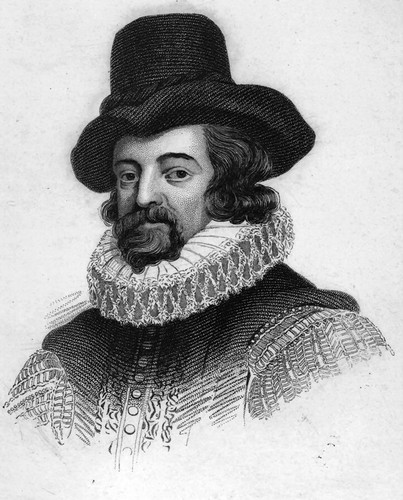
Francis Bacon

Also known as: Francis Bacon Viscount St. Albans, Sir Francis Bacon

38
BOOKS
4.1
AVG RATING (18)
1
READERS

An English philosopher, statesman, scientist, lawyer, jurist and author known as the father of Empiricism.

York House, Strand, Kingdom of England
Wikipedia

I have come to this beautiful, historic city after many years.

— from Selections

Most acclaimed

#2

Works

0.0 (0)

Hippocrates, said to have been born in Cos in or before 460 BCE, learned medicine and philosophy; travelled widely as a medical doctor and teacher; was consulted by King Perdiccas of Macedon and Artaxerxes of Persia; and died perhaps at Larissa. Apparently he rejected superstition in favour of inductive reasoning and the study of real medicine as subject to natural laws, in general and in individual people as patients for treatment by medicines and surgery. Of the roughly 70 works in the Hippocratic Collection," many are not by Hippocrates; even the famous oath may not be his. But he was undeniably the "Father of Medicine."

#1

Novum organum

0.0 (0)

"When The New Organon appeared in 1620, as part of a six-part programme of scientific inquiry entitled 'The Great Renewal of Learning', Francis Bacon was at the high point of his political career, and his ambitious work was groundbreaking in its attempt to give formal philosophical shape to a new and rapidly emerging experimentally based science. Bacon combines theoretical scientific epistemology with examples from applied science, examining phenomena as various as magnetism, gravity and the ebb and flow of the tides, and anticipating later experimental work by Robert Boyle and others. His work challenges the entire edifice of the philosophy and learning of his time, and has left its mark on all subsequent philosophical discussions of scientific method. This volume presents a new translation of the text into modern English by Michael Silverthorne, together with an introduction by Lisa Jardine that sets the work in the context of Bacon's scientific and philosophical activities."--Jacket.
#3

Selections

3.4 (5)

Born in India and considered the leading poet on the South Asian subcontinent, Faiz Ahmed Faiz (1911-1984) was a two-time Nobel nominee and winner of the 1962 Lenin Peace Prize. His evening readings in Hindi/Urdu-speaking regions drew thousands of listeners. Associated with the Communist party in his youth, Faiz became an outspoken poet in opposition to the Pakistani government. He was also a professor of English literature, a distinguished editor and a major figure in the Afro-Asian writer's movement. This volume offers a selection of Faiz's poetry in a bilingual Urdu/English edition with a new introduction by poet and translator Agha Shahid Ali.

Books

Newest First
