
RUSSIAN SOCIALIST FEDERATIVE SOVIET REPUBLIC AUTHOR · COMMUNISM · POLITICS AND GOVERNMENT
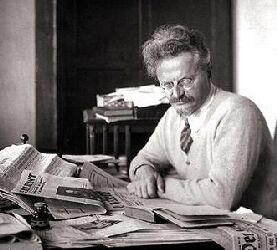
Leon Trotsky
Also known as: Лев Давидович Троцкий, Лев Давидович Троцький
Lev Davidovich Trotsky (né Bronstein; 7 November [O.S. 26 October] 1879 – 21 August 1940), better known as Leon Trotsky, was a Russian revolutionary, Soviet politician and political theorist. He was a key figure in the 1905 Revolution, October Revolution of 1917, Russian Civil War, and the establishment of the Soviet Union, from which he was exiled in 1929 before his assassination in 1940. Trotsky and Vladimir Lenin were widely considered the two most prominent figures in the Soviet state from 1917 until Lenin's death in 1924. Ideologically a Marxist and a Leninist, Trotsky's ideas and beliefs inspired a school of Marxism known as Trotskyism. Trotsky joined the Russian Social Democratic Labour Party in 1898, being arrested and exiled to Siberia for his activities.
When Stalin was long established in Moscow as the ruler of a vast, largely Russian empire, his young son told his even younger daughter, 'You know, Papa used to be a Georgian once' The comment is true.
— from Stalin
Most acclaimed

Stalin
"A magnificent new biography that revolutionizes our understanding of Stalin and his world. It has the quality of myth: a poor cobbler's son, a seminarian from an oppressed outer province of the Russian empire, reinvents himself as a top leader in a band of revolutionary zealots. When the band seizes control of the country in the aftermath of total world war, the former seminarian ruthlessly dominates the new regime until he stands as absolute ruler of a vast and terrible state apparatus, with dominion over Eurasia. While still building his power base within the Bolshevik dictatorship, he embarks upon the greatest gamble of his political life and the largest program of social reengineering ever attempted: the collectivization of all agriculture and industry across one sixth of the earth. Millions will die, and many more millions will suffer, but the man will push through to the end against all resistance and doubts. Where did such power come from? In Stalin, Stephen Kotkin offers a biography that, at long last, is equal to this shrewd, sociopathic, charismatic dictator in all his dimensions. The character of Stalin emerges as both astute and blinkered, cynical and true believing, people oriented and vicious, canny enough to see through people but prone to nonsensical beliefs. We see a man inclined to despotism who could be utterly charming, a pragmatic ideologue, a leader who obsessed over slights yet was a precocious geostrategic thinker--unique among Bolsheviks--and yet who made egregious strategic blunders. Through it all, we see Stalin's unflinching persistence, his sheer force of will--perhaps the ultimate key to understanding his indelible mark on history. Stalin gives an intimate view of the Bolshevik regime's inner geography of power, bringing to the fore fresh materials from Soviet military intelligence and the secret police. Kotkin rejects the inherited wisdom about Stalin's psychological makeup, showing us instead how Stalin's near paranoia was fundamentally political, and closely tracks the Bolshevik revolution's structural paranoia, the predicament of a Communist regime in an overwhelmingly capitalist world, surrounded and penetrated by enemies. At the same time, Kotkin demonstrates the impossibility of understanding Stalin's momentous decisions outside of the context of the tragic history of imperial Russia. The product of a decade of intrepid research, Stalin is a landmark achievement, a work that recasts the way we think about the Soviet Union, revolution, dictatorship, the twentieth century, and indeed the art of history itself"--
Selected works
1959
Since his first play, And Things That Go Bump in the Night, which premiered in 1965, McNally has proven himself to be a trailblazing figure and unique voice in American theater, known for his exploration of gay themes and his chronicling of America's changing social attitudes over the past fifty years. His thirty-three plays, nine musicals, three operas, and seven scripts for film and television, are a testament to his astonishing commitment to writing. In Selected Plays, for the very first time, McNally collects a set of eight plays that he considers the most important of his oeuvre, including the Tony-nominated Mothers and Sons and the critically acclaimed And Away We Go, neither of which have been previously published. Introducing each play with a personal essay that recounts an anecdote or discusses an aspect of the play that proceeds it, McNally himself frames his own life in the theater. Selected Plays is a landmark publication, a memoir in plays from one of America's most highly regarded and best-loved playwrights.