Discover

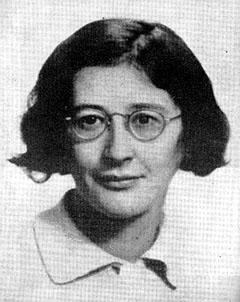
Simone Weil

Personal Information

Born February 3, 1909
Died August 24, 1943 (34 years old)
Paris, France
Also known as: SIMONE WEIL, Weil, Simone, 1900-1943.
32 books
4.0 (7)
225 readers

Description

French philosopher, Christian mystic, and social activist

Books

Newest First

Œuvres

Jan Potocki, Sophie, comtesse de Ségur, Antoine Laurent Lavoisier, Joseph Louis Lagrange, James Joyce, Jean François Paul de Gondi de Retz, Lewis Carroll, Paul-Louis Courier, Antoine Léonard Thomas, Stéphane Mallarmé, Nicolas Malebranche, Henri Hymans, Jean Paul Marat, Rosa Luxemburg, Mikhail Aleksandrovich Bakunin, Arthur, comte de Gobineau, Lucius Accius, Arthur Rimbaud, Bernardin de Saint-Pierre, Achille Mbembe, Rudyard Kipling, Pierre Augustin Caron de Beaumarchais, Charles-Louis de Secondat baron de La Brède et de Montesquieu, François duc de La Rochefoucauld, Paul de Kock, Francis de Sales, Lucian of Samosata, Jacques Maritain, Philo of Alexandria, 谷崎潤一郎, Magali Bessone, Henri-Dominique Lacordaire, Simone Weil, Alexis de Tocqueville, François Villon, Bartolomé de las Casas, Jean de La Bruyère, Jean de La Fontaine, Louis Pasteur, Alphonse de Lamartine, Gérard de Nerval, Jacques Bénigne Bossuet, Pierre Maine de Biran, Camille Desmoulins, Turgot, Claude Joseph Dorat, Henri Poincaré, Olympe de Gouges, Jean-Pierre Vernant, Emile Coué, Marquis de Sade, Jean-Pierre Serre, Emmanuel Mounier, Denis Diderot, Friedrich Nietzsche, Gustave Flaubert, Armand Borel, Teresa of Avila, Joseph Conrad, Molière, Gérard Desargues, Alphonse Daudet, Jean-Baptiste Massillon, Frantz Fanon, Ernst Troeltsch, François Rabelais, Emil Cioran, Anatole France, Henri Bergson, François de Salignac de La Mothe-Fénelon, Charles Augustin Sainte-Beuve, Proudhon M., Pierre Corneille, Edmé Mariotte
0.0 (0)
0

Œuvres complètes

Émile Zola, Etienne Bonnot de Condillac, Ivan Illich, André Chénier, André Malraux, Saint-John Perse, Stéphane Mallarmé, René Char, Joris-Karl Huysmans, Julien Green, Nicolas Malebranche, Honoré Daumier, Antonin Artaud, Auguste comte de Villiers de L'Isle-Adam, Mikhail Aleksandrovich Bakunin, Arthur Rimbaud, Stéphanie Félicité, comtesse de Genlis, Paul Éluard, Flavius Josephus, Pierre de Bérulle, Jean-Georges Lefranc de Pompignan, Saint Bernard of Clairvaux, H. R. Casgrain, Louis Armand de Lom d'Arce baron de Lahontan, Joachim Trotti de La Chétardie, Jules Michelet, Marie de Gournay, Cyrano de Bergerac, Augustin Louis Cauchy, François-René de Chateaubriand, P. J. G. Cabanis, William Robertson, Augustine of Hippo, X. Barbier de Montault, Henri-Dominique Lacordaire, Isabelle de Charrière, Jean-Louis Petit, Simone Weil, Alexis de Tocqueville, Maximilien Robespierre, Georges Bataille, Georges Canguilhem, Octave Crémazie, Pierre Reverdy, André Breton, J. S. Stas, Charles Rollin, Jean de La Bruyère, Benedictus de Spinoza, Dominique François Jean Arago, Honoré de Balzac, Roland Barthes, Sigmund Freud, Henri Michaux, Helvétius, Pierre de Ronsard, Madame de La Fayette, Victor Segalen, Bernard Le Bovier de Fontenelle, Maurice Blondel, Charles Baudelaire, Jean-Jacques Rousseau, Jean Gerson, George Sand, Charles Fourier, Thomas Jan Stieltjes, Jean Meslier, Louis Bourdaloue, Montaigne, Michel de, Boileau, Xavier de Maistre, Irène Némirovsky, Jean-Joseph Rabearivelo, Adam de La Halle, Isabelle Eberhardt, Esdras Minville, Dante Alighieri, Joseph de Maistre, Louis Auguste Blanqui, Teresa of Avila, Luc de Clapiers marquis de Vauvenargues, Jacques Prévert, Alfred de Vigny, Alfred Jarry, Saʻadia ben Joseph, Christiaan Huygens, François Rabelais, Jacques Roumain, Blaise Pascal, Pierre Corneille, Gabriel Bonnot de Mably, Hippocrates, Henri Marie Boudon, Saint-Just
0.0 (0)
1

Essays

Jeremy Collier, Umberto Eco, H. I. D. Ryder, Arthur Penrhyn Stanley, Walter Kasper, Béla Bartók, Clement Mansfield Ingleby, John Fiske, John Dalberg-Acton, 1st Baron Acton, Jean-Luc Nancy, Michael Pye, Octavio Paz, Sayyid Aḥmad K̲h̲ān̲, Joseph Addison, Algirdas Julien Greimas, Евгений Иванович Замятин, Henry F. (Henry Francis) Pelham, Arthur Christopher Benson, Grant, Percy Stickney, Charles Carroll Everett, Jean François Lyotard, Herbert Spencer, Raymond Williams, William Hazlitt, Giorgio Agamben, Alfred Kerr, Aleksandr Aleksandrovich Blok, William Butler Yeats, William Graham Sumner, Allen Tate, James Beattie, J. H. Plumb, William Godwin, Francis Bacon, Henry David Thoreau, Henry Thomas Buckle, Arthur Schopenhauer, Herman Friedrich Grimm, John Addington Symonds, James Hadley, James Laughlin, Joseph Isaac Schneersohn, Irving Howe, E. M. W. Tillyard, Benjamin Rush, Plutarch, Morton Feldman, Simone Weil, Ralph Waldo Emerson, Howard Zinn, Ellen Key, Salisbury, Robert Cecil marquess of, J. Logie Robertson, Oliver Goldsmith, Thomas Henry Huxley, Arnold Zweig, Hugh Miller, Mackenzie, Morell Sir, George Orwell, Bing Xin, Roland Barthes, Errico Malatesta, George John Romanes, Parsons, Theophilus, Alice Meynell, Alejo Carpentier, Charles Baudelaire, Jacques Barzun, James Huneker, Thomas Paine, Thomas Merton, Jean-Paul Sartre, Montaigne, Michel de, David Hume, Paul Valéry, Félix Guattari, Wilhelm Max Wundt, Christopher Hill, Shen, Congwen, Italo Calvino, Robert Morgan, James Martineau, Abūlkalām Āzād, Friedrich Schiller, Rosemond Tuve, René Descartes, Immanuel Kant, Joseph Alois Schumpeter, Carl Gustav Jung, John Henry Newman, Thomas De Quincey, Virginia Woolf, Matthew Arnold, Frederic William Henry Myers, Ernst Troeltsch, Martin Buber, Hermann Bahr, Thomas Mann, Charles Augustin Sainte-Beuve, Jonathan Franzen, Samuel Johnson, Anscombe, G. E. M., Charles Lamb, George Brimley, John Abercrombie, Thomas Monro, Hubert Bland
0.0 (0)
1

Oppression et liberté

3.0 (1)
17

Dans le présent recueil qui réunit les études consacrées par Simone Weil à la critique sociale et politique, les Réflexions sur les causes de la liberté et de l'oppression sociale développent le raisonnement principal, qui commande tous les autres parce qu'il a été le souci privilégié de l'auteur, le tourment qui n'a jamais quitté Simone Weil, même, et surtout, à l'intérieur de sa pensée religieuse:le tourment de l'injustice. Depuis Marx, en tout cas, dont la doctrine est d'ailleurs longuement examinée ici, la pensée politique et sociale n'avait rien produit en Occident de plus pénétrant et de plus prophétique. Simone Weil a elle-même considéré les Réflexions sur les causes de la liberté et de l'oppression sociale comme son oeuvre principale. Ce texte a été écrit en 1934. ([Éditions Gallimard](

The Simone Weil reader

0.0 (0)
10

The immediate and guiding aim of this book is to introduce the contemporary reader to the work and thought of Simone Weil.

Simone Weil's The Iliad, or, The poem of force

0.0 (0)
0

"Simone Weil, a brilliant young teacher, philosopher, and social activist, wrote the essay, The Iliad or the Poem of Force in France at the beginning of World War II. Her profound meditation on the nature of violence provides a remarkably vivid and accessible testament of the Greek epic's continuing relevance to our lives. The work appears here for the first time in a bilingual version, based on the text of the authoritative edition of the author's complete writings. An introduction discusses the significance of the essay both in the evolution of Weil's thought and as a distinctively iconoclastic contribution to Homeric studies. The commentary draws on recent interpretations of the Iliad and examines the parallels between Weil's version of Homer's warriors and the experiences of modern soldiers."--Jacket.
