
ANCIENT ROME AUTHOR · EARLY WORKS TO 1800 · HISTORY
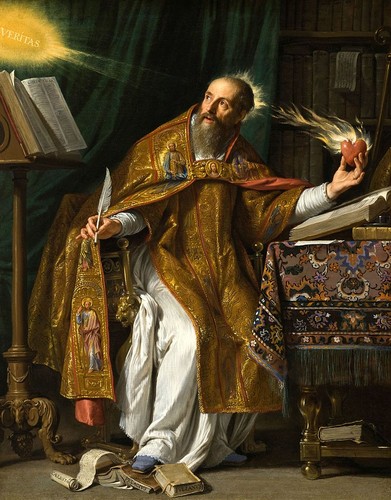
Augustine of Hippo
Also known as: Augustine Saint, Bishop of Hippo, Augustine Saint, Bishop of Hippo.
Augustine was born in Thagaste (present-day Souk Ahras, Algeria), a provincial Roman city in North Africa, the son of a Catholic mother and pagan father. He was raised a Catholic, and at age of 11, he went to school at Madaurus, about 19 miles south of Thagaste. There he learned both Latin literature and pagan beliefs and practices. He returned home in 369 and stayed for about two yeras, reading Cicero's dialogue Hortensius. At age 17 he went to Carthage to continue his education in rhetoric. He decided to follow the Manichaean religion, lived a hedonistic lifestyle for a time, and took a lover who stayed with him for over thirteen years and gave birth to his son. In 373-374, Augustine taught grammar at Tagaste. In 375 he moved to Carthage to conduct a school of rhetoric. In 383 he moved to Rome to establish another school. However, he was disappointed with the Roman schools, and instead of paying their fees, his students fled. Through his friends he obtained a professorship teaching rhetoric at the imperial court at Milan in 384. The young provincial won the job and headed north to take up his position in late 384. While in Rome, he turned away from Manichaeanism in favour of the skepticism of the New Academy movement. He became engaged and left his lover, but never married the girl to whom he had been engaged. In 386, converted to Catholic Christianity, left his career in rhetoric, devoted himself to serving God. He returned to north Africa, sold his patrimony and gave the money to the poor, and converted his family house into a monastic foundation. In 391 he was ordained a priest in Hippo Regius (now Annaba, Algeria). He became a famous preacher, and in 396 he was made assistant bishop and then full bishop shortly after. He left his monastery, but continued to lead a monastic life in the episcopal residence, and he remained Bishop of Hippo until his death in 430. Augustine was one of the most prolific authors of his time in surviving works, which number more than a hundred. Of these, the most well known is his Confessiones, written in 397-398.
i (1) 'You are great, Lord, and highly to be praised (Ps. 47: 2): great is your power and your wisdom is immeasurable' (Ps. 146:5).
— from Confessions
Most acclaimed

City of God
"EL Doctorow's City of God starts off not merely with a bang but with the big bang itself, that "great expansive flowering, a silent flash into being in a second or two of the entire outrushing universe". It doesn't remain on this cosmic plane throughout. There's a mystery here, along with a romance, a chilling Holocaust narrative and a deep-focus portrait of fin-de-siécle Manhattan. In the early pages of the novel, an enormous brass cross is pilfered from a church on the Lower East Side. Father Thomas Pemberton of St Timothy's promptly sets off in search of it, dubbing himself the Divinity Detective. Yet he suspects from the start that this is no ordinary theft, with no ordinary solution. The cross eventually turns up on the roof of the Synagogue for Evolutionary Judaism, a tiny Manhattan institution to which Pemberton has clearly been led by fate. His encounter with the synagogue's rabbinical duo -- a husband-and-wife team struggling to reclaim a pre-scriptural state of "unmediated awe"--Transforms his life. It also destroys what's left of his conventional Christian belief. As his relationship with Judaism deepens, he discards the clerical collar altogether and embarks upon a penitential exploration of the Holocaust -- which in turn allows Doctorow to loop his narrative back and forth between several generations of (mostly) Jew and Gentile. City of God is a marvellous hybrid which includes a meta-fictional framework (i.e., an author-as-character with a rather Doctorovian CV), an ongoing rumination on city life and a dozen other major strands and minor players. There is an undeniable power to the way Doctorow makes his fictional worlds collide, setting off all manner of historical and philosophical conflagrations. At one point he imagines "the totality of intimate human narrations/composing a hymn to enlightenment/if that were possible". A tall order, yes. But despite its occasional longueurs, City of God suggests that it is possible indeed." -- from www.amazon.co.uk (Jan. 30, 2011).