
KINGDOM OF GREAT BRITAIN AUTHOR · POLITICAL SCIENCE · HISTORY
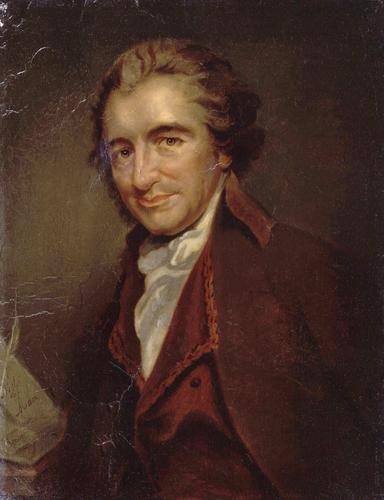
Thomas Paine
Also known as: Tom Paine
Thomas Paine (born Thomas Pain, February 9, 1737 [O.S. January 29, 1736] – June 8, 1809; ) was an English-born American Founding Father, inventor, political philosopher, and statesman. His pamphlets Common Sense (1776) and The American Crisis (1776–1783) framed the Patriot argument for independence from Great Britain at the outset of the American Revolution. Paine advanced Enlightenment-era arguments for human rights that shaped revolutionary discourse on both sides of the Atlantic. Born in Thetford, Norfolk, Paine immigrated to the British American colonies in 1774 with the help of Benjamin Franklin, arriving in time to participate in the American Revolution. Virtually every American Patriot read his 47-page pamphlet Common Sense, which catalyzed the call for independence from Great Britain.
Two very beautiful naked girls are crouched facing each other.
— from Essays, 1987
Most acclaimed

Prentice Hall Literature--Timeless Voices, Timeless Themes--The American Experience
Modern Biblical criticism (as opposed to pre-Modern criticism) is the use of critical analysis to understand and explain the Bible without appealing to the supernatural. During the eighteenth century, when it began as historical-biblical criticism, it was based on two distinguishing characteristics: (1) the scientific concern to avoid dogma and bias by applying a neutral, non-sectarian, reason-based judgment to the study of the Bible, and (2) the belief that the reconstruction of the historical events behind the texts, as well as the history of how the texts themselves developed, would lead to a correct understanding of the Bible. This sets it apart from earlier, pre-critical methods; from the anti-critical methods of those who oppose criticism-based study; from the post-critical orientation of later scholarship; and from the multiple distinct schools of criticism into which it evolved in the late twentieth and early twenty-first centuries. The emergence of biblical criticism is most often attributed by scholars to the German Enlightenment (c. 1650 – c. 1800), but some trace its roots back further, to the Reformation. Its principal scholarly influences were rationalist and Protestant in orientation; German pietism played a role in its development, as did British deism.
Words of Ages
Explorers and early settlers -- The general history of Virginia, New England, and the Summer Isles / John Smith -- The history and present state of Virginia / Robert Beverley -- Of Plymouth Plantation / William Bradford -- "A model of Christian charity" / John Winthrop -- "In memory of my dear grandchild Anne Bradstreet" / Anne Bradstreet -- "The minister's black veil" / Nathaniel Hawthorne -- Voices of a revolution -- "Sinners in the hands of an angry God" / Jonathan Edwards -- "The way to wealth" / Benjamin Franklin -- "Considerations on keeping Negroes" / John Woolman -- "The last of the Mohicans: a narrative of 1757" / James Fenimore Cooper -- Common sense / Thomas Paine -- Declaration of independence / Thomas Jefferson -- personal letters / John Adams & Abigail Adams -- The search for a national identity -- "On the emigration to America and peopling the western country" / Philip Freneau -- "Federalist no.2" / John Jay -- "The interesting narrative of the life of Olaudah Equiano" / Olaudah Equiano -- The history of the Lewis and Clark expedition / Meriwether Lewis & William Clark -- A tour on the prairies / Washington Irving -- "Tecumseh's plea to the Choctaws and the Chickasaws" / Tecumseh -- The shackles of power: three Jeffersonian decades / John Dos Passos. A confident nation -- "The young American" / Ralph Waldo Emerson -- "Resistance to civil government" / Henry David Thoreau -- Woman in the nineteenth century / Margaret Fuller -- "Great are the myths" / Walt Whitman -- "Annexation" / John L. O'Sullivan -- Personal memoirs / Juan Nepomuceno Seguin -- Slavery and the abolition movement -- Narrative of the life of Frederick Douglass / Frederick Douglass -- Incidents in the life of a slave girl / Harriet Jacobs -- Uncle Tom's cabin / Harrriet Beecher Stowe -- Sociology for the South / George Fitzhugh -- "Appeal to the Christian women of the South" / Angelina Grimke Weld -- "The hunters of men" / John Greenleaf Whittier -- Civil war and reconstruction -- "The portent" / Herman Melville -- The red badge of courage: an episode of the American Civil War / Stephen Crane -- "Hospital sketches" / Louisa May Alcott -- "O Captain! My Captain!" / Walt Whitman -- "Up from slavery" / Booker T. Washington -- The souls of Black folk / W.E.B. DuBois. Industrializing America -- The closing of the frontier -- O pioneers! / Willa Cather -- "Chiquita" / Bret Harte -- The life and adventure of Nat Love, better known in the cattle country as Deadwood Dick / Nat Love -- "Kansas I" / A Mexican Folk Ballad -- "The passing of the buffalo" / Hamlin Garland -- Black Elk speaks / Black Elk -- Artists render industrialization and urbanization -- "What the engines said" / Bret Harte -- "Life in the iron mills" / Rebecca Harding Davis -- The age of innocence / Edith Wharton -- "Proem: to Brooklyn Bridge" / Hart Crane -- Yekl: a tale of the New York ghetto / Abraham Cahan -- "Chicago" / Carl Sandburg -- Social critics and reformers -- "We are all bound up together" / Francis E. Watkins Harper -- Eighty years and more: reminiscences 1815-1897 / Elizabeth Cady Stanton -- "A church mouse" / Mary Wilkins Freeman -- Huckleberry Finn / Samuel L. Clemens -- The shame of the cities / Lincoln Steffens -- The jungle / Upton Sinclair. Americans abroad and World War I -- The portrait of a lady / Henry James -- "The white man's burden" / Rudyard Kipling -- "The real 'white man's burden'" / Ernest Crosby -- "Hallelujahs" / Jose de Diego -- One of ours / Willa Cather -- "next to of course god america i" / E. E. Cummings -- Democracy and adversity -- The jazz age -- The great Gatsby / F. Scott Fitzgerald -- "Song of perfect propriety" / Dorothy Parker -- The flivver king / Upton Sinclair -- Jazz / Toni Morrison -- "The weary blues" / Langston Hughes -- Their eyes were watching God / Zora Neale Hurston -- The Great Depression and the New Deal -- The big money / John Dos Passos -- Waiting for Lefty / Clifford Odets -- "Women on the breadlines" / Meridel LeSueur -- The grapes of wrath / John Steinbeck -- "Colonial Park" / Ralph Ellison -- "Proud day" / Genevieve Taggard. World War II -- "Freedom" / E. B. White -- Battle cry / Leon Uris -- Farewell to Manzanar / Jeanne Wakatsuki Houston and James D. Houston -- "Apostrophe to the land" / Countee Cullen -- The face of war / Martha Gellhorn -- Night / Elie Wiesel -- Hiroshima / John Hershey -- The challenges of power -- Prosperity and anxiety -- An American childhood / Annie Dillard -- The man in the gray flannel suit / Sloan Wilson -- On the road / Jack Kerouac -- Coming of age in Mississippi / Anne Moody -- The cruicible / Arthur Miller -- The right stuff / Tom Wolfe -- Rights and revolutions -- "Letter from a Birmingham jail" / Martin Luther King, Jr. -- "Message to the grass roots" / Malcolm X -- "Why I want a wife" / Judy Brady -- The house on Mango Street / Sandra Cisneros -- Lakota woman / Mary Crow Dog -- "Blowin' in the wind" / Bob Dylan -- The Vietnam years -- One very hot day / David Halberstam -- Going after Cacciato / Tim O'Brien -- "Life at war" / Denise Levertov -- American pastoral / Philip Roth -- "Letters from my father" / Robert Olen Butler.
Essays
1987
The titles of Ralph Waldo Emerson’s essays consist of a range of general concepts such as character, experience, friendship, history, intellect, love, nature, politics, prudence and, most famously, self-reliance. However, in no case is the content of an essay limited to considerations relevant to its title concept. Emerson’s style is digressive and aphoristic, his lengthy paragraphs strewn with terse, dogmatic assertions. The pieces record the diffuse preconceptions and opinions of the author, typically without arguing for them. “Nature,” Emerson’s first published essay, was published independently five years before his first collection of essays. It became a foundational text for transcendentalism, the New England intellectual movement that upheld the divine character of the natural world and the importance of spiritual connection with it. In its emphasis on reason, individual conscience, and innate human goodness, transcendentalism was related to Unitarianism, where Emerson began his career as a minister. While Emerson resigned from this post after only a few years, he retained a lifelong concern with religion and theology that is frequently manifest in his essays. Even in the earlier essays Emerson expresses in passing a general opposition to slavery, but he has sometimes been criticized for remaining aloof from the social issues of his day, and especially from abolition. Emerson’s growing willingness to think and speak about slavery as he aged is visible in the collection; its final essay is a lecture given before the American Anti-Slavery Society. In “Politics,” he includes “emancipat[ing] the slave” alongside befriending the poor, building schools and cherishing the arts in a list of causes that he takes to represent “real good.” Emerson’s essays were especially influential among the members of the Transcendental Club that met in Cambridge, Massachusetts, which included Henry Thoreau among its members. Reading the essays was also instrumental in the literary development of Emerson’s later correspondent Walt Whitman, who in Leaves of Grass aimed to attain the ideal of the American poet described in “The Poet.” In German translation, the essays were read and appreciated by Nietzsche, who chose a quotation from “History” as the epigraph for the first edition of his 1882 book The Gay Science and in the same book named Emerson among the few men he judged to be “masters of prose.” The essays collected here were originally released in two volumes, or “series,” the first in 1841 and the second in 1844. In the original editions, each essay was prefaced by a poem of Emerson’s own authorship. While some of these poems were omitted in later editions, all have been included here.