
ANCIENT ROME AUTHOR · EARLY WORKS TO 1800 · TRANSLATIONS INTO ENGLISH
Cicero
Also known as: Marcus Tullius Cicero, M. Tullius Cicero
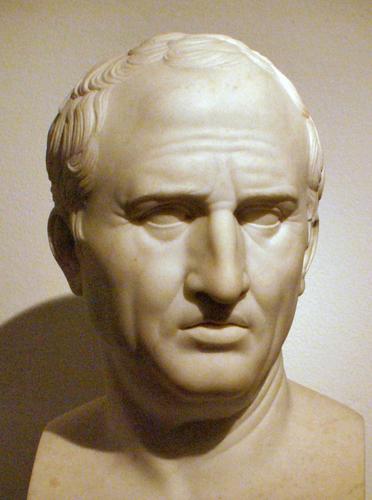
Marcus Tullius Cicero (pronounced /ˈsɪsɨroʊ/; Classical Latin: [ˈkikeroː]; January 3, 106 BC – December 7, 43 BC) was a Roman philosopher, statesman, lawyer, political theorist, and Roman constitutionalist. He came from a wealthy municipal family of the equestrian order, and is widely considered one of Rome's greatest orators and prose stylists. He introduced the Romans to the chief schools of Greek philosophy and created a Latin philosophical vocabulary (with neologisms such as humanitas, qualitas, quantitas, and essentia) distinguishing himself as a linguist, translator, and philosopher. An impressive orator and successful lawyer, Cicero thought that his political career was his most important achievement. Today, he is appreciated primarily for his humanism and philosophical and political writings. His voluminous correspondence, much of it addressed to his friend Atticus, has been especially influential, introducing the art of refined letter writing to European culture. Cornelius Nepos, the 1st-century BC biographer of Atticus, remarked that Cicero's letters contained such a wealth of detail "concerning the inclinations of leading men, the faults of the generals, and the revolutions in the government" that their reader had little need for a history of the period. Cicero's speeches and letters remain some of the most important primary sources that survive on the last days of the Roman Republic. During the chaotic latter half of the first century B.C. marked by civil wars and the dictatorship of Gaius Julius Caesar, Cicero championed a return to the traditional republican government. However, his career as a statesman was marked by inconsistencies and a tendency to shift his position in response to changes in the political climate. His indecision may be attributed to his sensitive and impressionable personality; he was prone to overreaction in the face of political and private change. "Would that he had been able to endure prosperity with greater self-control and adversity with more fortitude!" wrote C. Asinius Pollio, a contemporary Roman statesman and historian. Cicero became an enemy of Mark Antony, attacking him in a series of speeches. He was proscribed an enemy of the state by the Second Triumvirate and subsequently murdered in 43 BC. Source: Wikipedia
"I just don't want to argue about it."
— from How to Win an Argument
Most acclaimed

Epistolae ad familiares
CICEREO was a prodigious letter writer, and happily a splendid treasury of his letters has come down to us. Collected and in part published not long after his death, over 800 of them were rediscovered by Petrarch and other Italian humanists in the fourteenth century. Among classical texts this correspondence is unparalleled: nowhere else do we get such an intimate look at the life of a prominent Roman and his social world, or such a vivid sense of a momentous period in Roman history, years marked by the rise of Julius Caesar and the downfall of the Republic. The 435 letters collected here represent Ciceros correspondence with friends and acquaintances over a period of twenty years, from 62 BC, when Ciceros political career was at its peak, to 43, the year he was put to death by the forces of Octavian and Mark Antony. They range widely in substance and style, from official dispatches and semi-public letters of political importance to casual notes that chat with close friends about travels and projects, domestic pleasures and books, and questions currently debated. This new Loeb Classical Library edition of the Letters to Friends, in three volumes brings together D.R. Shackleton Baileys standard Latin text, now updated, and a revised version of his much admired translation first published by Penguin Books. This authoritative edition complements the new Loeb edition of Ciceros Letters to Atticus, also translated by Shackleton Bailey.
[Opera]
The book introduces opera and analyzes eight masterpieces: "Don Giovanni" by Mozart, "Dido and Aeneas" by Purcell, "The Barber of Seville" by Rossini, "Rigoletto" by Verdi, "The mastersingers of Nuremberg" by Wagner, "Boris Godunov" by Mussorgsky, "Carmen" by Bizet, and "Tosca" by Puccini. The cd contains key songs from each opera that are broken into "timelines" in the text.
Selected works
1959
Since his first play, And Things That Go Bump in the Night, which premiered in 1965, McNally has proven himself to be a trailblazing figure and unique voice in American theater, known for his exploration of gay themes and his chronicling of America's changing social attitudes over the past fifty years. His thirty-three plays, nine musicals, three operas, and seven scripts for film and television, are a testament to his astonishing commitment to writing. In Selected Plays, for the very first time, McNally collects a set of eight plays that he considers the most important of his oeuvre, including the Tony-nominated Mothers and Sons and the critically acclaimed And Away We Go, neither of which have been previously published. Introducing each play with a personal essay that recounts an anecdote or discusses an aspect of the play that proceeds it, McNally himself frames his own life in the theater. Selected Plays is a landmark publication, a memoir in plays from one of America's most highly regarded and best-loved playwrights.