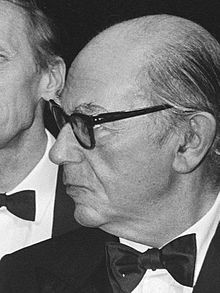
Isaiah Berlin
Personal Information
Description
Sir Isaiah Berlin (6 June 1909 – 5 November 1997) was a Russian-British social and political theorist, philosopher and historian of ideas. Although averse to writing, his improvised lectures and talks were recorded and transcribed, with his spoken word being converted by his secretaries into his published essays and books. Source: [Isaiah Berlin]( on Wikipedia.
Books
Selected writings
Four Essays on Liberty
The four essays are 'Political Ideas in the Twentieth Century'; Historical Inevitability', which the Economist described as a magnificent assertion of the reality of human freedom, of the role of free choice in history'; Two Concepts of Liberty', a ringing manifesto for pluralism and individual freedom; and John Stuart Mill and the Ends of Life'. There is also a long and masterly introduction written specially for this collection, in which the author replies to his critics
Russian Thinkers
Few, if any, English-language critics have written as perceptively as Isaiah Berlin about Russian thought and culture. Russian Thinkers is his unique meditation on the impact that Russia's outstanding writers and philosophers had on its culture. In addition to Tolstoy's philosophy of history, which he addresses in his most famous essay, 'The Hedgehog and the Fox,' Berlin considers the social and political circumstances that produced such men as Herzen, Bakunin, Turgenev, Belinsky, and others of the Russian intelligentsia, who made up, as Berlin describes, 'the largest single Russian contribution to social change in the world.' (Source: [Penguin Books](
Karl Marx
The hedgehog and the fox
"The fox knows many things, but the hedgehog knows one big thing." This ancient Greek aphorism, preserved in a fragment from the poet Archilochus, describes the central thesis of Isaiah Berlin's masterly essay on Leo Tolstoy and the philosophy of history, the subject of the epilogue to War and Peace. Although there have been many interpretations of the adage, Berlin uses it to mark a fundamental distinction between human beings who are fascinated by the infinite variety of things and those who relate everything to a central, all-embracing system. Applied to Tolstoy, the saying illuminates a paradox that helps explain his philosophy of history: Tolstoy was a fox, but believed in being a hedgehog. One of Berlin's most celebrated works, this extraordinary essay offers profound insights about Tolstoy, historical understanding, and human psychology. This new edition features a revised text that supplants all previous versions, English translations of the many passages in foreign languages, a new foreword in which Berlin biographer Michael Ignatieff explains the enduring appeal of Berlin's essay, and a new appendix that provides rich context, including excerpts from reviews and Berlin's letters, as well as a startling new interpretation of Archilochus's epigram.
Two concepts of liberty
«Dos conceptos de libertad» es una defensa del pluralismo y de la libertad individual. La obra del filósofo Isaiah Berlin (1909-1997) es una de las más firmes defensas del pluralismo occidental. Su famoso ensayo 'Dos conceptos de libertad' ofrece una introducción accesible a su pensamiento. El incisivo análisis de Berlin sobre el concepto de libertad sigue determinando nuestro pensamiento sociopolítico actual.
Flourishing
"When this volume opens Berlin is eighteen, a pupil at St. Paul's School in London. He becomes an undergraduate at Oxford, then a Fellow of All Souls, where he writes his celebrated biography of Karl Marx. When that is complete he moves to New College to teach philosophy, and after the outbreak of the Second World War sails to America in somewhat mysterious circumstances with Guy Burgess. He stays in the USA, working for the British Government (apart from visits home and his famous trip to the Soviet Union in 1945-6) until April 1946, when he returns to Oxford and the volume closes." "Berlin's letters are marvellously accessible, and as entertaining as a novel. During the two decades covered here we see his personality and career growing and blooming. In America he writes a regular telegram to his anxious parents, often saying just 'Flourishing'; the word is entirely apt, not only for his wartime experience, but for the whole of his early life, vividly displayed in this book in all its multi-faceted delightfulness."--BOOK JACKET.
Three critics of the Enlightenment
"Isaiah Berlin was deeply admired during his life, but his full contribution was perhaps underestimated because of his preference for the long essay form. The efforts of Henry Hardy to edit Berlin's work and reintroduce it to a broad, eager readership have gone far to remedy this. Now, Princeton is pleased to return to print, under one cover, Berlin's essays on Vico, Hamann, and Herder. These essays on three relatively uncelebrated thinkers are not marginal ruminations, but rather among Berlin's most important studies in the history of ideas. They are integral to his central project: the critical recovery of the ideas of the Counter-Enlightenment and the explanation of its appeal and consequences - both positive and (often) tragic."--BOOK JACKET.
Jewish slavery and emancipation
Berlin argues that the Enlightenment and the French Revolution liberated Jews from Western Europe. Allowing the vast majority to integrate peacefully into Gentile societies and to abandon, as far as possible, their Jewish identities. But then there were three types of Jews who responded to the temptation of assimilation in different ways. The first group refused this assimilation and, closed in orthodoxy, continued to live on the fringes of Gentile society. But what interested Berlin were the following two groups, who continued to live their Jewish condition in a disturbing and disturbed way. As if they were "deformed human beings", bearers of a "hump." There were those who exhibited this deformity, hysterically, as if the hump was the chief of human virtues. And there were those who hid this condition, living in the permanent anxiety of being discovered. Either way, they were both humpbacked, both sharing the same fate: feeling strangers in a strange land. At least until the creation of Israel. For Berlin, Israel had normalized the Jewish condition. Or, in his own words, Israel was the surgical operation that had removed the deformity. For the first time in 2,000 years, the Jews could walk with their backs straight.
The sense of reality
Isaiah Berlin's The Sense of Reality at last makes available an important body of previously unknown work by one of our leading historians of ideas and one of the finest essayists writing in English. Eight of the nine pieces included here are published for the first time, and their range is characteristically wide. The subjects explored include realism in history, judgment in politics, the history of socialism, the nature and impact of Marxism, the radical cultural revolution instigated by the Romantics, Russian notions of artistic commitment, and the origins and practice of nationalism. The title essay, starting from the impossibility of historians being able to re-create a bygone epoch, is a superb centerpiece.
Liberty
"Liberty: God's Gift to Humanity is a defense of liberalism, the political philosophy which holds that governments should be established for the protection of individual liberty. Since the seventeenth century the bond between liberalism and religion has been strong. Where and when that bond has been severed, liberalism has withered and religion has become tyrannical. Although libertarians, free market economists, and the Christian right often disagree about the nature of man and the nature of the universe, this work provides a philosophically and historically coherent account of their shared commitment to limited government and individual liberty."--Jacket.