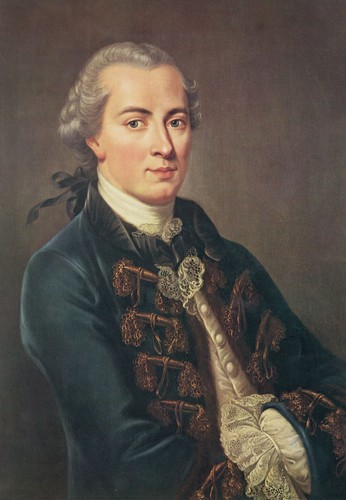
Immanuel Kant
Personal Information
Description
Immanuel Kant was an 18th-century German philosopher from the Prussian city of Königsberg. Kant was the last influential philosopher of modern Europe in the classic sequence of the theory of knowledge during the Enlightenment beginning with thinkers John Locke, George Berkeley, and David Hume. Kant created a new perspective in philosophy which had widespread influences on philosophy continuing through to the 21st century. He published important works on epistemology, as well as works relevant to religion, law, and history. One of his most prominent works is the Critique of Pure Reason, an investigation into the limitations and structure of reason itself. It encompasses an attack on traditional metaphysics and epistemology, and highlights Kant's own contribution to these areas. The other main works of his maturity are the Critique of Practical Reason, which concentrates on ethics, and the Critique of Judgment, which investigates aesthetics and teleology.
Books
Essays
Werkausgabe
Correspondence
Prolegomena
"Kant is the central figure of modern philosophy. He sought to rebuild philosophy from the ground up, and he succeeded in permanently changing its problems and methods. This new, revised edition of the Prolegomena, which is the best introduction to the theoretical side of his philosophy, presents his thought clearly by paying careful attention to his original language. Also included are selections from the Critique of Pure Reason, which fill out and explicate some of Kant's central arguments (including famous sections of the Schematism and Analogies), and in which Kant himself explains his special terminology. The first reviews of the Critique, to which Kant responded in the Prolegomena, are included in this revised edition. The volume is completed by a historical and philosophical introduction, explanatory notes, a chronology and a guide to further reading."--Jacket.
Werke
Oeuvres philosophiques
Immanuel Kant's Kritik der Urtheilskraft
Book digitized by Google from the library of Harvard University and uploaded to the Internet Archive by user tpb.
The metaphysical elements of ethics
If there exists on any subject a philosophy (that is, a system of rational knowledge based on concepts), then there must also be for this philosophy a system of pure rational concepts, independent of any condition of intuition, in other words, a metaphysic. It may be asked whether metaphysical elements are required also for every practical philosophy, which is the doctrine of duties, and therefore also for Ethics, in order to be able to present it as a true science (systematically), not merely as an aggregate of separate doctrines (fragmentarily). As regards pure jurisprudence, no one will question this requirement; for it concerns only what is formal in the elective will, which has to be limited in its external relations according to laws of freedom; without regarding any end which is the matter of this will. Here, therefore, deontology is a mere scientific doctrine (doctrina scientiae).Now in this philosophy (of ethics) it seems contrary to the idea of it that we should go back to metaphysical elements in order to make the notion of duty purified from everything empirical (from every feeling) a motive of action. For what sort of notion can we form of the mighty power and herculean strength which would be sufficient to overcome the vice-breeding inclinations, if Virtue is to borrow her "arms from the armoury of metaphysics," which is a matter of speculation that only few men can handle? Hence all ethical teaching in lecture rooms, pulpits, and popular books, when it is decked out with fragments of metaphysics, becomes ridiculous. But it is not, therefore, useless, much less ridiculous, to trace in metaphysics the first principles of ethics; for it is only as a philosopher that anyone can reach the first principles of this conception of duty, otherwise we could not look for either certainty or purity in the ethical teaching. To rely for this reason on a certain feeling which, on account of the effect expected from it, is called moral, may, perhaps, even satisfy the popular teacher, provided he desires as the criterion of a moral duty to consider the problem: "If everyone in every case made your maxim the universal law, how could this law be consistent with itself?" But if it were merely feeling that made it our duty to take this principle as a criterion, then this would not be dictated by reason, but only adopted instinctively and therefore blindly.But in fact, whatever men imagine, no moral principle is based on any feeling, but such a principle is really nothing else than an obscurely conceived metaphysic which inheres in every man's reasoning faculty; as the teacher will easily find who tries to catechize his pupils in the Socratic method about the imperative of duty and its application to the moral judgement of his actions. The mode of stating it need not be always metaphysical, and the language need not necessarily be scholastic, unless the pupil is to be trained to be a philosopher. But the thought must go back to the elements of metaphysics, without which we cannot expect any certainty or purity, or even motive power in ethics.