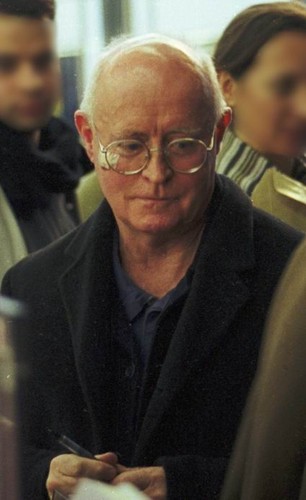

UNITED KINGDOM AUTHOR · DRAMA · HISTORY
Edward Bond
Also known as: Edward BOND, Edward L. Bond
Thomas Edward Bond (18 July 1934 – 3 March 2024) was an English playwright, theatre director, poet, dramatic theorist and screenwriter. He was the author of some 50 plays, among them Saved (1965), the production of which was instrumental in the abolition of theatre censorship in the UK. His other well-received works include Narrow Road to the Deep North (1968), Lear (1971), The Sea (1973), The Fool (1975), Restoration (1981), and the War Plays (1985). Bond was broadly considered among the major living dramatists but he has always been and remains highly controversial because of the violence shown in his plays, the radicalism of his statements about modern theatre and society, and his theories on drama.
Bernard's sermon On Conversion was given in 1140 in Paris, as a public discourse.
— from Correspondence, 1975
Most acclaimed

Coffee
Coffee trader and historian Antony Wild delivers a rollicking history of the most valuable legally traded commodity in the world after oil -- an industry that employs 100 million people throughout the world. From obscure beginnings in east Africa in the fifteenth century as a stimulant in religious devotion, coffee became an imperial commodity, produced by poor tropical countries and consumed by rich temperate ones. Through the centuries, the influence of coffee on the rise of capitalism and its institutions has been enormous. Revolutions were once hatched in coffeehouses, commercial alliances were forged, secret societies were formed, and politics and art were endlessly debated. Today, while coffee chains spread like wildfire, coffee-producing countries are in crisis: with prices at a historic low, they are plagued by unprecedented unemployment, abandoned farms, enforced migration, and massive social disruption. Bridging the gap between coffee's dismal colonial past and its perilous corporate present, Coffee reveals the shocking exploitation that has always lurked at the heart of the industry. - Publisher.
The sea
A wild storm shakes a small East Anglian seaside village and sets off a series of events that changes the lives of all its residents. Set in the high Edwardian world of 1907, 'The Sea' is a fascinating blend of wild farce, high comedy, biting social satire and bleak poetic tragedy.
Correspondence
1975
""I am leaving to Tahiti where I shall hope to end my days. My art...I regard as no more than a tender shoot, though one that I hope to develop into a wild and primitive growth.... The European Gauguin has ceased to exist and nobody will ever see any of his works here again."" "With these words, Paul Gauguin set off on a voyage that would not only irrevocably change his own life and work, but also the entire course of modern art. This volume combines for the first time the artist's public expressions of his world - his paintings - with his private correspondence - to his estranged wife, his agent, and his illustrious contemporaries such as Strindberg and van Gogh. Gauguin vividly describes his creative movements as well as the details of his daily life, most poignantly his consuming worries about health and finances." "The book is illustrated throughout with many of Gauguin's most ambitious and beautiful canvases. Watercolors and pencil sketches illuminate the early stages of these major works, and illustrated journal pages and rare vintage photographs reveal the people and places he knew." "An invaluable insight into Gauguin's life, this volume is equally important for its determined look at the transgressive spirit of those artists who challenge the conventions of their time to create an art of the future."--BOOK JACKET.