Discover

Gertrude Stein

Personal Information

Born February 3, 1874
Died July 27, 1946 (72 years old)
Allegheny, United States
Also known as: Gertrude Gertrude Stein, Gertrude STEIN
70 books
3.2 (17)
240 readers

Description

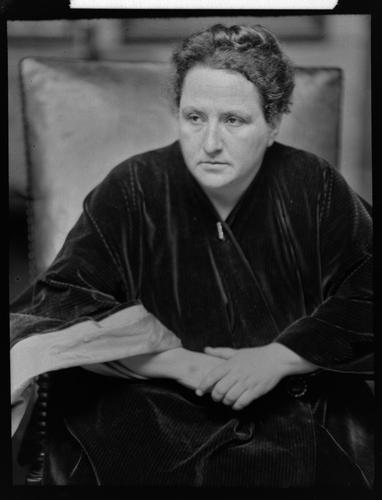
Gertrude Stein was an American writer who spent most of her life in France, and who became a catalyst in the development of modern art and literature. Her life was marked by two primary relationships, the first with her brother Leo Stein, from 1874-1914 (Gertrude and Leo), and the second with her partner Alice B. Toklas, from 1907 until Stein's death in 1946 (Gertrude and Alice). Stein shared her salon at 27 rue de Fleurus, Paris, first with Leo and then with Alice. Throughout her lifetime, Stein also cultivated significant relationships with well-known members of the avant garde artistic and literary world.

Books

Newest First

The letters of GertrudeStein and Thornton Wilder

0.0 (0)
3

The friendship and correspondence of Gertrude Stein and Thornton Wilder encompassed the last twelve years of Stein's life and a period of major work by Wilder. A generation apart in age, the two writers met during Stein's acclaimed American lecture tour in 1934-35, during which they shared the experience of lecturing to audiences in the wake of great success. They quickly became mentor and pupil as well as friends, and Wilder eloquently passed on what Stein taught him through his introductions to her books. While Wilder supported Stein's efforts at publication, she held him to his vocation as a writer, urging him to ignore the distractions incurred by family and fortune. . The letters between Stein and Wilder contain ideas and plans about publications, attitudes toward fame and work, and thoughts about other artists and people near to them. They also refer to European-American cultural relations prior to and through World War II, show how Stein and Wilder responded to critical reception of their new work, and above all, examine how the two writers affected one another's progress. It is clear from the letters that without their friendship, Stein's Narration lectures would not have come about, The Geographical History and the novel Ida would have become different books, and Wilder's Our Town might not have become the play we know. The edition, fully annotated by Edward M. Burns and Ulla E. Dydo, includes a detailed chronology of Stein's lecture tour prepared by William Rice, staging histories of Our Town and The Skin of Our Teeth, and an account of Stein in World War II with new documentation.

Gertrude Stein

0.0 (0)
1

Editor Renate Stendhal has selected 360 photographs (more than 100 of those seen here for the first time) of Gertrude Stein, her companion Alice B. Toklas, and the many familiar and famous faces who surrounded her.

Operas and Plays

4.0 (3)
15

Although Gertrude Stein, as much as James Joyce, is often considered the most famous and influential of modern experimental writers of prose and poetry, few realize the breadth and depth of her contribution to theater and opera, which hardly stops with the justly famous collaboration with Virgil Thomson, "Four Saints in Three Acts." She considered Operas and Plays to be her definitive statement, as of 1932, for the stage. Born in 1874 in Allegheny, Pennsylvania, raised in Oakland, California, she lived in France from 1903 till her death in 1946.

Correspondence

Montagu, Mary Wortley Lady, Gertrude Stein, Hugh MacDiarmid, Yonatan Netanyahu, Théodore de Bèze, Guy Debord, John Dalberg-Acton, 1st Baron Acton, Paul Celan, Hector Berlioz, Dylan Thomas, Wolfgang Amadeus Mozart, Stéphane Mallarmé, Delmore Schwartz, Theodor W. Adorno, Vanessa Bell, Jean Leclercq, Erik Satie, Gottfried Wilhelm Leibniz, Cyprian Norwid, Saint Catherine of Siena, John Conduitt, Wen, Yiduo, Antonio Baldini, John Crowe Ransom, William Pitt Earl of Chatham, Maria Celeste Galilei, Henry III King of France, Xu, Zhimo, M. Basil Pennington, Pietro Aretino, Max Frisch, Philip Dormer Stanhope, 4th Earl of Chesterfield, Zongtang Zuo, Maud Gonne, Paul Gauguin, William Gilmore Simms, Laurence Sterne, Saint Bernard of Clairvaux, Aldo Palazzeschi, Gregorio Mayans y Siscar, Sean O'Casey, Henry David Thoreau, Kingsley Amis, Richard Watson Gilder, Francis de Sales, François-René de Chateaubriand, Jean Dubuffet, Marianne Moore, Lloyd James Austin, Roy, M. N., Charles Victor de Bonstetten, Belgrano, Manuel, Gustav Radbruch, Edward Bond, Olive Schreiner, J. W. Johnston, Yu, Dafu, Charles Sumner, Edvard Grieg, Claude Debussy, Ludwig van Beethoven, Photius I Saint, Patriarch of Constantinople, Gershom Scholem, Gustav Mahler, Harry S. Truman, Saint Jerome, Claudio Monteverdi, Voltaire Foundation, José Martí, Zeng, Guofan, Sigmund Freud, Francis Poulenc, Cicero, Anna Freud, Jonathan Swift, Philipp Melanchthon, Sir Leslie Stephen, André Gide, Binyamin Netanyahu, Tao, Xingzhi, Paula Modersohn-Becker, Hart Crane, Giacomo Meyerbeer, Hügel, Friedrich Freiherr von, Carossa, Hans, Narcissa Prentiss Whitman, Arthur Hugh Clough, Clara Schumann, Saint Cyprian, Bishop of Carthage, Sir Walter Alexander Raleigh, Felix Mendelssohn, Hester Lynch Piozzi, Joseph de Maistre, William Blake, Immanuel Kant, George Santayana, Giuseppe Tornatore, Lei Fu, Saint Bede the Venerable, Germaine de Staël, William Makepeace Thackeray, Britten, Benjamin, Amos Bronson Alcott, Thomas Percy, Roger Chartier, Frida Kahlo, Matthew Arnold, George III King of Great Britain, John Wilson Croker, Federico García Lorca, Ferruccio Busoni, Gabriel Faure
2.0 (1)
1

Stanzas in meditation

0.0 (0)
3

Written in 1932 at the house that Gertrude Stein and Alice B. Toklas had rented in the Rhone Valley, Stanzas in Meditation is one of Stein's most abstract and complex works. It is almost as if Stanzas was conceived as a mirror opposite of The Autobiography of Alice B. Toklas, penned in the same year. The latter, written in a more direct and normative language, brought Stein international acclaim and resulted in the attention she received from 1934 on, while the former remained unavailable until its publication, after her death, in 1956. To Stein readers and admirers, however, this is one of her most important works, a poetic achievement central to her canon. From John Ashbery's groundbreaking essay-review of Stanzas in 1957 to Richard Bridgman's 1970 publication, Gertrude Stein in Pieces, poets and critics have recognized the importance of this masterpiece.

Writings and lectures, 1911-1945

0.0 (0)
0

Duplicate, see [OL5643332M]: /books/OL5643332M

Look at Me Now and Here I Am

0.0 (0)
2

Gertrude Stein was one of the most colourful personalities of the literary world during the inter-war years. This volume of her writings attempts to dispel some of the misunderstandings that surrounds her work, presenting many of her lectures for the first time.

Tender Buttons

2.7 (3)
26

Gertrude Stein's Tender Buttons: Objects, Food, Rooms from 1914 is a poetic exploration of words - clustered, juxtaposed, redefined and played off one another - to subterfuge their common meanings, which Stein felt had become watered down, and to re-infuse them with expressive force.

A novel of thank you

0.0 (0)
2

"This is the first paperback edition of one of Stein's most revealing novels. Written in 1925-26 (but not published until 1958), it is Stein's midcareer assessment of herself, her writing, and her relationships, composed in the unique style for which she is celebrated. In place of a traditional narrative, Stein explores the nature of narrative, its possibilities, the various genres (historical novels, the novel of manners, adventure stories) available to the writer, the conventions of novel-writing, and the novelist's relation to her materials. In a sense, the novel is about "preparing a novel" (the subject of chap. 50), about everything that goes through a writer's head as she begins to write. Mixed in with her meditations on writing are daily events in her marriage to Alice B. Toklas, visits from friends - including such notable figures of the period as Josephine Baker, Virgil Thomson, Rene Crevel, and a number of expatriate American writers and artists - travels in and around France, memories of the past, inquiries into names and the nature of identity, and virtually anything else that occurs to her. As she writes at one point, "It can easily be remembered that a novel is everything," so everything of interest to Stein goes into her preparations for the novel that is A Novel of Thank You."--BOOK JACKET.
