Discover

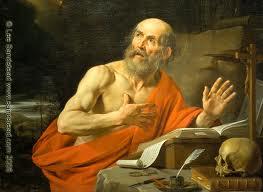
Saint Jerome

Personal Information

Born March 7, 342
Died March 7, 420 (78 years old)
Dalmatia, Ancient Rome
Also known as: JEROME SAINT., st Jerome
22 books
2.0 (1)
26 readers

Description

There is no description yet, we will add it soon.

Books

Newest First

Correspondence

Montagu, Mary Wortley Lady, Gertrude Stein, Hugh MacDiarmid, Yonatan Netanyahu, Théodore de Bèze, Guy Debord, John Dalberg-Acton, 1st Baron Acton, Paul Celan, Hector Berlioz, Dylan Thomas, Wolfgang Amadeus Mozart, Stéphane Mallarmé, Delmore Schwartz, Theodor W. Adorno, Vanessa Bell, Jean Leclercq, Erik Satie, Gottfried Wilhelm Leibniz, Cyprian Norwid, Saint Catherine of Siena, John Conduitt, Wen, Yiduo, Antonio Baldini, John Crowe Ransom, William Pitt Earl of Chatham, Maria Celeste Galilei, Henry III King of France, Xu, Zhimo, M. Basil Pennington, Pietro Aretino, Max Frisch, Philip Dormer Stanhope, 4th Earl of Chesterfield, Zongtang Zuo, Maud Gonne, Paul Gauguin, William Gilmore Simms, Laurence Sterne, Saint Bernard of Clairvaux, Aldo Palazzeschi, Gregorio Mayans y Siscar, Sean O'Casey, Henry David Thoreau, Kingsley Amis, Richard Watson Gilder, Francis de Sales, François-René de Chateaubriand, Jean Dubuffet, Marianne Moore, Lloyd James Austin, Roy, M. N., Charles Victor de Bonstetten, Belgrano, Manuel, Gustav Radbruch, Edward Bond, Olive Schreiner, J. W. Johnston, Yu, Dafu, Charles Sumner, Edvard Grieg, Claude Debussy, Ludwig van Beethoven, Photius I Saint, Patriarch of Constantinople, Gershom Scholem, Gustav Mahler, Harry S. Truman, Saint Jerome, Claudio Monteverdi, Voltaire Foundation, José Martí, Zeng, Guofan, Sigmund Freud, Francis Poulenc, Cicero, Anna Freud, Jonathan Swift, Philipp Melanchthon, Sir Leslie Stephen, André Gide, Binyamin Netanyahu, Tao, Xingzhi, Paula Modersohn-Becker, Hart Crane, Giacomo Meyerbeer, Hügel, Friedrich Freiherr von, Carossa, Hans, Narcissa Prentiss Whitman, Arthur Hugh Clough, Clara Schumann, Saint Cyprian, Bishop of Carthage, Sir Walter Alexander Raleigh, Felix Mendelssohn, Hester Lynch Piozzi, Joseph de Maistre, William Blake, Immanuel Kant, George Santayana, Giuseppe Tornatore, Lei Fu, Saint Bede the Venerable, Germaine de Staël, William Makepeace Thackeray, Britten, Benjamin, Amos Bronson Alcott, Thomas Percy, Roger Chartier, Frida Kahlo, Matthew Arnold, George III King of Great Britain, John Wilson Croker, Federico García Lorca, Ferruccio Busoni, Gabriel Faure
2.0 (1)
1

The homilies of Saint Jerome

0.0 (0)
2

Volume two of a 2 volume set.

Psalterium iuxta Hebraeos Hieronymi

0.0 (0)
0

The name of St. Jerome is connected with three versions of the Psalter. Two of these -- generally known as the Roman and the Gallican -- were revisions made by him of the Old Latin Psalter previously in use. In these two revisions St. Jerome had recourse, not to the Hebrew, but to the Greek of the Septuagint. His third version, which was made at the end of the fourth century, was a translation from the Hebrew original. Hence its usual name, the Hebrew Psalter. The more I have studied the Psalter the more I have been convinced that the text translated by St. Jerome at the end of the fourth century was substantially the same as our present Masoretic text. For this reason I have always been inclined to admit a reading which agreed with that text. Also I have learned to view with suspicion any reading which was simply a reproduction of the corresponding word or words of the Gallican version. - Introduction.

Commentary on Galatians

0.0 (0)
3

"Prior to the middle of the fourth century, the exegesis of St. Paul had been monopolized by Greek and Syriac commentators. Then, in the space of half a century (c. 360 - c. 409), there appeared no less than 52 commentaries by six different Latin authors. This sudden flurry of literary activity has been dubbed the western "Renaissance of Paul." Jerome's commentaries on four Pauline epistles (Galatians, Ephesians, Titus, Philemon), which he composed in 386 shortly after establishing himself in Bethlehem, occupy a central place in this relatively short but prolific segment of the history of Pauline exegesis in Latin. Jerome was the greatest biblical scholar of the ancient Latin church, and his Commentary on Galatians is one of the crowning achievements of his illustrious career. It far outclasses the five other contemporary Latin commentaries on Galatians in its breadth of classical and patristic erudition, Hebrew and Greek textual criticism of the Bible, and expository thoroughness. It is unique also because it is the only one of the Latin commentaries to make the Greek exegetical tradition its main point of reference. Jerome's Commentary in fact preserves, in one form or another, a treasure-trove of otherwise lost Greek exegesis, particularly Origen's Commentary on Galatians, from which he worked very closely when composing his own work. Jerome's Commentary on Galatians is presented here in English translation in its entirety. The introduction and notes situate the Commentary in its historical, exegetical, and theological contexts and also provide extensive coverage of ancient and modern scholarly debates about the interpretation of Paul's epistle."--Publisher's website.

Jerome's epitaph on Paula

0.0 (0)
0

"Jerome's Epitaph on Saint Paula (Epitaphium Sanctae Paulae) is one of the most famous writings by one of the most prolific authors in all of Latin antiquity. Composed in 404, it is an elaborate eulogy commemorating the life of Paula (347-404), a wealthy Christian widow from Rome who renounced her senatorial status and embraced a lifestyle of ascetic self-discipline and voluntary poverty. She used her vast inherited fortune to fund various charitable causes and to co-found with Jerome, in 386, a monastic complex in Bethlehem which was equipped with a hostelry for Christian pilgrims. The Epitaphium is one of the core primary texts on female spirituality (both real and idealized) in Late Antiquity, and it also is one of Jerome's crowning literary achievements, yet until now it has not received the depth of scholarly analysis that only a proper commentary can afford. This book presents the first full-scale commentary on this monumental work in any language. Cain accesses a very extensive array of ancient sources to fully contextualize the Epitaphium and he comprehensively addresses stylistic, literary, historical, topographical, theological, text-critical and other issues of interpretive interest, including relevant matters of Hebrew, Greek, and Latin philology. Considerable effort also is expended on extricating the elusive Paula of history from the sticky web of Jerome's idealized hagiographic construct of her. Accompanying the commentary is an introduction which situates the Epitaphium in the broader context of its author's life and work and exposes its various propagandistic dimensions"--

Lettera di san Girolamo a Leta matrona romana

0.0 (0)
0

St. Jerome advises a Roman matron named Leta on the education of her daughter; he advises that she should each day study a Scriptural passage, followed by prayer, followed by more reading, and then followed by more prayer. This is in the hope that she ... "instead of [desiring] jewels and silk clothing, may she love the Divine books."

Saint Jerome's Hebrew questions on Genesis

0.0 (0)
1

St. Jerome was one of the very few early Christian scholars who knew Hebrew. This is the first translation, complete with a comprehensive introduction and commentary, of his Hebrew Questions on Genesis - providing a striking and fascinating picture of that knowledge put to work. It shows clearly that Jerome was not only familiar with biblical Hebrew, which he had to know in order to translate the Old Testament into Latin; but that he was also aware of Jewish tradition, now preserved in the classic writings of Judaism, the Talmuds and the Midrashim. Jerome was interested in popular Jewish tradition as well as scholarly lore, and he often records details known to the Aramaic Targumim, the popular combined translations and interpretations of the Hebrew Bible in the every-day Aramaic language of the common Jew. Jerome's work provides unique evidence for the dating of much early Jewish material, now of increasing importance as modern critical study of Jewish texts has begun to question hitherto accepted dates. As a Christian who knew Hebrew, Jerome's influence on the Church was very great; but he acquired his knowledge with great effort, and his work reflects the curious relations between this particular Christian and his Jewish informants which is not without interest for current Jewish-Christian relations. Why Jerome wrote the Hebrew Questions is one of the major concerns of the book.