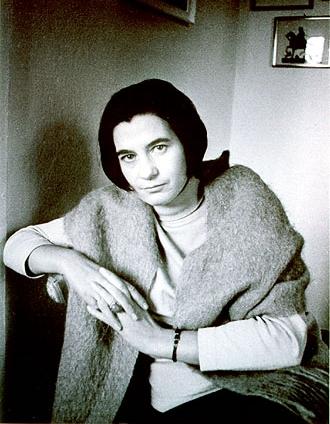
Christa Wolf
Personal Information
Description
There is no description yet, we will add it soon.
Books
Werke
What remains and other stories
What Remains collects Christa Wolf's short fiction, from her early work in the sixties to the recently published title story, which was widely debated when it appeared in Germany in 1990. These powerful and often very personal stories examine a wide range of topics, from sexual politics to the nature of memory. In "What Remains", an East German writer who is under observation by the secret police traces the way in which this almost constant surveillance gradually destroys every shred of normalcy in her life. In "Exchanging Glances", a woman remembers, from a far distance in time, place, and politics, the flight of her family from the advancing Russian Army during World War II. And in the biting and very funny satire "The New Life and Opinions of a Tomcat", we meet Max the cat, the devoted pet of a professor of applied psychology who is working on the realization of TOHUHA (Total Human Happiness), or the abolition of tragedy. What Remains offers a fascinating introduction to Wolf's work.
Medea. Stimmen
A revisionist account of Medea, the sorceress of Greek mythology, famous for her cruelty and manipulation of men. Here she is presented as a kind woman, victimized by men. By a German author.
August
Christa Wolf was arguably the best-known and most influential writer in the former East Germany. Having grown up during the Nazi regime, she and her family were forced to flee their home like many others, nearly starving to death in the process. Her earliest novels were controversial because they contained veiled criticisms of the Communist regime which landed her on government watch lists. Her past continued to permeate her work and her life, as she said, "You can only fight sorrow when you look it in the eye." August is Christa Wolf's last piece of fiction, written in a single sitting as an anniversary gift to her husband. In it, she revisits her stay at a tuberculosis hospital in the winter of 1946, a real life event that was the inspiration for the closing scenes of her 1976 novel Patterns of Childhood.
In The Flesh
Detective Cortez drove hard to close an open case. The man was bold, single-minded in his pursuit and determined to work his way under Dr. Jennifer Madden's skin. His security details and around-the-clock surveillance were becoming all too personal. And the detective's protection was making a menace out of a stalker. If the beautiful doctor had any chance to survive she'd have to surrender to a protector who demanded her full cooperation...and then some.
Till Eulenspiegel
Unfolds the life of the merry prankster Till, from his rowdy infancy to his final joke at his own funeral.
Kassandra
Novel retells the story of the fall of Troy from Cassandra's point of view. The four accompanying pieces describe the novel's genesis.
Ein Tag im Jahr im neuen Jahrhundert 2001-2011
Continues Wolf's devotion to the date September 27, which she began in Ein Tag im Jahr, 1960-2000, with an account of each September 27 of the next decade. Includes public and private concerns, the political and the artistic.
Stadt der Engel oder The Overcoat of Dr. Freud
Tijdens een verblijf in Amerika wordt een schrijfster uit de voormalige DDR geconfronteerd met onthullingen over haar betrokkenheid bij de Stasi.
Störfall
An East German writer, awaiting a call from the hospital where her brother is undergoing brain surgery, instead receives news of a massive nuclear accident at Chernobyl, one thousand miles away. In the space of a single day, in a potent, lyrical stream of thought, the narrator confronts both mortality and life and above all, the import of each moment lived-open, as Wolf reveals, to infinite analysis.
