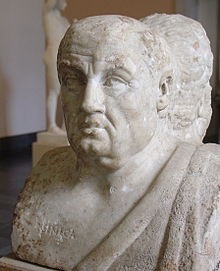
Seneca the Younger
Personal Information
Description
Seneca the Younger (c. 4 BC – AD 65), fully Lucius Annaeus Seneca and also known simply as Seneca, was a Roman Stoic philosopher, statesman, dramatist, and—in one work—satirist of the Silver Age of Latin literature. Source: [Seneca the Younger]( on Wikipedia.
Books
Philosophische Schriften
Seneca
"The relationship between Seneca's prose works and his career as a first-century Roman statesman is problematic, for while he writes in the first person, he tells little of his external life or of the people and events that formed its setting. In this book, Miriam Griffin addresses the problem by first reconstructing Seneca's career using only outside sources and his de Clementia and Apocolocyntosis. In the second part of the book she studies Seneca's treatment of subjects of political significance, including his views on slavery, provincial policy, wealth, and suicide. Finding that on the whole, the word of the philosopher illuminates the work of the statesman, this book provides an important objective reconstruction of Seneca's the word of the philosopher illuminates the work of the statesman, this book provides an important objective reconstruction of Seneca's political career". --Publisher.
Seneca's morals, by way of abstract
Book digitized by Google and uploaded to the Internet Archive by user tpb.
Letters from a Stoic (A Penguin Classics Hardcover)
A new series of beautiful hardcover nonfiction classics, with covers designed by Coralie Bickford-Smith World-changing ideas meet eye-catching design: the best titles of the extraordinarily successful Great Ideas series are now packaged in Coralie Bickford-Smith’s distinctive, award-winning covers. Whether on a well-curated shelf or in your back pocket, these timeless works of philosophical, political, and psychological thought are absolute must-haves for book collectors as well as design enthusiasts. A philosophy that saw self-possession as the key to an existence lived "in accordance with nature," Stoicism called for the restraint of animal instincts and the severing of emotional ties. These beliefs were formulated by the Athenian followers of Zeno in the fourth century BC, but it was in Seneca that the Stoics found their most eloquent advocate. Stoicism, as expressed in the Letters, helped ease pagan Rome's transition to Christianity, for it upholds upright ethical ideals and extols virtuous living, as well as expressing disgust for the harsh treatment of slaves and the inhumane slaughter witnessed in the Roman arenas. Seneca's major contribution to a seemingly unsympathetic creed was to transform it into a powerfully moving and inspiring declaration of the dignity of the individual mind. Robin Campbell's distinguished translation captures Seneca's humour and concise, memorable aphorisms and his introduction discusses the tensions between Seneca's philosophy and his turbulent career as adviser to the tyrannical emperor Nero. For more than sixty-five years, Penguin has been the leading publisher of classic literature in the English-speaking world. With more than 1,500 titles, Penguin Classics represents a global bookshelf of the best works throughout history and across genres and disciplines. Readers trust the series to provide authoritative texts enhanced by introductions and notes by distinguished scholars and contemporary authors, as well as up-to-date translations by award-winning translators.
L. Annaei Senecae Tragoediae
Book digitized by Google from the library of the University of Michigan and uploaded to the Internet Archive by user tpb.
