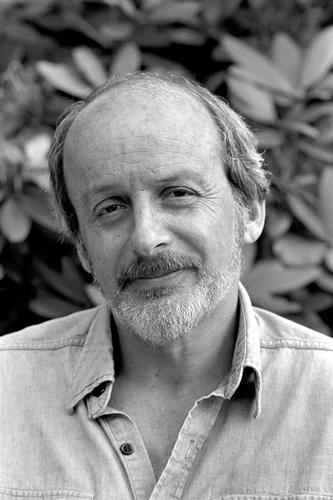

UNITED STATES AUTHOR · FICTION · HISTORY
E. L. Doctorow
Also known as: Edgar Lawrence Doctorow
Edgar Lawrence Doctorow has received the National Book Award, two National Book Critics Circle Awards, the PEN/Faulkner Award, the Edith Wharton Citation for Fiction, the William Dean Howell Medal of the American Academy of Arts and Letters, and the National Humanities Medal. Doctorow was born in New York City on January 6, 1931, and attended the Bronx High School of Science. After graduating with honors from Kenyon College in 1952, he did graduate work at Columbia University and served in the U.S. Army, which stationed him in Germany. In 1954, he married Helen Setzer. They have three children. Doctorow was senior editor for New American Library from 1959 to 1964 and then served as editor in chief at Dial Press until 1969. Since then, he has devoted his time to writing and teaching. He holds the Glucksman Chair in American Letters at New York University and over the years has taught at several institutions, including Yale University Drama School, Princeton University, Sarah Lawrence College, and the University of California, Irvine.
In 1902 Father built a house at the crest of the Broad-view Avenue hill in New Rochelle, New York.
— from Ragtime
Most acclaimed

Short stories
For over three decades, Reynolds Price has been one of America's most distinguished writers, in a career that has been remarkable both for its virtuosity and for the variety of literary forms he has embraced. Now he shows himself as much a master of the story as he is of the novel, in a volume that presents fifty stories, including two early collections - The Names and Faces of Heroes and Permanent Errors - as well as more than two dozen new stories that have never been gathered together before. In his introduction, Mr. Price explains how, after the publication of his first two collections, he wrote no new stories for almost twenty years. "But once I needed - for unknown reasons in a new and radically altered life - to return to the story, it opened before me like a new chance...A collection like this then," he adds, "...will show a writer's pre-occupations in ways the novel severely rations (novels are partly made for that purpose - the release from self, long flights through the Other). John Keats's assertion that 'the excellence of every Art is its intensity' has served as a license and standard for me. From the start my stories were driven by heat - passion and mystery, often passion for the mystery I've found in particular rooms and spaces and the people they threaten or shelter - and my general aim is the transfer of a spell of keen witness, perceived by the reader as warranted in character and act.". There is, indeed, much for the reader to "witness" here of passion and mystery, of character and act. And the variety of stories - many of them set in Reynolds Price's native North Carolina, but a surprising number set in distant parts: Jerusalem in "An Early Christmas," the American Southwest in "Walking Lessons," and a number in Europe - will astonish even his most devoted readers. In short, The Collected Stories of Reynolds Price is as deeply rewarding a book as any he has yet published.
City of God
"EL Doctorow's City of God starts off not merely with a bang but with the big bang itself, that "great expansive flowering, a silent flash into being in a second or two of the entire outrushing universe". It doesn't remain on this cosmic plane throughout. There's a mystery here, along with a romance, a chilling Holocaust narrative and a deep-focus portrait of fin-de-siécle Manhattan. In the early pages of the novel, an enormous brass cross is pilfered from a church on the Lower East Side. Father Thomas Pemberton of St Timothy's promptly sets off in search of it, dubbing himself the Divinity Detective. Yet he suspects from the start that this is no ordinary theft, with no ordinary solution. The cross eventually turns up on the roof of the Synagogue for Evolutionary Judaism, a tiny Manhattan institution to which Pemberton has clearly been led by fate. His encounter with the synagogue's rabbinical duo -- a husband-and-wife team struggling to reclaim a pre-scriptural state of "unmediated awe"--Transforms his life. It also destroys what's left of his conventional Christian belief. As his relationship with Judaism deepens, he discards the clerical collar altogether and embarks upon a penitential exploration of the Holocaust -- which in turn allows Doctorow to loop his narrative back and forth between several generations of (mostly) Jew and Gentile. City of God is a marvellous hybrid which includes a meta-fictional framework (i.e., an author-as-character with a rather Doctorovian CV), an ongoing rumination on city life and a dozen other major strands and minor players. There is an undeniable power to the way Doctorow makes his fictional worlds collide, setting off all manner of historical and philosophical conflagrations. At one point he imagines "the totality of intimate human narrations/composing a hymn to enlightenment/if that were possible". A tall order, yes. But despite its occasional longueurs, City of God suggests that it is possible indeed." -- from www.amazon.co.uk (Jan. 30, 2011).
Ragtime
Published in 1975, Ragtime changed our very concept of what a novel could be. An extraordinary tapestry, Ragtime captures the spirit of America in the era between the turn of the century & the First World War. The story opens in 1906 in New Rochelle, NY, at the home of an affluent American family. One lazy Sunday afternoon, the famous escape artist Harry Houdini swerves his car into a telephone pole outside their house. Almost magically, the line between fantasy & historical fact, between real & imaginary characters, disappears. Henry Ford, Emma Goldman, J.P. Morgan, Evelyn Nesbit, Sigmund Freud & Emiliano Zapata slip in & out of the tale, crossing paths with Doctorow's imagined family & other fictional characters, including an immigrant peddler & a ragtime musician from Harlem whose insistence on a point of justice drives him to revolutionary violence.