Discover

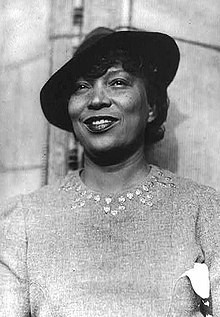
Zora Neale Hurston

Personal Information

Born January 7, 1891
Died January 28, 1960 (69 years old)
Notasulga, United States
Also known as: Z. N. Hurston
41 books
4.1 (62)
1,013 readers

Description

Zora Neale Hurston (January 7, 1891  – January 28, 1960) was an American author, anthropologist, and filmmaker. She portrayed racial struggles in the early-1900s American South and published research on hoodoo. The most popular of her four novels is Their Eyes Were Watching God, published in 1937. She also wrote more than 50 short stories, plays, and essays. [source](

Books

Newest First

Mules and Men (P.S.)

0.0 (0)
56

Mules and Men is a treasury of black America's folklore as collected by a famous storyteller and anthropologist who grew up hearing the songs and sermons, sayings and tall tales that have formed an oral history of the South since the time of slavery. Returning to her hometown of Eatonville, Florida, to gather material, Zora Neale Hurston recalls "a hilarious night with a pinch of everything social mixed with the storytelling." Set intimately within the social context of black life, the stories, "big old lies," songs, Vodou customs, and superstitions recorded in these pages capture the imagination and bring back to life the humor and wisdom that is the unique heritage of African Americans.

Their Eyes Were Watching God

4.2 (48)
532

Their Eyes Were Watching God (1937) is a classic Harlem Renaissance novel by American writer Zora Neale Hurston. The novel follows Janie Crawford as she recounts the story of her life as she journeys from a naive teenager to a woman in control of her destiny.

Barracoon

3.8 (4)
69

The true story of the last known survivor of the Atlantic slave trade, illegally smuggled from Africa on the last "black cargo" ship to arrive in the United States.

Every Tongue Got to Confess

0.0 (0)
11

E-Book Extra: Oral Tradition: A Reading Group GuideAn extensive volume of nearly 500 folktales celebrating African American oral tradition, community, and faith, collected by Zora Neale Hurston on her travels through the Gulf States in the late 1920s. The New York Times calls these bitter and often hilarious tales “splendidly vivid and true”.Every Tongue Got to Confess is an extensive volume of African American folklore that Zora Neale Hurston collected on her travels through the Gulf States in the late 1920s.The bittersweet and often hilarious tales -- which range from longer narratives about God, the Devil, white folk, and mistaken identity to witty one-liners -- reveal attitudes about faith, love, family, slavery, race, and community. Together, this collection of nearly 500 folktales weaves a vibrant tapestry that celebrates African American life in the rural South and represents a major part of Zora Neale Hurston's literary legacy.

Go gator and muddy the water

0.0 (0)
4

Researching a work on the Florida Federal Writers' Project, Pamela Bordelon discovered writings in the collection that were unmistakably from the hand of Zora Neale Hurston, author of Their Eyes Were Watching God and one of the leading writers of the Harlem Renaissance. Most of these works are not well known. All of Hurston's novels draw upon her deep interest in folklore, particularly from Florida, her home state. Here we see the roots of that work, from the captivating folktale of the monstrous alligator living in a local lake to her recording of folk songs and her work on children's games and the black church. Of great interest are the transcriptions of a rare interview with Hurston singing gambling and work songs and telling how she learned them.

Sweat

0.0 (0)
5

Now frequently anthologized, Zora Neale Hurston's short story "Sweat" was first published in Fire!!, a legendary literary magazine of the Harlem Renaissance, whose sole issue appeared in November 1926. In "Sweat" Hurston claimed the voice that animates her mature fiction, notably the 1937 novel Their Eyes Were Watching God; the themes of marital conflict and the development of spiritual consciousness were introduced as well. "Sweat" exemplifies Hurston's lifelong concern with women's relation to language and the literary possibilities of black vernacular. This casebook for this story includes an introduction by the editor, a chronology of the author's life, the authoritative text of "Sweat," and a second story, "The Gilded Six-Bits." Published in 1932, this second story was written after Hurston had spent years conducting fieldwork in the southern United States.

Folklore, memoirs, and other writings

0.0 (0)
11

When she died in poverty and obscurity in 1960, all of Zora Neale Hurston's books were out of print. Today her groundbreaking works, suffused with the culture and traditions of African-Americans and the poetry of black speech, have won her recognition as one of the most significant African-American writers. This volume, with its companion, Novels & Stories brings together for the first time all of Hurston's best writings in one authoritative set. "Folklore is the arts of the people," Hurston wrote, "before they find out that there is any such thing as art." A pioneer of African-American ethnography who did graduate study in anthropology with the renowned Franz Boas, Hurston devoted herseif to preserving the black folk heritage. In Mules and Men (1935), the first book of African-American folklore written by an African-American, she returned to her native Florida and to New Orleans to record stories and sermons, blues and work songs, children's games, courtship rituals, and formulas of hoodoo doctors. This classic work is presented here with the original illustrations by the great Mexican artist Miguel Covarrubias. . Tell My Horse (1938), part ethnography, part travel book, vividly recounts the survival of African religion in Jamaican obeah and Haitian voodoo in the 1930s. Keenly alert to political and intellectual currents, Hurston went beyond superficial exoticism to explore the role of these religious systems in their societies. The text is illustrated by 26 photographs, many of them taken by Huston. Her extensive transcriptions of Creole songs here accompanied by new translation. A special feature of this volume is Hurston's controversial 1942 autobiography, Dust Tracks on a Road. With consultation by Henry Louis Gates, Jr., it is presented here for the first time as she intended, restoring passages omitted by the original publisher because of political controversy, sexual candor, or fear of libel. Included in an appendix are four additional chapters, one never before published, that represent earlier stages of Hurston's conception of the book.

Mule bone

0.0 (0)
5

The only literary collaboration between Langston Hughes and Zora Neale Hurston, this play marked a turning point in African-American theater. This volume tells the story of the play's conception and inspiration and gives complete details of the irreparable rift in Hurston and Hughes's friendship that came about because of it. Also included is Hurston's short story, "Bone of Contention."

I love myself when I am laughing ... and then again when I am looking mean and impressive

0.0 (0)
22

Anthology of essays, folklore and fiction by a leading figure in the Harlem Renaissance.

Seraph on the Suwanee, a novel

0.0 (0)
14

In a perceptive study of the meaning of love, two people find themselves at once deeply in love and deeply at odds.

Dust tracks on a road

4.0 (1)
43

xii, 308, 16 pages : 21 cm

Tell my horse

5.0 (1)
35

As a first-hand account of the weird mysteries and horrors of voodoo, Tell My Horse is an invaluable resource and fascinating guide. Based on Zora Neale Hurston's personal experiences in Haiti and Jamaica, where she participated as an initiate rather than just an observer of voodoo practices during her visits in the 1930s, this travelogue into a dark world paints a vividly authentic picture of ceremonies and customs and superstitions of great cultural interest.

Jonah's gourd vine

0.0 (0)
24

Jonah's Gourd Vine, Zora Neale Hurston's first novel, originally published in 1934, tells the story of John Buddy Pearson, "a living exultation" of a young man who loves too many women for his own good. Lucy, his long-suffering wife, is his true love, but there's also Mehaley and Big 'Oman, as well as the scheming Hattie, who conjures hoodoo spells to ensure his attentions. Even after becoming the popular pastor of Zion Hope, where his sermons and prayers for cleansing rouse the congregation's fervor, John has to confess that though he is a preacher on Sundays, he is a "natchel man" the rest of the week. And so in this sympathetic portrait of a man and his community, Zora Neale Hurston shows that faith, tolerance, and good intentions cannot resolve the tension between the spiritual and the physical. That she makes this age-old dilemma come so alive is a tribute to her understanding of the vagaries of human nature.