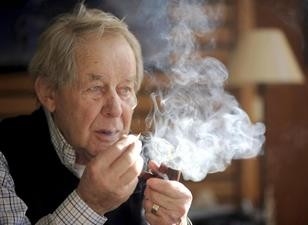
Siegfried Lenz
Personal Information
Description
German writer
Books
Das Feuerschiff
Das Feuerschiff ist eine Erzählung des deutschen Schriftstellers Siegfried Lenz. Sie ist die Titelgeschichte eines Bandes von Erzählungen, der 1960 bei Hoffmann und Campe erschien. Die Handlung spielt auf einem Feuerschiff, auf dem es zum Konflikt zwischen der Besatzung und einer Bande von flüchtigen Gangstern kommt. Unted den Besatzungsmitgliedern herrscht keine Einigkeit über Art und Weise eines Widerstandes. Insbesondere der Kapitän und sein Sohn vertreten gegensätzliche Anschauungen und entzweien sich. The lightship is a story by the German writer Siegfried Lenz. She is the cover story of a band of short stories, that appear in Hoffmann und Campe in 1960. The action takes place on a lightship on which there is a conflict between the crew and a gang of fugitive gangsters. Among the crew members there is no consensus about the way of the resistor. In particular, the captain and his son have conflicting views.
Exerzierplatz
The family saga of a German family, representative of the many who grew from the ruins of the militaristic Third Reich, bringing with them tensions and problems of the past.
Minute's Silence
A new novella from the eminence grise of German letters - a story of doomed love between a teenage boy and his teacher, set in the 1930s in a small Baltic fishing community.
Stella
Deutschstunde
Siggi Jepsen (the first-person narrator), an inmate of a juvenile detention center, is forced to write an essay with the title "The Joy of Duty." In the essay, Siggi describes his youth in Nazi Germany where his father, the "most northerly police officer in Germany," does his duty, even when he is ordered to debar his old childhood friend, the expressionist painter Max Nansen, from his profession, because the Nazis banned expressionism as "degenerate art" (entartete Kunst). Siggi, however, is fascinated by Nansen's paintings, "the green faces, the Mongol eyes, these deformed bodies ... " and, without the knowledge of his father, manages to hide some of the confiscated paintings. Following the end of World War II, Jepsen senior is interned for a short time and later reinstalled as a policeman in rural Schleswig-Holstein. When he then obsessively continues to carry out his former orders, Siggi brings Nansen paintings that he believes to be in danger to safety. His father discovers his doings and dutifully turns him in for art theft. When forced to write the essay on "The Joy of Duty" during his term in the juvenile detention center near Hamburg, the memories of his childhood come to the surface and he goes far beyond the "duty" of writing his essay by filling several notebooks with caustic recollections of this entire saga. - Wikipedia
The heritage
Short stories
Rip Van Winkle / Washington Irving [Young Goodman Brown]( / Nathaniel Hawthorne [Fall of the House of Usher]( / Edgar Allan Poe The lightning-rod man / Herman Melville The diamond lens / Fitzjames O'Brien The celebrated jumping frog of Calaveras County / Mark Twain The outcasts of Poker Flat / Bret Harte [Damned Thing]( / Ambrose Bierce The turn of the screw / Henry James The Hiltons' holiday / Sarah Orne Jewett The gift of the Magi / O. Henry The moving finger / Edith Wharton The open boat / Stephen Crane Lou, the prophet / Willa Cather The men of Forty Mile / Jack London Babylon revisited / F. Scott Fitzgerald [A rose for Emily]( William Faulkner Big two-hearted river / Ernest Hemingway Flight / John Steinbeck
Landesbühne
Landesbühne ("Countryside Theatre") is a short novel by the German author Siegfried Lenz. Like Schweigeminute, (transl. A Minute's Silence reviewed here, Landesbühne feels closer to Anglo-American literature, than to German literature.