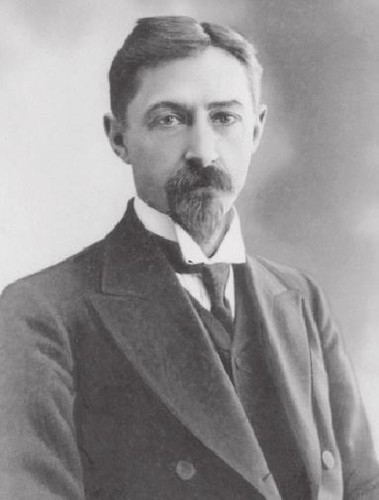
Иван Алексеевич Бунин
Personal Information
Description
Ivan Alekseyevich Bunin (Russian: Ива́н Алексе́евич Бу́нин) was the first Russian writer awarded the Nobel Prize for Literature. He was noted for the strict artistry with which he carried on the classical Russian traditions in the writing of prose and poetry. The texture of his poems and stories, sometimes referred to as "Bunin brocade", is considered to be one of the richest in the language.
Books
The liberation of Tolstoy
"Written in 1937, more than two decades after Leo Tolstoy's death, The Liberation of Tolstoy - equal parts biography, memoir, and literary study - serves as a dialogue between two great writers on the proklyatye voprosy, or "damned questions," of life.". "Bunin conveys the drama of Tolstoy's last days; his early love and eventual hatred of his wife, Sofya; his relationship with his eccentric family; his difficulties with the Russian Orthodox Church and his embrace of Buddhism; and the politics and events surrounding his funeral. At the same time, this work reflects the drama of Bunin's own difficult circumstances and his search for spiritual deliverance."--BOOK JACKET.
Cursed Days
On July 30, 1925, Vera Muromtseva-Bunina, the wife of the Russian writer Ivan Bunin (who was soon to win the Nobel Prize for Literature), wrote in her diary: "Ian [her name for her husband] has torn up and burned all his diary manuscripts. I am very angry. 'I don't want to be seen in my underwear,' he told me." Seeing Vera so upset, Bunin confided to her: "I have another diary in the form of a notebook...". This is the diary that Bunin published in 1936 with the title Cursed Days. Set against the backdrop of Moscow and Odessa in 1918 and 1919, it is a scathing account of the Bolshevik takeover and of the last days of the Russian master in his homeland. Banned during the years of Soviet power, Cursed Days is now translated into English for the first time, with an introduction and notes by Thomas Gaiton Marullo, Bunin's foremost interpreter in the West. Cursed Days, Thomas Marullo observes in his introduction, foreshadows the later anti-Soviet memoirs of Nadezhda Mandelstam, Evgeniya Ginzburg, and others, and the rebellions of Bulgakov and Pasternak.
The Greatest Russian Stories Of Crime And Suspense
Short Fiction
Leonid Andreyev was a Russian playwright and author of short stories and novellas, writing primarily in the first two decades of the 20th century. Matching the depression he suffered from an early age, his writing is always dark of tone with subjects including biblical parables, Russian life, eldritch horror and revolutionary fervour. H. P. Lovecraft was a reader of his work, and The Seven Who Were Hanged (included here) has even been cited as direct inspiration for the assassination of Arch-Duke Ferdinand: the event that started the first World War. Originally a lawyer, his first published short story brought him to the attention of Maxim Gorky who not only became a firm friend but also championed Andreyev’s writing in his collections to great commercial acclaim. Widely translated into English during his life, this collection comprises the best individual translations of each of his short stories and novellas available in the public domain, presented in chronological order of their original publication in Russian.
Velga
In order not to be left alone, Velga determines to kill the man she loves when she discovers he plans to marry her sister.
Short stories
Rip Van Winkle / Washington Irving [Young Goodman Brown]( / Nathaniel Hawthorne [Fall of the House of Usher]( / Edgar Allan Poe The lightning-rod man / Herman Melville The diamond lens / Fitzjames O'Brien The celebrated jumping frog of Calaveras County / Mark Twain The outcasts of Poker Flat / Bret Harte [Damned Thing]( / Ambrose Bierce The turn of the screw / Henry James The Hiltons' holiday / Sarah Orne Jewett The gift of the Magi / O. Henry The moving finger / Edith Wharton The open boat / Stephen Crane Lou, the prophet / Willa Cather The men of Forty Mile / Jack London Babylon revisited / F. Scott Fitzgerald [A rose for Emily]( William Faulkner Big two-hearted river / Ernest Hemingway Flight / John Steinbeck